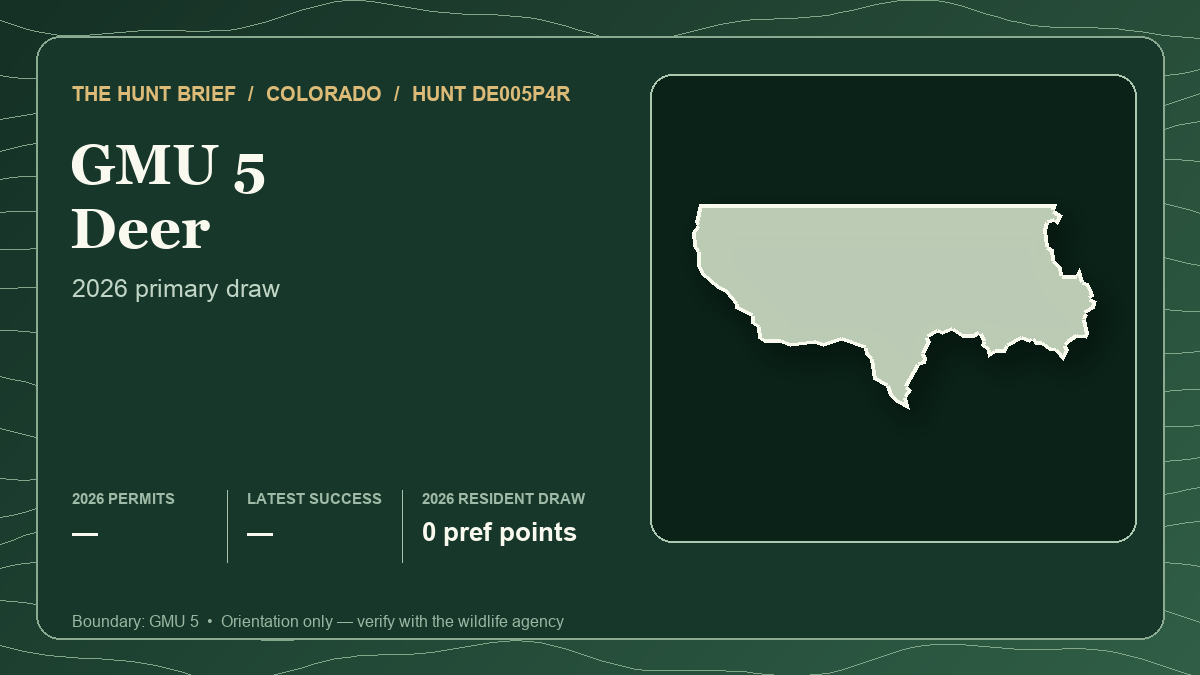
Colorado Hunt DE005P4R is a useful warning against treating “zero points” as a synonym for “easy.” The 2026 primary draw closed at zero preference points for both resident and nonresident adults, but this was a 10-license, private-land-only hunt. At the final zero-point level, one of one resident applicants drew while only one of six nonresident applicants drew.
That distinction matters on August 4, 2026, when Colorado's leftover limited licenses go on sale. A historical draw threshold does not establish that DE005P4R is available today. Check CPW's live list and licensing system before making a purchase decision; inventory can change quickly.
Start with the static Hunt Planner profile for DE005P4R and open GMU 5 in the Hunt Planner 3D map. The profile and boundary card are orientation tools. The license is valid only on private land in GMU 5, so a colored unit boundary is not an access map.
The quick verdict
DE005P4R best fits a hunter who already has specific, written private-land permission for November 18–22, 2026 and wants an either-sex deer license during Colorado's fourth rifle season. The draw history is secondary. Without permission on land that holds deer during those five days, a zero-point application is not a workable hunt plan.
It is a poor speculative choice for someone hoping to solve access after drawing. The 2026 draw recap shows only 10 total licenses and meaningful nonresident competition at the final level. A small quota can swing sharply with only a few applicants, so the 2026 outcome should not be projected as a stable 2027 probability.
What Hunt DE005P4R actually authorizes
CPW's current 2026 Big Game brochure lists DE005P4R as an either-sex deer license valid on private land only in GMU 5 from November 18 through November 22, 2026. “Either sex” means the license may be filled by a buck or a doe, subject to the current legal definitions and all other restrictions. It does not grant permission to enter any parcel.
The hunt code itself carries the most important planning constraint: the P designates private-land-only. CPW says private-land-only licenses require landowner permission. A public road, nearby state wildlife area or public parcel does not convert adjoining private ground into legal hunting access, and this hunt is not valid on public land simply because the land lies inside GMU 5.
What the 2026 draw recap says
The official 2026 deer draw recap lists a total quota of 10. The post-draw allocation was three resident adult licenses, five nonresident adult licenses, one unrestricted Landowner Preference Program license and one restricted landowner license.
For first choices, the report lists three resident adult applications and 10 nonresident adult applications, plus one application in each landowner category. All three resident adults ultimately drew. Five of the 10 nonresident adults ultimately drew, but that overall 50% result combines different preference-point levels.
The final-level line is more precise. The resident draw reached zero points with one of one applicants successful at that level. The nonresident draw also reached zero points, but only one of six applicants at that level was successful, a 17% result after CPW's rounding. Four higher-point nonresident applicants were awarded licenses before the zero-point tier was reached.
That is why “drawn out at zero” is a threshold description, not a guarantee. CPW gives first-choice priority to applicants with more points, then works down through the point levels until the available licenses are gone. The last successful level can be partially filled.
Why this private-land hunt exists
The current hunt should be planned from the 2026 brochure and draw report. An older CPW Commission paper provides useful historical context, but it is not a current population estimate. In January 2021, CPW explained that public access to GMU 5 winter range was restricted to two BLM parcels and that crowding was a concern. The agency proposed the fourth-season either-sex private-land-only code to add harvest opportunity without concentrating more hunters on those public parcels and to support chronic-wasting-disease and herd-management objectives.
That rationale helps explain the code's design: the hunt directs a small number of hunters toward private winter-range ground. It does not tell a 2026 hunter which ranch holds deer, whether permission is available or how animals will respond to this year's weather.
Hunt Planner does not currently carry a hunt-level harvest row for DE005P4R. CPW publishes a 2025 deer harvest report at the species level, but this local record does not support a clean, hunt-code-specific success rate. Rather than substitute a GMU-wide or statewide number, this brief leaves harvest success unstated. Those unlike measures would create false precision for a 10-license private-land hunt.
Build the access plan before the deer plan
Permission should be parcel-specific and settled in writing. Confirm the landowner, the exact property boundary, dates, vehicle and foot-access rules, guest rules, camping policy, retrieval expectations and whether other hunters will be present. Ask how the landowner wants gates, livestock and ranch roads handled. A license and a handshake for a neighboring parcel are not enough.
Once access is real, scout habitat patterns without publishing precise locations:
- Use the 3D map to identify broad edges among browse, open feeding cover and broken terrain, then match every feature to the permitted parcel.
- Plan for a five-day window. Build more than one observation route and account for late-November snow, mud, wind and short daylight.
- Treat weather as a distribution variable, not a promise of migration. Check current sign instead of assuming deer have moved onto a particular ranch.
- Keep retrieval inside the permission agreement. A deer crossing a fence after the shot can create a separate access problem that should be discussed in advance.
- Verify road status immediately before the hunt. CPW notes that federal road closures can change with snow, ice and resource protection needs.
CPW's mule deer profile describes deer as browsers that use edge habitat and notes that populations respond to severe winters, drought, habitat quality, disease and human activity. For this late hunt, that supports a flexible plan around current forage, cover and disturbance—not a claim that one aspect or elevation will always produce.
Who should consider it
Choose DE005P4R when permission is already secured, either-sex flexibility fits the objective and a short fourth-season window works with the hunter's schedule. The 2026 draw result shows that a resident could reach the hunt without accumulated points, but access remains the true prerequisite.
Look elsewhere if the goal is a public-land hunt, if permission depends on drawing first, or if the hunter needs a long season to learn unfamiliar ground. For nonresidents, the 2026 zero-point tier was competitive despite the low headline threshold. A future application should be based on a current access agreement and the newest draw recap, not on the phrase “zero points.”
Verification checklist
- Read the current DE005P4R row in the 2026 Big Game brochure and compare it with the printed license.
- Confirm the license remains valid only on private land in GMU 5 for November 18–22, 2026.
- Obtain written permission for the exact parcel, entry method, hunting dates and retrieval plan.
- Check CPW's live leftover list before assuming any license is available on August 4, 2026 or later.
- Recheck current road, weather, fire and emergency restrictions immediately before travel.
- Treat the 2026 draw as one small-quota result, not a forecast, and do not substitute broader harvest statistics for hunt-level evidence.
Sources and verification
- Colorado Parks and Wildlife 2026 Big Game brochure: DE005P4R season, sex and private-land-only restriction
- CPW 2026 deer draw recap: quota, application and award detail
- CPW 2026 deer drawn-out-at report
- CPW deer statistics library: draw, harvest and population reports
- CPW primary draw guidance and preference-point mechanics
- CPW leftover and reissued license rules and live-list entry point
- CPW January 2021 Commission paper: historical rationale for the GMU 5 fourth-season PLO hunt
- CPW mule deer biology, habitat and research overview
- Colorado Hunting Atlas
Official dates, inventory, rules, landownership and access can change. Verify the current brochure, license, CPW account and landowner permission before hunting. The 2021 management paper is historical context, not a current CWD estimate; no 2018 prevalence figure is used as a present-day rate. This article was prepared with AI-assisted research and drafting, then checked against the linked official sources. Read Hunt Planner's methodology, editorial and AI policy and corrections process.