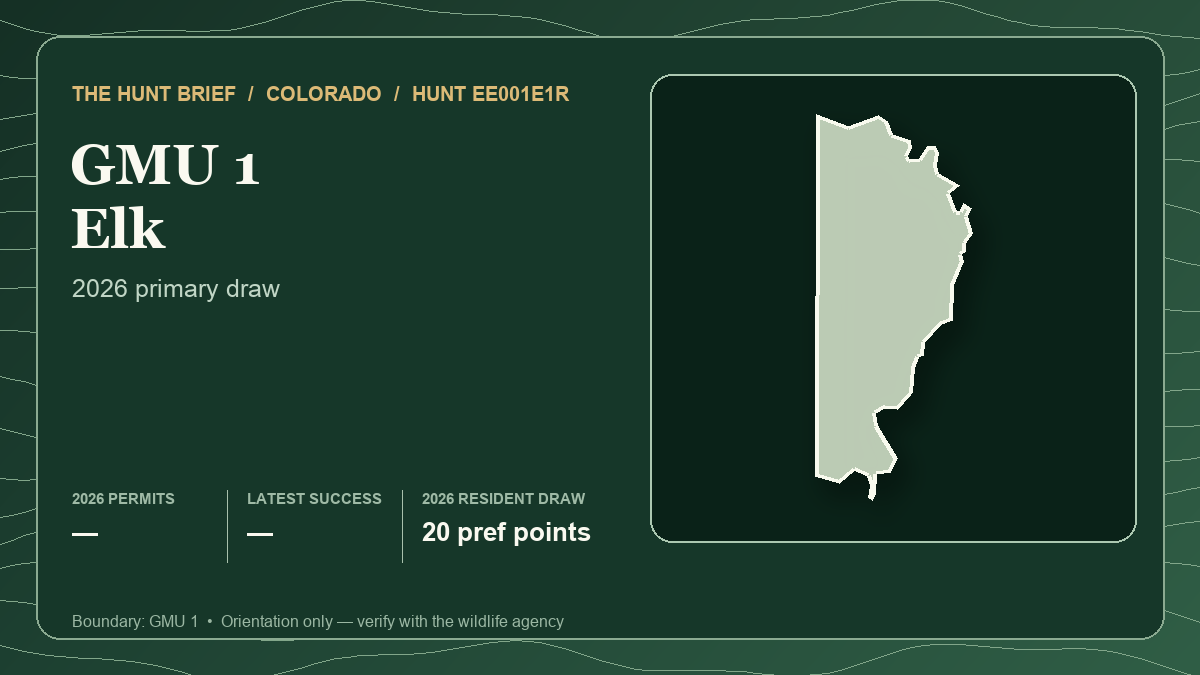
Colorado Hunt EE001E1R gives a licensed hunter an October 1–11, 2026 early-rifle elk season in GMU 1. As of September 15, the opener is sixteen days away. This brief is for holders turning a scarce license into a workable field plan, and future applicants deciding what the published point threshold actually means.
The 2026 drawing filled all 11 licenses. Resident adults reached 20 preference points, with two of six applicants successful at that final level; the nonresident adult result reached 32 points, with one of one successful there. Yet the recap also records one hybrid-draw license. Calling this simply a “20-point hunt” leaves out a consequential part of the evidence.
Start with the EE001E1R static Hunt Planner profile and open GMU 1 in the Hunt Planner 3D map. Use both for orientation, then verify the current agency boundary and lawful access before traveling.
An early season with its own dates
The current CPW 2026 Big Game brochure, printed page 45, lists E-E-001-E1-R as an early, either-sex, limited rifle hunt valid in GMU 1 and classified List A. It is an eleven-day season, distinct from the October 14–18 regular first-rifle dates. A calendar built around the regular opener would miss this license's opening thirteen days.
Either-sex status makes the hunter's goal worth deciding in advance. Someone committed to a particular bull standard and someone willing to take a legal cow can use the same season differently. Neither should let a large point investment dictate an unsafe shot or an animal they cannot retrieve. The brochure's printed page 36 lists GMU 1 among units without antler-point restrictions, while retaining a five-inch minimum antler length. Check the full legal definitions and equipment requirements before hunting.
The useful planning consequence is flexibility within a fixed window. Reserve time to observe, adjust and retrieve meat. Do not treat all eleven days as interchangeable: work obligations, weather and road conditions can reduce the days that are actually usable.
Eleven licenses, several allocation paths
The 2026 CPW elk primary-draw recap, report page 3, records an original quota of 11, a general-draw quota of nine and two Landowner Preference Program allocations, one unrestricted and one restricted. The post-draw balance is zero. Final distribution was eight resident adults, one nonresident adult and the two landowner allocations; no youth licenses were drawn for this code.
Demand totaled 322 general first-choice applications and 12 landowner first-choice applications in 2026. Those pools should stay separate. Dividing the entire quota by only the general applicants would include licenses allocated through a different path and would still ignore preference order, residency caps and hybrid selection. This brief therefore does not present that quotient as personal draw odds.
The 2026 drawn-out report, page 1, independently confirms the adult final levels: residents drew two of six at 20 points; nonresidents drew one of one at 32. The resident result was roughly one-third at the final tier. The nonresident result involved just one applicant at its final tier, far too little evidence to describe a stable future probability.
A threshold is an outcome of a particular drawing. It is useful when comparing your position with that year's applicants, but it cannot promise what a changed quota or applicant pool will do next year. CPW makes that limitation explicit in its elk statistics library.
The hybrid exception matters
EE001E1R appears in the brochure's 2026 hybrid list on printed page 19. Qualified individual applicants with at least five elk preference points who put an eligible code first automatically enter that process; groups are excluded, nonresident caps apply and winners lose their species points. The mechanism can issue up to 20 percent of available licenses randomly. For this hunt, the recap reports one license drawn through the hybrid allocation.
That makes five points an eligibility condition, not a new substitute threshold. The correct takeaway is that a lower-point applicant had a narrow additional route in 2026. The total first-choice count does not tell us the precise eligible hybrid pool after the other allocations, so it cannot support a reliable hybrid percentage here.
For a future applicant, decide whether the chance is worth making this your first choice and accepting the point consequences of winning. Recheck the next brochure's eligible-code list before applying. A strategy built on the hybrid rule needs an annual rules check just as much as a strategy built on preference points.
Harvest evidence has a different clock
CPW's statistics library currently lists a 2025 harvest report alongside the 2026 draw reports. Hunt Planner's local EE001E1R record contains the 2026 draw threshold but no hunt-specific harvest result or quota field. This article verifies the quota separately from the official recap and leaves harvest success unstated.
Missing local harvest data does not establish poor hunting, and eleven licenses do not establish high success. Nor should a statewide elk percentage, another weapon's result or an adjacent unit's result stand in for this hunt. Applicants need matching scope and a stated survey year before making a meaningful comparison. Current holders need current animal observations more than a borrowed percentage.
Make access part of the hunt plan
The Colorado Hunting Atlas overlays GMUs and big-game concentrations on topographic maps and aerial imagery. Use that to compare broad feeding openings, cover and terrain connections inside the verified boundary. Concentration layers describe habitat patterns; they are not a promise that elk will occupy a particular patch during your eleven-day season.
Our planning recommendation is to identify several independent public-land options or permission-based options, each with a legal approach and a realistic retrieval plan. Favor places you can observe without repeatedly disturbing animals, then let fresh sign decide where to spend time. Keep wind, visibility and the full pack-out distance in the decision. These are habitat-level planning judgments, not verified locations of 2026 elk.
The BLM Little Snake Field Office provides regional maps, seasonal-closure information and current fire links for northwest Colorado. Its jurisdiction extends well beyond this hunt: a regional public-acreage total would not describe GMU 1's huntable acreage. Verify parcel ownership and route status individually. BLM's hunting guidance stresses private-land permission and advance route planning; public ownership does not authorize crossing a private approach.
There is a timely logistics change. In its September 11, 2026 notice, BLM lifted Stage 1 restrictions on Little Snake-administered public lands, retaining year-round wildfire prevention rules. That is a dated agency-land observation, not a blanket statement about county, private or other federal land, and not an October forecast. Recheck restrictions immediately before departure.
Best fit and final checks
EE001E1R best fits a current holder who can protect enough October time for scouting, changing conditions and meat recovery. Future applicants should see a scarce, multi-path drawing whose final point tiers describe 2026 history. The hybrid opportunity may justify a first-choice decision for some eligible applicants, but it should not become their only realistic plan to hunt elk.
- Match the license code, GMU 1 validity and October 1–11, 2026 dates against the current brochure.
- Review legal animal definitions, equipment, List A limits and carcass requirements.
- Confirm ownership, permission, lawful motorized routes and a complete retrieval plan.
- Check fire restrictions and closures for the actual land manager immediately before travel.
- Read both the preference tiers and hybrid provisions before planning a future application.
- Keep the 2026 draw year separate from 2025 harvest reporting and leave unmatched success metrics blank.
Sources and verification
- CPW 2026 Big Game brochure: GMU 1 season and license row, printed page 45; hybrid rules, page 19; antler rules, page 36
- CPW 2026 elk primary-draw recap: EE001E1R quota, demand, allocation and final tiers, report page 3
- CPW 2026 elk drawn-out report: adult final levels, page 1
- CPW elk statistics library: current draw and harvest report years and forecasting caveat
- Colorado Hunting Atlas and map library: boundary and habitat orientation
- BLM Little Snake Field Office: regional maps, closures and current fire information
- BLM September 11, 2026 fire-restriction rescission: land-manager-specific change and remaining prevention rules
- BLM hunting and fishing guidance: public-land route planning and private-land permission
Verified September 15, 2026. Official seasons, quotas, draw systems, boundaries, equipment rules, ownership and access can change. Draw statistics describe 2026; the latest harvest reporting cycle is 2025, and no matching harvest statistic is supplied here. The card reflects the local dataset's available fields and does not depict access rights. Field recommendations are planning judgments; this brief uses no anecdotal hunter reports. Prepared with AI-assisted research and drafting and checked against the linked official evidence. Read our methodology, editorial and AI policy and corrections process.