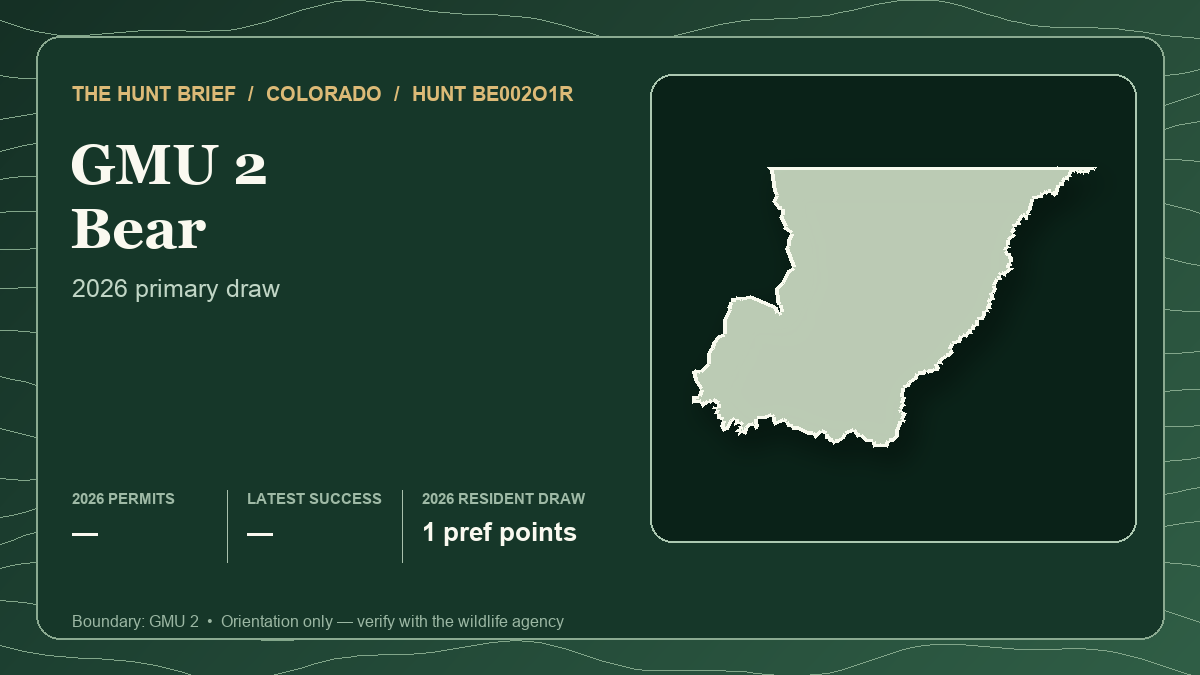
Colorado's limited September rifle bear Hunt BE002O1R is open in GMU 2 through September 30, 2026. This brief is for the five people whose licenses came through the 2026 primary draw, and for applicants trying to interpret a deceptively simple “one preference point” label. The useful story is not that one point buys a bear hunt. It is that five licenses were allocated in a small, tiered drawing, while the September field decision depends on food, legal access and a workable recovery plan.
Start with the BE002O1R static Hunt Planner profile and open the GMU 2 boundary in the 3D planner. The displayed polygon is orientation, not proof that every parcel inside it can be hunted or reached. Confirm the CPW boundary, land status and travel rules before heading out.
The calendar and the license are specific
The 2026 Colorado Big Game brochure, printed page 64, lists B-E-002-O1-R as an either-sex, limited rifle, List B bear license valid in GMU 2 from September 2–30. A different code, B-E-002-O5-R, covers the October and November concurrent rifle dates. Do not read the later dates into a September-only O1 license. September 22 leaves nine calendar days including today, not nine guaranteed days of usable weather or access.
The either-sex classification does not remove the prohibition on taking a cub or an adult accompanied by cubs. CPW's bear field guidance stresses observation with binoculars because a small bear separated temporarily from its mother can be misidentified. A hunter who cannot confidently identify a legal animal should pass. Check the physical license and the complete current brochure for legal methods, hours, fluorescent-orange or pink requirements and possession rules; a summary cannot replace those instructions.
What actually happened in the 2026 draw
On page 9 of CPW's 2026 primary bear post-draw recap, BE002O1R has an original and general-draw quota of five. All five were drawn by adult residents; the post-draw balance is zero. The recap records 17 total first-choice general applications: 15 resident adults, one nonresident adult and one nonresident youth. There were another six second-, three third- and five fourth-choice applications, but the licenses were gone at first choice. This was not a leftover opportunity after the primary draw.
The point rows explain the card's shorthand. Four first-choice resident adults entered with two preference points and all four drew. Five entered with one point; one drew. Six entered with zero points and none drew. The single first-choice nonresident adult at one point and the single first-choice nonresident youth at zero points did not draw. The report separately says the nonresident cap was up to 25%, with zero licenses allocated to nonresidents. It does not establish the reason for each unsuccessful applicant's outcome beyond the reported draw sequence.
Thus “drawn out at one point” describes the last resident adult tier reached in 2026, not a one-point guarantee. At that final tier, the recorded result was one of five, or 20%; that small conditional fraction is not a forecast for next year. Dividing five licenses by 17 first-choice applications would also collapse different point tiers, residency and youth categories into a misleading personal probability. CPW warns on its bear statistics page that quotas, applicants and codes can change from year to year. A future applicant should use the entire recap, not only the threshold printed on the card.
Do not turn the quota into harvest success
The five 2026 drawn licenses are not five harvested bears, five hunters afield or a five-bear population estimate. CPW's statistics library lists a 2025 bear harvest report, but Hunt Planner's local BE002O1R record has no matching hunt-code harvest or success field. We therefore do not attach a GMU-wide, statewide, differently timed or differently licensed harvest percentage to this September code. The 2026 season is still underway, so its actual harvest outcome is not known here.
That absence matters for both audiences. A tag holder should rely on present food and sign, not an unsupported success number. An applicant should not assume that the five-license quota implies either abundant bears or difficult hunting. Quota decisions and observed harvest measure different things; the draw describes access to a license, whereas any eventual harvest survey would describe a later field result with its own definitions and year.
A late-September food search, not a pin drop
CPW describes autumn hyperphagia as a shift toward energy-rich fruits and nuts and recommends finding current food and sign before watching from a position that allows careful identification. That is a species-level pattern, not evidence that a particular GMU 2 drainage has a good crop in 2026. In a large, varied unit, compare broad habitat transitions—vegetated draws, brush edges and nearby cover—against what is actually producing food this week. If the food is absent, move the plan, not an unsupported claim about where bears must be.
Keep wind, visibility, shot discipline and the full pack-out in view. An apparently convenient road on an aerial layer may cross private land or lead toward a restriction; the distance between seeing a bear and safely cooling its meat can be much harder than the map suggests. CPW cautions that September warmth and insulating fat and hide make prompt meat care important. Set up coolers and a realistic extraction plan before pursuing a bear, and never use human food, bait or garbage as an attractant; baiting big game is prohibited.
Public land is not blanket permission
Use the Colorado Hunting Atlas to compare the official GMU outline, surface ownership and broad bear-habitat layers. Then confirm ingress, private-land permission and motorized routes with the actual land manager. The BLM Little Snake travel-management page organizes its route inventories by management area; an inventory line is not itself a current open-road designation. Check the current field-office map and closure notices before relying on any route.
The nearby Dinosaur National Monument rules are an especially important exclusion: hunting and firearm discharge are prohibited within the monument. Do not treat a state GMU-colored planning map as authorization on National Park Service land. Check the monument boundary independently if a prospective approach lies near it. None of these sources supplies a verified BE002O1R public-land percentage, so this brief does not manufacture one.
Field checklist and best fit
- Confirm that the physical license reads BE002O1R, GMU 2, September 2–30, 2026, and recheck the current CPW unit boundary.
- Verify ownership, lawful entry, current BLM route designations, closures and fire restrictions; exclude Dinosaur National Monument from any hunting plan.
- Use current natural-food evidence and enough observation time to identify an unaccompanied legal adult. Prepare safe meat cooling and transport.
- Read CPW's current bear rules for legal methods, tagging, edible-meat care and the mandatory inspection. CPW says the hunter must present a harvested bear, including head and hide, for inspection within five business days; arrange with a CPW office rather than assuming a drop-off.
- Keep the 2026 drawing, any 2025 harvest material and this ongoing 2026 season in separate evidence years.
BE002O1R best fits an existing license holder with several verified access options and time to follow present food conditions through September 30. For a future applicant, the 2026 one-point final tier is a useful historical comparison only; the full first-choice competition and changing quota deserve more weight than a single point label.
Sources and verification
- CPW 2026 Big Game brochure, printed page 64: BE002O1R season, GMU, sex and List B
- CPW 2026 primary bear post-draw recap, report page 9: quota, applications and point tiers
- CPW bear statistics: latest report years and draw-statistics limitations
- CPW bear in-the-field guidance: food, identification, bait, meat care and inspection
- CPW Hunting Atlas and maps: GMU, ownership and habitat orientation
- BLM Little Snake Field Office travel-management information
- National Park Service: Dinosaur National Monument hunting and travel rules
Verified September 22, 2026. Seasons, rules, quotas, boundaries and access may change, and the 2026 season has not produced a final harvest result. CPW's latest listed harvest cycle is 2025, while this record's draw figures are from 2026; neither predicts an individual hunt. Habitat and logistics suggestions are planning judgments, not reports of bear locations. No anecdotal field reports or precise routes, camps or coordinates were used. Prepared with AI-assisted research and drafting and checked against the linked official evidence. Read Hunt Planner's methodology, editorial and AI policy and corrections process.