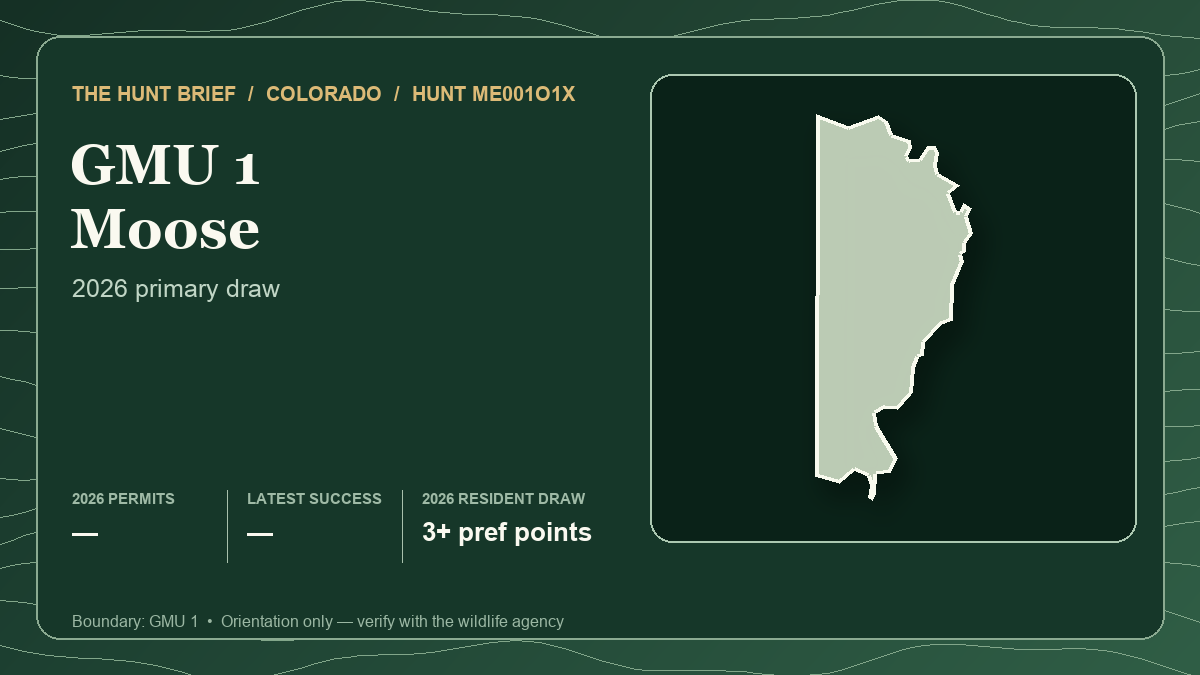
Colorado moose Hunt ME001O1X reaches a rare handoff on September 29, 2026: archery remains open through September 30, then the rifle season runs October 1–14. The same season-choice license can cover both windows until filled, but only with the legal method for the season currently open. This brief is for the single 2026 license holder planning that transition and applicants trying to understand what “3+ preference points” really means.
Start with the ME001O1X static Hunt Planner profile and open its lead GMU 1 boundary in the Hunt Planner 3D map. The official license is valid in both GMUs 1 and 201. Hunt Planner's local record and boundary card use GMU 1 as the representative profile, so neither should be mistaken for the complete two-unit legal boundary.
One license, three separate method windows
The 2026 Colorado Big Game brochure, printed page 61, lists ME001O1X as a resident, either-sex, List A season-choice moose license. It is valid in GMUs 1 and 201 during three periods: archery September 12–30, muzzleloader September 12–20 and rifle October 1–14. A holder may use any or all of those seasons until the tag is filled, but the brochure requires the correct method of take and all restrictions for each season.
That makes September 29 a planning deadline, not a blended weapon season. The muzzleloader window is already closed. An unfilled holder may still hunt with lawful archery equipment through September 30, then may switch to a legal rifle on October 1. The X in the code signals season choice; it does not authorize a rifle two days early or extend muzzleloader dates.
Either-sex status permits a legal bull or cow. CPW also applies a lifetime limit of one antlered moose, so a hunter who has already taken a bull cannot use an either-sex license for another bull. Check the physical license and current legal-method table before hunting; the code summary is not an equipment specification.
The 2026 drawing awarded one resident tag
CPW's 2026 moose primary-draw recap, report pages 3–4, shows an original and general quota of one, allocated to a resident adult. The nonresident quota was zero. CPW recorded 127 general first-choice applications: 118 resident adults and nine resident youths. The post-draw balance was zero.
The recap and 2026 drawn-out report, report page 1, describe the resident adult result as “3+ preference points,” with one of 76 drawn at that final level. That does not mean three points guaranteed this tag. It means 76 resident adult applicants had reached the qualified pool of three regular preference points and the one license was issued from that pool. Applicants with fewer than three regular points appear in the recap but were not in the weighted selection for this license.
The winning resident adult had three regular preference points and 17 weighted points in 2026. That is an observed winner, not a new cutoff. CPW explains that after an applicant reaches three regular points, each further unsuccessful year can add a weighted point. The agency converts the application number to a random number, divides it by weighted points plus one, then sorts the results from low to high. More weighted points improve position probabilistically; they do not create a strict seniority line.
So three different figures answer three different questions: 127 was total first-choice demand across resident adult and youth categories; 76 was the qualified resident-adult pool reported at the final level; 17 was the weighted-point count of the 2026 winner. None alone is a personal forecast. CPW's moose statistics library warns that quotas, applicant pools and hunt codes can change year to year.
A small herd estimate is not a success rate
CPW's latest population table estimates 20 moose after the 2025 hunting seasons in Data Analysis Unit M10, which comprises GMUs 1 and 201, with an estimated ratio of 50 bulls per 100 cows. A DAU estimate is a modeled management number for the combined herd, not a literal animal count on September 29, 2026 and not a location report.
The one-license 2026 quota and the 2025 population estimate operate on different evidence clocks. Dividing one by 20 would manufacture a harvest rate and ignore survey uncertainty, movement, sex structure and the fact that a license is not a kill. Hunt Planner's local ME001O1X record has no matching harvest-success field, so this brief leaves hunt success unstated rather than substituting a statewide or unrelated unit percentage.
Search habitat, then verify every access layer
CPW describes Colorado moose habitat broadly as country near lakes, rivers and wetlands with willow, aspen, shrubs, aquatic plants and grasses. In this two-unit hunt, that supports a habitat-pattern search: compare riparian corridors, wet draws and adjacent cover, then let current tracks, browsing and sightings determine where to spend time. It does not justify publishing a drainage, camp or precise approach.
The Colorado Hunting Atlas is the correct starting point for the two GMU outlines and broad land-status orientation. Follow it with parcel and route verification. The BLM Little Snake travel-management page includes inventories for Cold Springs, Browns Park and nearby management areas, but an inventoried line is not proof that a road is currently designated open. Confirm the current route map, private crossings, fire restrictions and temporary closures with the responsible office.
Do not treat a state GMU boundary as hunting permission on every federal parcel. Dinosaur National Monument regulations prohibit hunting and firearm discharge in the monument. If an approach nears that boundary, verify it independently before hunting or planning a recovery. Private land also requires permission, including entry to retrieve a harvested animal.
Recovery and mandatory inspection belong in the first plan
Moose size changes the logistics. Build a retrieval plan around the actual distance, heat, terrain and vehicle restrictions before committing to a shot. CPW requires every license holder to return the mandatory report within 30 days after the season, including people who did not hunt or did not harvest.
For a harvested moose, CPW's field instructions require the hunter to appear for inspection within five working days. A bull inspection requires the head with antlers naturally attached and the lower jaw; a cow hunter may bring an incisor instead of the head. Arrange the inspection with a CPW office rather than assuming an unattended drop-off will satisfy the rule.
Best fit and final checks
ME001O1X best fits its current holder when the plan uses the full two-unit choice, protects the weapon-date boundary and includes multiple verified access options plus realistic meat recovery. A future applicant should see a one-license weighted lottery, not a hunt that “takes three points.”
- Confirm GMUs 1 and 201, either-sex status and the September 12–30 archery and October 1–14 rifle dates against the physical 2026 license.
- Use only the legal method for the season open that day; the muzzleloader period ended September 20.
- Verify parcel ownership, private permission, current motorized routes, closures, fire conditions and the Dinosaur National Monument boundary.
- Prepare cooling, extraction and CPW inspection logistics before hunting.
- Keep the 2026 draw, 2025 population estimate and any later harvest report in their proper years and scopes.
Sources and verification
- CPW 2026 Big Game brochure, printed pages 58 and 61: season-choice dates, units, sex, methods and mandatory moose requirements
- CPW 2026 moose primary-draw recap, report pages 3–4: quota, demand, weighted-point rows and final allocation
- CPW 2026 moose drawn-out report, report page 1: qualified-pool result
- CPW moose licensing page: weighted-draw calculation, point rules and group restriction
- CPW moose statistics library: latest draw, harvest and 2025 population-estimate sources
- CPW moose conservation page: habitat and DAU interpretation
- CPW moose field guidance: identification, road and fire cautions, reporting and inspection
- Colorado Hunting Atlas: GMU and land-status orientation
- BLM Little Snake travel-management information
- National Park Service: Dinosaur National Monument hunting and vehicle rules
Verified September 29, 2026. Seasons, methods, quotas, boundaries, ownership and access can change. Draw statistics describe the 2026 selection; the population estimate is for post-hunt 2025 and is not a current count or harvest probability. Habitat and logistics suggestions are planning judgments, not reports of animal locations. No anecdotal hunter reports, precise routes, camps or coordinates were used. Prepared with AI-assisted research and drafting and checked against the linked official evidence. Read Hunt Planner's methodology, editorial and AI policy and corrections process.