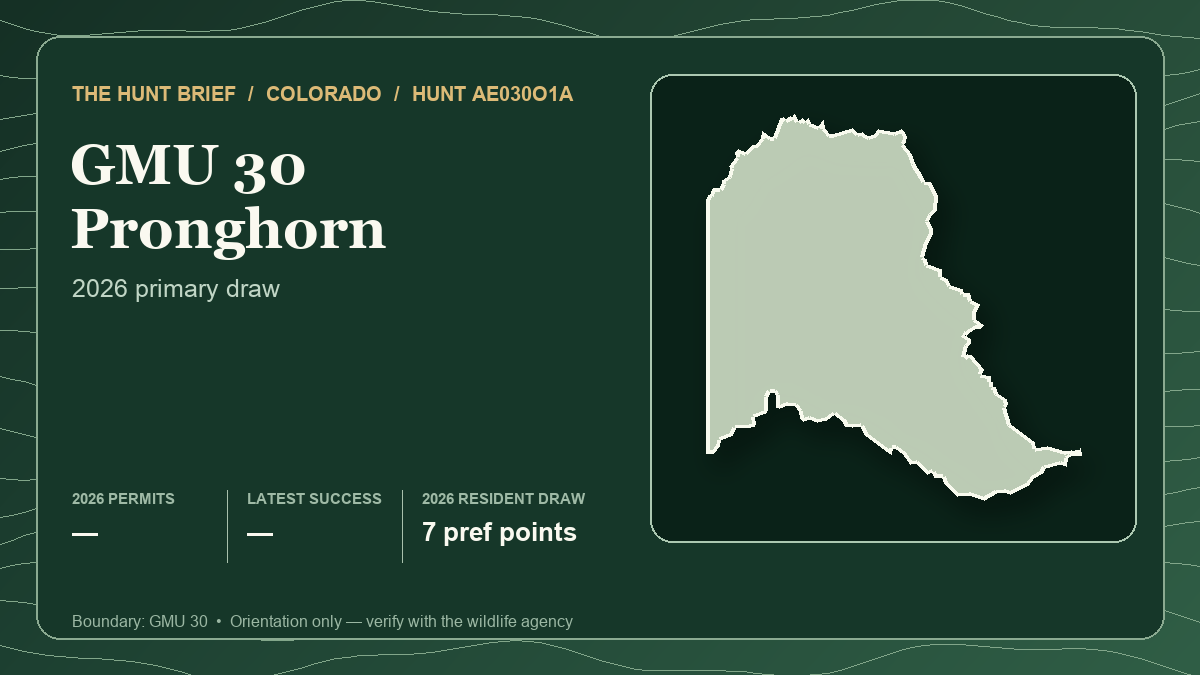
Colorado Hunt AE030O1A is a first-year, 10-license archery pronghorn draw in GMU 30. The 2026 season opened August 15 and runs through September 20. All 10 licenses were issued in the primary draw, where Colorado Parks and Wildlife recorded 81 first-choice applications and a resident adult draw that reached seven preference points.
That makes the hunt noteworthy, not predictable. There is no prior season under this hunt code, no hunt-specific harvest percentage to borrow and no reason to treat one small inaugural draw as a stable 2027 forecast. For a current permit holder, the useful task is an access-and-stalk plan for the remaining season. For a future applicant, the useful evidence is how quickly demand found a brand-new code.
Start with the static Hunt Planner profile for AE030O1A and open GMU 30 in the Hunt Planner 3D map. The profile and card are orientation tools. Confirm the current CPW boundary, landownership and open routes before field use.
The quick verdict
AE030O1A best fits an archery hunter who already holds the 2026 license and has solved legal access to several independent pieces of pronghorn habitat in GMU 30. The long August-to-September window allows more than one scouting cycle, but open-country visibility works both ways: finding animals is not the same as getting within ethical bow range.
For a future applicant, seven points is a description of the 2026 resident adult outcome, not a recommended bank. This was the hunt's first drawing, the quota was only 10 and applicant behavior can change sharply after one season of results becomes public.
What the 2026 license authorizes
CPW's 2026 Big Game brochure identifies AE030O1A as a new either-sex archery pronghorn hunt in GMU 30. Its fixed 37-day season runs August 15 through September 20. “Either sex” allows a legal buck or doe; “archery” means legal hand-held bows under the current equipment rules. The hunt is a limited List A license, not an over-the-counter archery pronghorn license.
The official Commission issue paper explains why CPW created this code alongside new rifle and private-land-only rifle hunts in GMU 30. The agency cited increasing pronghorn numbers, game-damage concerns and an opportunity to use public hunters as a management tool. It deliberately included a public hunt code so hunters on both public and private land could participate.
That policy choice does not guarantee public access. A unit boundary can contain public land, private land, closed roads and parcels that cannot be reached legally. CPW's Hunting Atlas can display GMU boundaries, federal land and aerial imagery, but every candidate route still needs a current ownership and access check.
What the inaugural draw says
The 2026 primary draw recap lists a total quota of 10 and a remaining balance of zero. It shows 81 first-choice applications across the general draw and no landowner-program applications for the code. All 10 successful licenses went to resident adults; the report lists no nonresident adult applications and no youth winners.
At the final resident adult level, four of four applicants at seven preference points drew. CPW labels the hunt “drawn out at” seven points. That phrase identifies the last successful point tier after higher-point applicants were considered; it does not mean every one of the 81 first-choice applicants had the same chance. Dividing 10 issued licenses by 81 first choices gives a rough 12.3% hunt-level ratio, but preference-point order and allocation rules—not a simple lottery—produced the result.
The small quota makes every percentage fragile. A shift of only a few applications could move the final point tier. The absence of nonresident applications in the first drawing is especially poor evidence for future nonresident availability: once a new code is visible in published results, demand can reprice it quickly.
As of CPW's September 8 leftover report, run at 5:59 a.m. MDT and subject to a processing delay of up to one hour, AE030O1A was not listed. That matches the draw recap's zero balance. A current license holder should use the remaining season; someone without the license should not confuse “new for 2026” with “available now.”
No prior harvest result exists
AE030O1A did not exist for the 2025 season, so there is no same-code harvest survey to report. A GMU-wide pronghorn number, a rifle result or a neighboring hunt's percentage would mix different seasons, weapons, quotas and hunter groups. This brief leaves hunt-specific success unstated rather than manufacturing a benchmark.
That missing baseline matters in both directions. Ten licenses may limit pressure, but it does not establish encounter rate, access quality or bowhunting success. The first season will be a small sample even after CPW publishes a survey. Treat any eventual percentage as a description of those hunters and conditions, not a permanent unit grade.
Build three legal hunt systems
Use the agency's management rationale to choose broad habitat patterns, not to publish precise animal locations. GMU 30 lies in Garfield and Mesa counties, and its pronghorn country can combine large sightlines with mixed ownership and working-land edges. Build at least three independent hunt systems before committing a day to one band of animals:
- Confirm the parcel, legal approach and parking location. A public polygon without a legal route is not a usable system, and private land requires permission before entry or retrieval.
- Glass from enough distance to understand daily movement before starting a stalk. Identify folds, cuts and vegetation that can hide an approach rather than walking directly at visible animals.
- Plan the wind through the full route. A terrain feature that hides a hunter visually can still funnel scent into the herd.
- Keep a second and third option that do not depend on the same gate, road or landowner crossing. One access change should not erase the entire plan.
- Recheck fire restrictions, road status, weather and emergency contacts immediately before travel. The Hunting Atlas's Hunter Resource Report can help assemble contacts, but it is not a substitute for current closure notices.
Pronghorn are built to detect movement across open ground and can move rapidly when pressured. For an archer, patience around a repeatable habitat pattern is often more useful than repeatedly pushing a herd. Watch from outside its comfort zone, let current sign confirm use and keep the final approach within legal access. Do not assume that water, a fence crossing or a bed visible on imagery will be occupied on a particular day.
The planning decision
For a 2026 permit holder, AE030O1A offers a long, active season and an intentionally public component, but the code's management purpose does not solve the ground-level access puzzle. Verify several parcels and routes, preserve the wind and avoid turning one observed herd into the only plan.
For a 2027 applicant, the first draw is a warning against simple labels. The hunt filled all 10 licenses, attracted 81 first choices and reached seven resident points, while receiving no nonresident adult applications. Those facts describe an inaugural drawing; they do not say where next year's final tier will land. Recheck the 2027 brochure, quota and draw rules before applying.
Verification checklist
- Match
AE030O1Aon the license to the 2026 brochure's GMU 30 either-sex archery row and September 20 closing date. - Verify the current GMU boundary and every public/private ownership edge in CPW's Hunting Atlas.
- Confirm legal vehicle routes, gates, parking and any private-land permission immediately before entry.
- Check current fire, weather and emergency restrictions rather than relying on a saved map.
- Treat seven points and the 12.3% first-choice ratio as 2026 history, not personal future odds.
- Leave harvest success blank until CPW publishes a same-code result; do not substitute another hunt or weapon.
Sources and verification
- Colorado Parks and Wildlife 2026 Big Game brochure: new AE030O1A code, season, sex and equipment class
- CPW 2026 pronghorn primary-draw recap: quota, balance, applications and final point tier
- CPW final 2026 pronghorn license table: 10-license allocation for AE030O1A
- CPW Commission issue paper: management rationale for new GMU 30 pronghorn hunts
- CPW leftover, remaining and reissued license page
- CPW pronghorn statistics library: draw, harvest and population reports
- Colorado Hunting Atlas and map library
- CPW pronghorn field guidance
Official dates, boundaries, inventory, equipment rules, landownership and access can change. The live leftover observation is a time-stamped snapshot, not a guarantee. Draw evidence is from the first 2026 drawing, and no hunt-specific 2025 harvest history exists. This article uses official sources only and no hunter report as evidence. It was prepared with AI-assisted research and drafting, then checked against the linked sources. Read Hunt Planner's methodology, editorial and AI policy and corrections process.