Colorado doe pronghorn Hunt AF006O1R is open in GMU 6 through October 11, 2026. This brief is for a current license holder with six calendar days left including October 6, and for an applicant trying to understand why a 25-tag antlerless hunt still reached three resident preference points. The short answer is that North Park's herd evidence and its access reality are two different things.
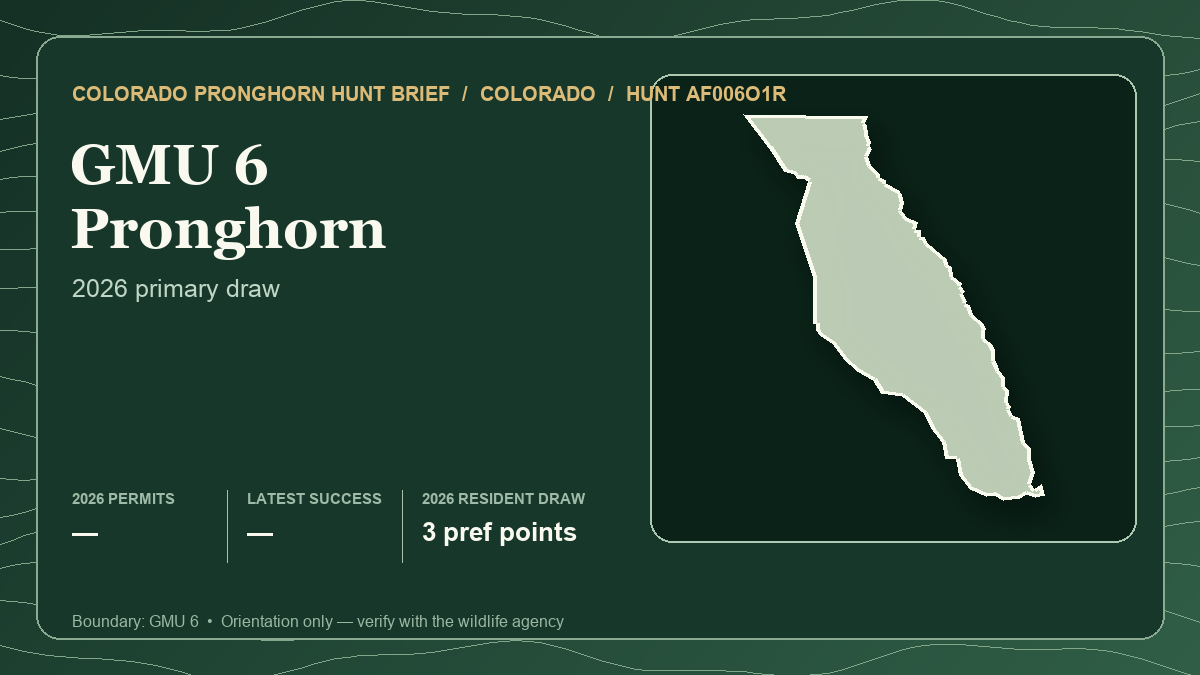
Start with the static Hunt Planner profile for AF006O1R and open the GMU 6 hunt in the Hunt Planner 3D map. The card uses the actual GMU 6 polygon. It is an orientation graphic, not proof of public access, an open road or permission to cross private land.
The quick verdict
AF006O1R best fits a current permit holder who has already verified several legal access systems across open sagebrush and grassland habitat and can adjust when pressure moves animals. The 2026 draw issued all 25 licenses, but the code attracted 120 first-choice general applications. At the final resident adult tier, three of 23 applicants with three points drew.
For a future applicant, “three points” is a record of the 2026 sequence, not a guaranteed cost. The quota, applicant pool, youth preference, landowner allocation and point distribution can all change before another drawing.
What the 2026 license covers
Colorado Parks and Wildlife's 2026 Big Game brochure lists A-F-006-O1-R as a doe rifle pronghorn license valid in GMU 6 from October 3–11. It is a List A limited license. The code is distinct from first-season doe codes for GMUs 16, 17, 161 and 171, and from the new AF006O2R code that covers all five North Park units from October 17–25. Match the physical license to the exact code and unit rather than treating “North Park doe tag” as interchangeable shorthand.
The final 2026 regulation and primary-draw recap both list 25 AF006O1R licenses, the same published number shown for this code in 2025. The recap shows a zero remaining balance after the primary draw. A person without this license should not read the active season as an over-the-counter opportunity.
The draw was layered, not a 21% lottery
CPW's 2026 primary pronghorn recap records 120 first-choice general applications: 95 resident adults and 25 resident youths. The 25 licenses ultimately went to 19 resident adults, five resident youths and one unrestricted landowner-preference applicant. The report records no nonresident adult or youth first-choice applicants and no nonresident winners for this code.
Among resident adults, the drawing reached three preference points, where three of 23 applicants succeeded, or 13% at that final level. The resident youth allocation also reached three points, where three of five succeeded. Those are separate sequences. Dividing 25 issued licenses by 120 first choices produces a rough 20.8% code-level ratio, but it is not an individual's draw probability because it mixes adult, youth and landowner paths and ignores point order.
The 2026 threshold also does not price 2027. CPW explicitly warns that quotas, applicant pools and hunt codes can change year to year. Read the full point table after the next drawing instead of adding one point to this year's last successful tier.
The herd evidence changed between seasons
CPW's July 2025 issue paper described the A-03 North Park herd—GMUs 6, 16, 17, 161 and 171—as approximately 1,600 pronghorn, citing a 2024 post-hunt estimate of 1,579 against a management objective of 1,400–1,600. It said the agency wanted continued doe harvest pressure while protecting the quality and number of bucks.
The newer 2025 population table reports a 1,770-animal pre-hunt estimate for the same five-unit herd and 56 bucks per 100 does. Those figures are not a correction to the older post-hunt count: they represent a later year and a different point in the annual cycle. They also apply to the whole A-03 herd, not just GMU 6 and not to the number of animals available on land a hunter can legally reach.
That distinction matters. A herd estimate above the population objective can support antlerless management without making any particular parcel easy to hunt. It cannot substitute for current observations, legal access or a hunt-specific harvest result.
No same-code success percentage is claimed here
CPW's statistics library lists a 2025 pronghorn harvest report, but Hunt Planner's local AF006O1R record does not contain a matched hunt-code harvest or success field. This brief therefore leaves success unstated rather than borrowing a herd-wide, all-method, neighboring-unit or Ranching for Wildlife percentage.
The omission is deliberate. A 2025 survey result would describe last year's hunters and conditions, while the 2026 season is still underway. The 25-license quota is not a harvest forecast, and the 1,770-animal herd estimate is not a count of huntable does in GMU 6.
Build the remaining days around access
CPW describes pronghorn habitat broadly as grasslands and shrublands, including mountain valleys and sagebrush country in northwestern Colorado. Use that as a habitat pattern, not a destination. In GMU 6, compare broad open basins, working-land edges and adjacent security terrain, then let current sightings, tracks and lawful entry determine where to spend time.
Keep the plan practical:
- Verify the GMU 6 boundary, parcel ownership, legal ingress, parking and motorized-route status before committing to an approach. A visible public polygon without legal access is not a hunt system.
- Obtain permission before entering or retrieving an animal on private property. CPW notes that private land need not be posted or fenced.
- Glass from outside the animals' comfort zone before moving. Pressure during the first rifle window can shift a group across a property boundary faster than a hunter can rebuild an access plan.
- Keep at least two backups that do not depend on the same gate, road or private crossing. Recheck weather, fire restrictions and closures each day.
- Plan tagging, recovery and rapid cooling before the shot. Open ground can make an animal look close while leaving a longer carry than expected.
Do not publish or circulate exact camps, private approaches, water locations, bedding areas, glassing points or animal coordinates. Habitat-level planning is useful without turning a current sighting into a pin drop.
Verification checklist
- Match the license to
AF006O1R, doe pronghorn, GMU 6 and October 3–11, 2026. - Recheck current rifle rules, legal hours, fluorescent orange or pink requirements, tagging and evidence-of-sex instructions in the current brochure.
- Confirm every ownership edge, legal access point, road and closure with CPW and the responsible land manager.
- Keep the 2024 post-hunt estimate, 2025 pre-hunt estimate and 2026 draw in their correct evidence years.
- Treat the three-point final tier as 2026 history, not a future guarantee.
- Do not substitute the new all-North-Park second-season code or its broader boundary for this GMU 6 license.
Sources and verification
- Colorado Parks and Wildlife 2026 Big Game brochure: AF006O1R code, GMU, season, sex and List A status
- CPW 2026 pronghorn primary-draw recap: 25-license quota, applicant pools and final point tiers
- CPW final 2026 Chapter 2 regulation: pronghorn season dates and license numbers
- CPW 2025 pronghorn population and sex-ratio estimates: A-03 North Park row
- CPW Commission issue paper: North Park objectives and second-season management rationale
- CPW pronghorn statistics library: current draw, harvest and population report years
- CPW pronghorn field guidance: private-land permission and retrieval rules
- CPW pronghorn conservation and management: habitat and DAU framework
- Colorado Hunting Atlas and map library
Verified October 6, 2026. Seasons, rules, quotas, boundaries, ownership, roads and access can change. Population estimates are herd-scale models, draw reports describe historical applicant pools and neither predicts an individual's hunt. No anecdotal reports or precise locations were used. This article was prepared with AI-assisted research and drafting, then checked against the linked official evidence. Read Hunt Planner's methodology, editorial and AI policy and corrections process.