This guide is for a hunter whose goal is straightforward—put elk meat in the freezer—but whose calendar points to December. The useful question is not which hunt has the largest success percentage. It is which late-season tag best matches the hunter's draw tolerance, access preparation, winter travel capacity and available time?
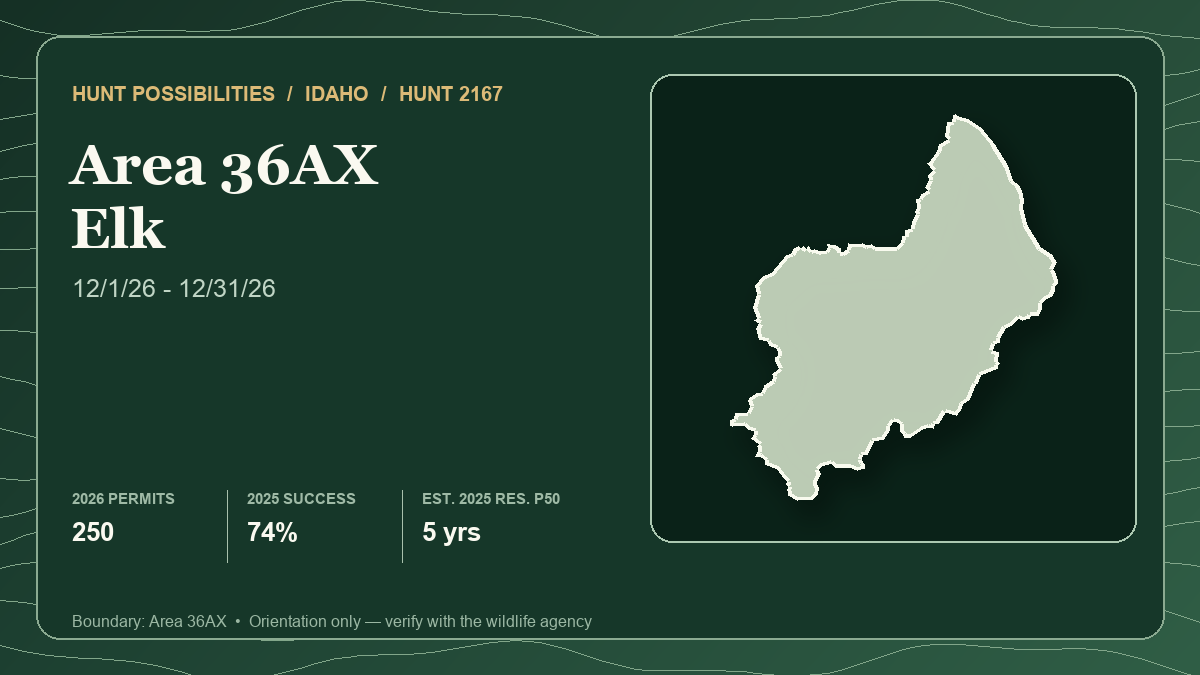
Four local records make that tradeoff concrete: Idaho 2066, Area 23-2, Idaho 2167, Area 36AX, Wyoming 108-1, Hunt Area 108 and Wyoming 124-4, Hunt Area 124. The card above represents Idaho 2167 only, not the whole comparison.
These are not interchangeable cow tags. Idaho's two hunts run December 1–31 and use a random controlled drawing. Wyoming 108-1 is a Type 1 license that becomes antlerless-only from November 1 through January 31. Wyoming 124-4 begins with a broad October 25–November 30 antlerless season, then narrows to specifically described portions of the hunt area in December and January. A strong historical result cannot erase those boundary and access differences.
What December changes
Idaho's current elk management plan describes many elk populations as migratory. Summer ranges commonly sit higher, while winter ranges provide relief from deep snow and cold. Wyoming's 2026 hunt forecast makes the planning consequence explicit: mild winters can leave elk dispersed and delay migration, while severe weather can move elk toward winter range earlier.
That is a framework, not a forecast. A December hunter should map several habitat systems across an elevation gradient, then update the plan with current snow, tracks, glassing and legal access. South-facing feed, wind-sheltered security cover and efficient travel between the two can be useful hypotheses. They are not guaranteed elk locations.
Winter also changes the cost of a mistake. A marginal road in the morning can be impassable after wind or warming. Short daylight compresses recovery. Cold protects meat only after it is cooled; a whole elk can still retain heat. Build the extraction plan before pursuing animals, carry traction and emergency equipment, and turn around before a vehicle or pack-out problem becomes the hunt.
Read the evidence on its own terms
Idaho publishes mandatory harvest reports and first-choice drawing results. Idaho does not use preference points for controlled hunts. Wyoming separates resident and nonresident pools and, for nonresidents, preference and random plus regular and special pools. A single Wyoming percentage cannot describe every applicant.
The harvest samples are hunt-wide. Wyoming 108-1's 2025 record combines the October any-elk segment with the later antlerless segment, so its 89.3% is not a December cow-only success rate. Wyoming 124-4 likewise combines every 2025 segment attached to that license type. Idaho's 2066 result comes from just 23 hunters. Treat each figure as descriptive history, never a forecast or a ranking of animal abundance.
Hunt 1: Idaho 2066 — small sample, severe access warning
- Current season and weapon: Controlled Hunt 2066, antlerless elk, any weapon, December 1–31, 2026, with 25 tags. Idaho defines antlerless here as no antlers or antlers shorter than six inches.
- Tag path: Idaho random controlled drawing; no points. A valid hunting license is required to apply. The 2026 application fee is $6.25 resident and $18 nonresident, excluding license, access fee, tag and transaction costs.
- Latest draw demand: The official 2026 row lists 99 resident first choices for 24 permits, or 24%, and one nonresident first choice for one permit, or 100%. One applicant and one permit are not a meaningful nonresident baseline.
- Latest harvest result: In 2025, 23 hunters reported 20 elk, 87% success and 97 hunter-days, or 4.2 days per hunter.
- Public-land/access pattern: The agency labels 23-2 “very limited access due to private property.” That warning matters more than a tempting success rate. Secure written permission where needed and prove the complete legal route before applying.
- Terrain character: A compact, partly bounded portion of Unit 23 west of U.S. 95 and north of the excluded Boulder Creek drainage. The exact hunt boundary controls.
- Principal tradeoff: The strongest recent percentage here is also the smallest Idaho sample and the clearest private-access warning.
- Best for: A hunter who already has confirmed access and wants a small-quota December hunt—not someone hoping to solve access after drawing.
Open Idaho 2066 in the Hunt Planner 3D map.
Hunt 2: Idaho 2167 — more tags and mostly public management
- Current season and weapon: Extra antlerless Controlled Hunt 2167, any weapon, December 1–31, 2026, with 250 tags across all of Unit 36A.
- Tag path: Idaho's random controlled draw. The same current license requirement and $6.25 resident or $18 nonresident application fee apply.
- Latest draw demand: The official 2026 row lists 2,206 resident first choices for 247 permits, or 11%, and 65 nonresident first choices for three permits, or 5%. Hunt Planner's connected 2025 row shows 14% resident and 19% nonresident, demonstrating why the year must stay attached.
- Latest harvest result: In 2025, 186 hunters reported 138 elk, 74% success and 561 hunter-days, or 3.0 days per hunter. This is the largest current harvest sample in the comparison.
- Public-land/access pattern: Idaho's page estimates 51.5% Forest Service, 42.4% BLM, 3.3% state and 2.8% private management. It lists no current Access Yes property. Management does not prove an open road or legal ingress.
- Terrain character: Nearly 494,000 acres, with mountain roads and broad elevation change making snow and vehicle strategy central.
- Principal tradeoff: The 250-tag quota and high public-management share improve planning flexibility, but 2026 demand was heavy and December access can contract quickly.
- Best for: A mobile, winter-equipped hunter who wants multiple public-land systems and accepts a low random-draw probability.
Open Idaho 2167 in the Hunt Planner 3D map.
Hunt 3: Wyoming 108-1 — a long antlerless window, mixed metric
- Current season and weapon: Type 1 any-legal-weapon license. The 2026 record is any elk October 1–31, then antlerless elk November 1–January 31.
- Tag path: Wyoming limited-quota drawing. Residents use a first-choice pool; nonresidents must distinguish regular and special, preference and random pools. Consult the current fee schedule before applying; costs are not reproduced here because the local record does not connect them.
- Latest draw demand: The connected 2025 record lists 309 resident applicants for 98 permits, 31.72%. Nonresident random odds were 4.55% regular (two of 44) and 5.26% special (one of 19); preference results depend on point level.
- Latest harvest result: The 2025 license-wide report lists 121 hunters, 108 elk, 89.3% success and 9.6 average days. It does not isolate December, cows or the later segment.
- Public-land/access pattern: Hunt Planner estimates 55% public land. Parcel boundaries, road status and seasonal restrictions still decide whether a specific plan works.
- Terrain character: Open basins and broken uplands can make glassing productive, but wind and snow can make exposed travel expensive.
- Principal tradeoff: The long antlerless window offers scheduling flexibility, but the appealing harvest figure is not a cow-only or December-only statistic.
- Best for: A hunter who values calendar flexibility and will evaluate each Wyoming draw pool separately.
Open Wyoming 108-1 in the Hunt Planner 3D map.
Hunt 4: Wyoming 124-4 — accessible draw history, boundary precision required
- Current season and weapon: Type 4 antlerless elk, any legal weapon. The broad 2026 segment runs October 25–November 30. In December the license is valid only in two separately described portions; one closes December 31 and the other January 31.
- Tag path: Wyoming limited-quota drawing with distinct resident and nonresident pools.
- Latest draw demand: The connected 2025 record lists 132 resident applicants for 126 permits, 95.45%. The nonresident regular random pool issued five of nine, or 55.56%; preference and special results must be read separately.
- Latest harvest result: The 2025 license-wide row lists 133 hunters, 102 elk, 76.7% success and 6.3 average days. It combines all segments and is not a December-only rate.
- Public-land/access pattern: Hunt Planner estimates 70% public land, highest of these four records. The December legal areas are narrower than the full Area 124 outline, so a top-line acreage share can mislead.
- Terrain character: High-desert basins, ridges and road-defined subareas put visibility, wind and boundary discipline ahead of timber-style calling tactics.
- Principal tradeoff: Favorable recent draw history and a high public-land estimate come with the most complicated December validity language.
- Best for: A boundary-disciplined applicant who wants relatively favorable recent draw history and can build the entire plan inside the current December subarea.
Open Wyoming 124-4 in the Hunt Planner 3D map.
A practical late-season field plan
- Start with legal polygons, not elk pins. Save the current hunt boundary, parcel layer and land-manager travel map offline. For 124-4, isolate the December subarea rather than relying on the full Area 124 outline.
- Build three snow-dependent options. One should survive a storm, one should work in mild weather with dispersed elk, and one should be reachable without gambling on an unmaintained road.
- Scout access before animals. Confirm gates, parking, permission and the recovery route. A legal glassing point is useless if a downed elk would cross land you cannot enter.
- Let fresh sign change the elevation hypothesis. Tracks, beds, feeding evidence and repeated sightings matter more than a generic “winter range” label.
- Budget daylight backward. Estimate shot-to-animal time, field care, pack-out and the return to a safe road. Set a hard latest-shot decision for each location.
- Prepare for meat care in cold weather. Open the body cavity or quarter promptly as conditions require, keep meat clean and ventilated, and do not treat snow as automatic refrigeration.
Best fit by hunter priority
- For the broadest Idaho public-land canvas: 2167. It has the largest quota and sample, but its 2026 first-choice results tightened to 11% resident and 5% nonresident.
- For an access-secured compact hunt: 2066. Its 2025 87% result is attractive only after the private-property warning is solved.
- For the longest scheduling window: 108-1. The antlerless segment extends through January, while its harvest record combines earlier any-elk hunting.
- For favorable recent draw history: 124-4. Its 2025 resident result was 95.45%, but December validity is limited to described subareas.
- For the simplest regulation read: 2167. It covers all of Unit 36A with no special hunt restriction listed; ordinary land, road and weapon rules still apply.
There is no universal winner. The best late cow tag is the one whose legal access and winter logistics can be proven before the application is submitted.
Verification checklist
- Confirm hunt number, license type, sex definition, 2026 dates, quota and application deadline in the current agency material.
- Read the exact controlled-hunt description, including exclusions and road-defined subareas.
- Recheck license, application, access-fee and tag costs immediately before purchase.
- Keep Idaho random-draw results separate from Wyoming resident, regular, special, preference and random pools.
- Treat 2025 harvest as history; note that Wyoming rows combine season segments.
- Confirm private permission, public ingress, winter closures, Motor Vehicle Use Maps and current road conditions.
- Carry field-ready official maps and weather/emergency equipment; Hunt Planner is an orientation tool.
- Verify tagging, evidence-of-sex and reporting rules before entering the field.
The Hunt Planner methodology explains how state-specific records and evidence years are preserved, and the corrections page accepts source mismatches. This article was researched and drafted with AI assistance, then checked against the linked local records and official sources under the editorial and AI policy. No anecdotal hunter report is used as representative evidence.
Sources and verification
- Idaho Fish and Game 2026 Big Game Seasons and Rules
- Idaho Hunt Planner: Hunt 2066 season, boundary, draw, harvest and access warning
- Idaho Hunt Planner: Hunt 2167 season, boundary, draw, harvest and surface management
- Idaho controlled-hunt application information
- Idaho Elk Management Plan 2024–2030: migration and winter-range biology
- Wyoming Hunt Planner: Area 108 current seasons and draw context
- Wyoming Hunt Planner: Area 124 current seasons and draw context
- Wyoming draw results and odds
- Wyoming harvest reports and surveys
- Wyoming Game and Fish 2026 hunt forecast: weather, distribution and migration caveats
Rules, costs, quotas, access, weather, roads and boundaries can change. Idaho's current hunt pages now show 2026 draw results, while Hunt Planner's connected draw records remain 2025; both years are explicitly labeled. Wyoming's 2025 harvest rows combine segments and cannot predict December cow success. Verify every official source again before applying and before hunting.