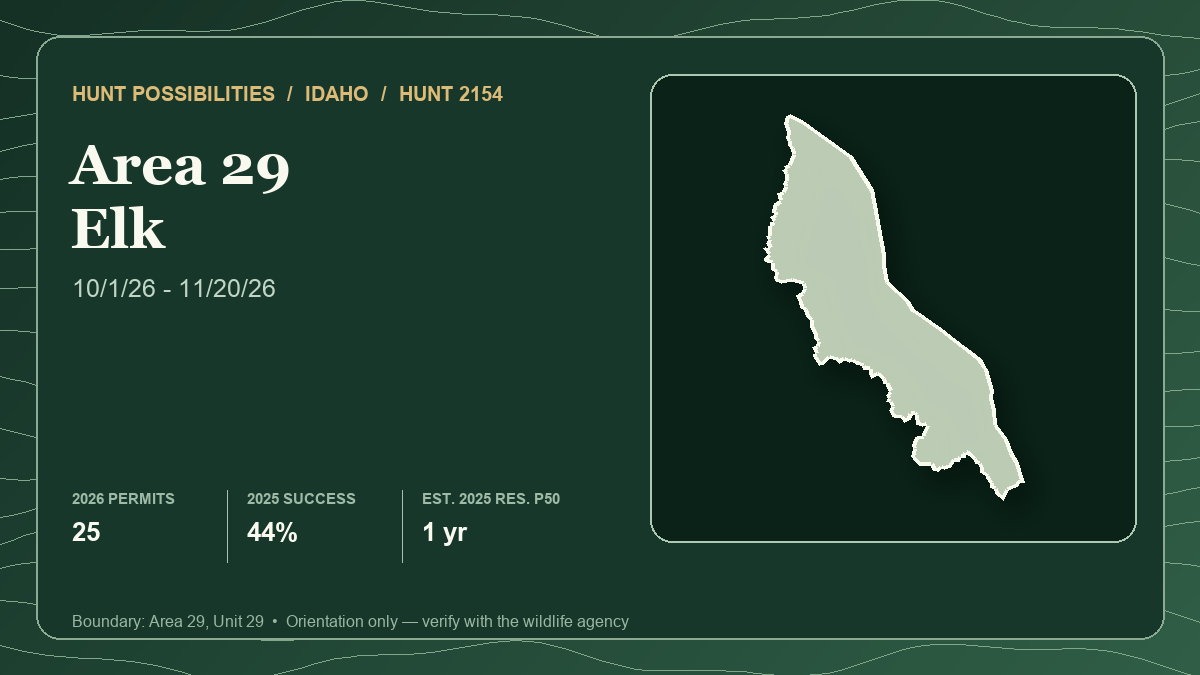
This guide is for a family choosing a first youth elk hunt and trying to balance tag certainty, a manageable field problem and a season long enough to learn. That choice matters now: the remaining any-legal-weapon portion of Utah EB1011, the general-season youth bull permit, begins October 3, while Idaho 2154 in Area 29 opens October 1. Idaho 2149 in Area 4 follows October 10, and Idaho 2157 in Area 37 opens November 1.
These are not four versions of the same hunt. Utah EB1011 is an unlimited over-the-counter bull permit whose holder must follow the weapon, dates and bull definition for the unit being hunted. The Idaho choices are 25-tag, youth-only, random-draw antlerless hunts. Utah offers flexibility and tag certainty; Idaho narrows the legal animal and geography but adds draw risk. The card above represents lead hunt Idaho 2154 only, not the full comparison.
A first elk hunt is a systems decision
Elk need forage, security cover and connected habitat, and Idaho Fish and Game's current northern-forest guidance emphasizes balancing all three across a landscape. During hunting seasons, roads, pressure, weather and the boundary between public and private land can matter as much as the amount of habitat shown on a map. A green ownership polygon is not a complete plan if the road is closed, the slope is unsafe for a new hunter or recovery would exceed the family's capacity.
For a youth hunter, define success before choosing a hunt. A family seeking the simplest legal path may prefer Utah's permit certainty. A family prioritizing an antlerless tag, a fixed unit and recent hunt-level evidence may prefer Idaho. A high harvest percentage can be encouraging, but none of these samples is large enough to promise a filled tag. The better comparison is whether the season, travel, terrain, access and mentor schedule create repeated chances to practice good decisions.
Eligibility and tag paths are fundamentally different
Utah says a big-game hunter must be at least 12 to hunt. An 11-year-old may obtain a permit if they will turn 12 by December 31, but cannot hunt before turning 12. To qualify for a youth permit, the hunter must be no older than 17 on July 31, 2026. A hunter under 16 must be accompanied in the field by a parent, guardian or responsible adult who is at least 21.
The Utah youth-opportunity page describes EB1011 as unlimited and available first-come, first-served. It lets a youth participate in the open general archery, any-legal-weapon, muzzleloader and extended-archery seasons, but only with the weapon legal for that season and only for the bull class legal in that unit. It excludes the separate draw-only September youth elk hunt.
Idaho's 2026 rules say applicants for youth-only big-game controlled hunts must be 9 through 17; a nine-year-old must be 10 before participating. A hunter who turns 18 during the controlled season may finish that hunt. A Hunting Passport cannot be used to apply for a youth-only controlled hunt. Accompaniment rules differ by residency, age and license type, so families should read the full youth section rather than assume Utah's definition carries across the state line.
Option 1: Utah EB1011 — the flexible, no-draw route
- Current season and weapon: The permit follows each open general-season weapon window. Remaining 2026 any-legal-weapon dates include October 3-9 and October 10-16 on general any-bull units, and October 3-15 on spike-only units. The general muzzleloader season runs October 28-November 5. The current guidebook controls unit exceptions and extended seasons.
- Tag path and latest demand: Unlimited over-the-counter general-season youth bull permit; no preference-point or random-draw history applies. Utah still listed EB1011 as not limited on its 2026 remaining-permits page.
- Latest harvest result: The local EB1011 record does not publish a permit-specific harvest sample. Do not substitute a statewide elk rate or a single unit's result for this broad, multi-unit permit.
- Public-land/access pattern: No single public-land percentage can describe EB1011 because the permit spans general any-bull and spike-only units. Select a legal unit first, then verify ownership, ingress, fire restrictions and road status for that specific plan.
- Terrain character: This is a menu, not one landscape. A family can choose among forested mountain, broken bench and other general-season elk settings, but that flexibility transfers the work of choosing a safe, realistic unit to the mentor.
- Principal tradeoff: The tag is certain and the calendar is flexible, but the legal animal changes by unit and the article cannot offer one meaningful harvest or access statistic for the entire permit.
- Best for: A Utah family that values schedule flexibility, can scout a specific general unit and wants the youth to pursue a bull or spike under the applicable unit rule.
Open Utah EB1011 in the Hunt Planner 3D map.
Option 2: Idaho 2149, Area 4 — strongest latest harvest, hardest draw here
- Current season and weapon: Antlerless elk, any weapon, October 10-December 1, 2026; 25 tags. Idaho defines antlerless elk as animals without antlers or with antlers shorter than six inches.
- Tag path and latest draw demand: Random youth-only controlled draw with no preference points. In the 2026 first drawing, 25 of 124 first-choice applicants received permits, displayed as 20%. The residency table lists 25 awards among 123 resident first choices and zero among one nonresident first choice.
- Latest harvest result: In 2025, 22 hunters reported 19 antlerless elk, 86% success and 95 total days, or about 4.3 days per hunter. That is a small one-year sample, not an 86% forecast.
- Public-land/access pattern: Idaho's surface-management table estimates 69% Forest Service, 6.5% BLM, 3.8% state and 20% private across roughly 788,000 acres. No Access Yes property is currently listed. Public acreage does not establish drivable access or an easy recovery.
- Terrain character: Northern Idaho forest rewards a plan that connects forage openings to security cover rather than simply maximizing distance from a road. Thick cover can shorten sight lines and make positive antlerless identification and follow-up harder for a new hunter.
- Principal tradeoff: Area 4 has the strongest latest harvest headline in this comparison and a long season, but it also had the lowest 2026 first-choice result among the three Idaho hunts and can impose a steep visibility-and-recovery problem.
- Best for: A prepared youth-mentor pair comfortable in timber, with time for repeated short hunts and a conservative recovery plan.
Open Idaho 2149 in the Hunt Planner 3D map.
Option 3: Idaho 2154, Area 29 — easiest latest resident draw, motorized limits
- Current season and weapon: Antlerless elk, any weapon, October 1-November 20, 2026; 25 tags.
- Tag path and latest draw demand: Random youth-only controlled draw. The 2026 first drawing awarded 24 permits among 26 first-choice applicants overall. By residency, all 22 resident first-choice applicants drew and two of four nonresident first-choice applicants drew. One permit reached a later choice, so “92% overall” is not a personal future probability.
- Latest harvest result: In 2025, 18 hunters reported eight elk, 44% success and 99 total days, or 5.5 days per hunter. The 2024 rate was 18%, showing why a single improved year should not become an expectation.
- Public-land/access pattern: The agency table estimates 50.6% Forest Service, 26.9% BLM, 2.6% state and 19.7% private across about 452,000 acres. No Access Yes property is currently listed. The Motorized Hunting Rule applies from August 30 through December 31, restricting applicable big-game hunters using motorized vehicles to established roads legally open to full-size automobiles.
- Terrain character: This central Idaho unit combines large public blocks with substantial relief and road-rule constraints. For a first hunt, favor a small number of walkable, repeatable systems over an ambitious traverse that makes an elk recovery unrealistic.
- Principal tradeoff: The 2026 resident first-choice result was the most forgiving Idaho draw in this comparison, but latest harvest was moderate and the motorized rule can turn map distance into physical effort.
- Best for: A resident family prioritizing tag accessibility and willing to trade the Area 4 harvest headline for a clearly bounded, access-planned hunt.
Open Idaho 2154 in the Hunt Planner 3D map.
Option 4: Idaho 2157, Area 37 — broadest public mix and latest calendar
- Current season and weapon: Antlerless elk, any weapon, November 1-December 31, 2026; 25 tags.
- Tag path and latest draw demand: Random youth-only controlled draw. The 2026 first drawing awarded 25 permits among 59 first-choice applicants, displayed as 42%. Residents received 23 of 53 first-choice awards; nonresidents received two of six.
- Latest harvest result: In 2025, 22 hunters reported nine elk, 41% success and 78 total days, or about 3.5 days per hunter. The 2024 result was also 41%, but two similar years still do not guarantee the next one.
- Public-land/access pattern: The agency estimates 49.3% BLM, 37.9% Forest Service, 3.1% state and 9.6% private across roughly 450,000 acres. That is the smallest private share of the three Idaho choices, not proof that every public parcel has legal or winter-safe access.
- Terrain character: The November-December window adds snow, shorter days and changing elk distribution to an already mountainous central Idaho setting. Weather may improve tracking or push animals, but it can also close roads and compress a youth hunter's safe field time.
- Principal tradeoff: Area 37 combines a relatively favorable 2026 draw result with the broadest public-land mix and longest calendar, but its latest harvest was 41% and winter logistics can become the dominant problem.
- Best for: A family with flexible late-season dates, winter driving and recovery gear, and the discipline to turn around when roads or daylight deteriorate.
Open Idaho 2157 in the Hunt Planner 3D map.
A practical first-hunt plan
- Choose the field problem before the statistic. Decide how far the youth can walk while still making a controlled shot and helping with recovery. Eliminate terrain that exceeds that limit even if its unit-level success looks attractive.
- Build two or three complete systems. Each needs a legal parking point, a low-stress approach, a safe shooting zone and a recovery route. A sighting without lawful access or pack-out capacity is not an opportunity.
- Practice the actual shot process. Use the field rest, clothing, hearing protection and distances the hunter will face. Stop when concentration or recoil tolerance fades; high round counts do not replace calm repetitions.
- Make legal-animal identification explicit. Utah's bull rule depends on the unit. Idaho's three hunts are antlerless. The mentor should require a clear view of the head and background and be willing to pass whenever branches, herd overlap or angle create doubt.
- Shorten the day. A warm meal, dry gloves and a planned stopping time often preserve better decisions than an all-day push. On late hunts, save enough daylight for tracking, tagging and meat care.
- Plan the elk after the shot. Carry bags, knives, lights and communication equipment, and know who can help. A first elk is physically much larger than a first deer; recovery capacity should shape where the family hunts.
- Treat roads and weather as live data. Recheck closures, fire notices and surface conditions before every outing. Do not drive around gates or create resource damage to rescue a schedule.
Best fit by family priority
- For a guaranteed tag and adaptable calendar: Utah EB1011. The trade is a more complex unit-selection and legal-bull decision, with no single permit-level harvest statistic.
- For the strongest 2025 harvest headline: Idaho 2149, Area 4. Its 86% came from only 22 hunters, while the 2026 first-choice draw awarded 25 of 124 applicants.
- For the most accessible 2026 resident draw among these Idaho hunts: Idaho 2154, Area 29. All 22 resident first-choice applicants drew, but only two of four nonresident first-choice applicants did, and future demand can change.
- For the broadest top-line public-land mix: Idaho 2157, Area 37, at about 90.3% combined BLM, Forest Service and state management. Access continuity and winter roads still require proof.
- For a family wanting a bull opportunity: Utah is the only bull path in this comparison. The Idaho hunts are antlerless and should not be sold to a young hunter as the same goal with easier odds.
- For a tightly defined antlerless learning hunt: Choose among the Idaho units based on terrain and logistics first, then use draw and harvest history as secondary evidence.
There is no universal winner. Utah best fits the family that wants to get afield without a draw and can take responsibility for narrowing a statewide menu. Area 4 best fits a timber-capable pair willing to accept a competitive draw. Area 29 best fits a resident family seeking a comparatively accessible draw and a bounded plan. Area 37 best fits the late-season family with winter flexibility.
Verification checklist
- Confirm age, hunter-education, license, permit and accompaniment eligibility for the youth and mentor in the current state rules.
- Confirm hunt number, unit, legal animal, weapon and 2026 dates immediately before hunting. Utah EB1011 changes legal bull class by unit; Idaho's three hunts are antlerless.
- Keep Utah's unlimited over-the-counter path separate from Idaho's random controlled draw. Keep Idaho resident, nonresident, first-choice and second-drawing rows separate.
- Keep evidence years visible: Idaho seasons and demand are 2026, while harvest is 2025. Utah's local EB1011 profile does not provide permit-specific harvest.
- Verify ownership, legal ingress, current road and gate status, fire restrictions, motorized rules and written private-land permission. Recheck after storms.
- Verify license, tag, application and transaction costs before applying or purchasing; this guide does not normalize two states' different fee stacks.
- Pack for an elk recovery and for an unplanned night, but keep the outing inside the youth hunter's physical and emotional capacity.
- Share habitat patterns, not camps, access workarounds, exact glassing points or current animal locations.
The Hunt Planner methodology explains how state-specific records and evidence years are preserved, and the corrections page accepts source mismatches. This article was researched and drafted with AI assistance, then checked against the linked local records and official sources under the editorial and AI policy. No hunter anecdote is used as representative evidence.
Sources and verification
- Utah DWR 2026 Big Game Field Regulations and corrections
- Utah DWR opportunities for young hunters
- Utah DWR 2026 remaining and over-the-counter permits
- Utah DWR 2026 deer and elk hunt update
- Utah DWR Hunt Boundary: EB1011
- Idaho Fish and Game 2026 Big Game Seasons and Rules
- Idaho Fish and Game Hunt 2149: current season, draw, harvest and land
- Idaho Fish and Game Hunt 2149: 2026 draw table
- Idaho Fish and Game Hunt 2154: current season, draw, harvest, land and motorized rule
- Idaho Fish and Game Hunt 2157: current season, draw, harvest and land
- Idaho Fish and Game Motorized Hunting Rule
- Idaho Elk Management Plan 2024-2030
- Idaho Fish and Game 2026 northern-forest elk habitat guidance
Regulations, availability, draw demand, fees, access, road conditions, fires, harvest reporting and boundaries can change. Idaho's 2026 draw tables are newer than the connected 2025 draw estimate printed on the Area 29 lead card. Harvest percentages come from small 2025 samples and do not predict an individual outcome. Verify every official source again before applying, purchasing and entering the field.