This guide is for the hunter asking a consequential application question: which high-country mountain goat hunt best fits my draw philosophy, field capacity and tolerance for access risk?
That comparison matters in late July 2026 because all three states have set their seasons, Idaho and Wyoming have posted 2026 demand, and successful applicants are turning rare permits into field plans. Utah rewards bonus-point history but preserves some random opportunity, Idaho resets applicants in a random drawing, and Wyoming offers no mountain goat preference points.
The local records are Utah GO6808, High Uintas West, Idaho 6004, Area 22 and Wyoming 001-1, Hunt Area 1. Each also has a Hunt Planner 3D map linked in its section.
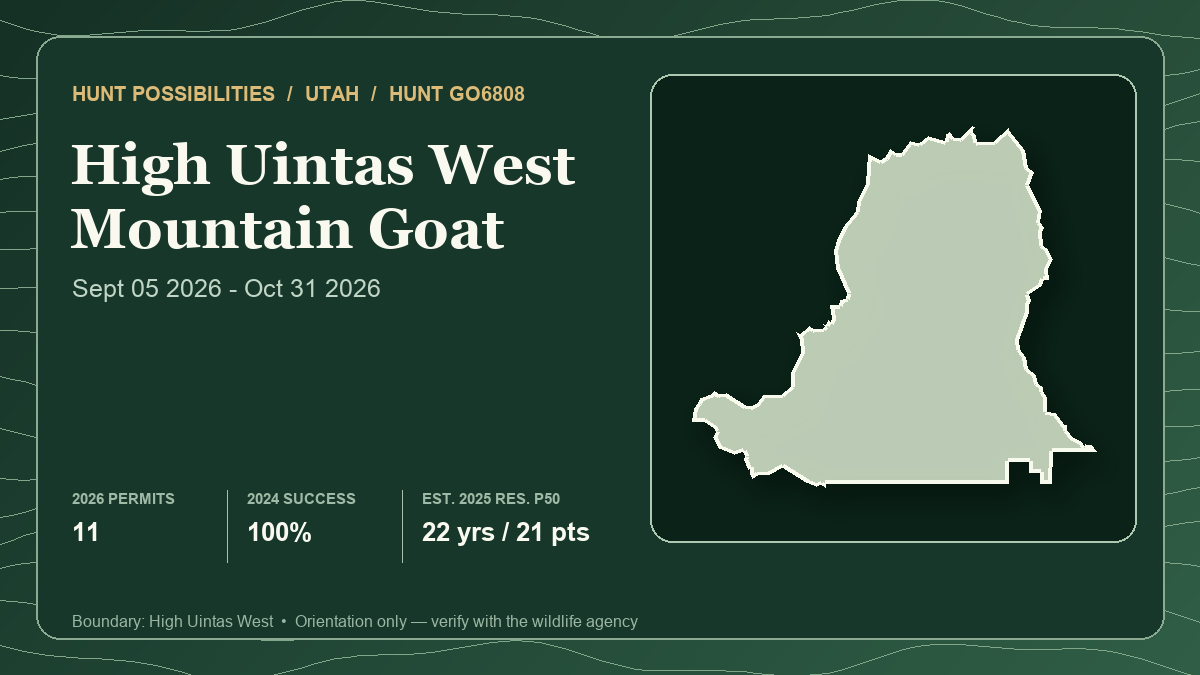
The card above represents lead hunt Utah GO6808 only, not the three-state comparison. It uses the current 2026 season and quota, 2025 draw history and the final 2024 harvest row connected to the local profile. A newer Utah preliminary 2025 harvest report is available and is used in the analysis below. That difference is stated rather than silently mixing reports.
What a mountain goat comparison can—and cannot—answer
Rarity alone is a poor reason to apply. The first filter is whether a hunter can safely operate in steep alpine terrain for several days, then recover an animal without depending on one road or weather window.
Utah DWR describes mountain goats as high-elevation animals associated with rugged, rocky terrain. They primarily eat grasses and flowering plants, plus shrubs and lichens, and generally do not migrate long distances. Extreme winter can move them somewhat lower; the typical rut is in November.
That timing separates these hunts. Idaho 6004 remains open through November 12, overlapping the beginning of the broad rut period. Utah GO6808 and Wyoming 001-1 close October 31. A later calendar can change group structure and behavior, but it can also trade longer observation opportunities for snow, frozen roads, shorter daylight and a more serious extraction problem.
E-scout three connected features: alpine feed, nearby escape terrain and a legal observation approach that avoids a hazardous descent. Utah's Uinta plan says most goats there have been found above 10,000 feet and models escape terrain using slopes steeper than 30 degrees. That model is not a climbing recommendation.
Plan to observe before moving. Both sexes have horns, and body size, color or a solitary animal is not enough to establish sex. Idaho specifically prohibits taking a female accompanied by kids and encourages billy selection because excessive nanny harvest can reduce productivity and future permit levels. Use multiple official identification characteristics, allow time to watch behavior, and accept that a questionable animal is not a shot opportunity.
A fair reading of the numbers
Draw percentages are snapshots, not promises: these three systems operate differently, and a permit-to-applicant ratio omits some allocation and eligibility rules. Harvest results are also small samples—12 Utah hunters, three Idaho hunters and 11 Wyoming hunters in 2025. A 100% result can mean three successful people, not a low-risk hunt.
Official fee snapshots are not total costs. Base licenses, access fees, stamps and transaction charges can apply; recheck the agency checkout.
Hunt 1: Utah GO6808 — bonus points and a broad High Uintas window
- Current season and weapon: Hunter's-choice mountain goat, any legal weapon, September 5 through October 31, 2026. Utah lists 11 permits: nine resident and two nonresident.
- Tag path or draw system: Utah manages this as a once-in-a-lifetime species. The bonus-point report separates permits awarded through the high-point bonus side from regular permits, so a lower-point applicant retains a chance but does not share the same historical position as the maximum-point pool.
- Latest draw demand: In 2025, 546 eligible residents sought nine permits, an aggregate historical ratio of one permit per 60.7 applicants. Nonresidents numbered 1,594 for two permits, or one per 797. A resident regular permit appeared at eight points and a nonresident regular permit at two; those isolated outcomes demonstrate random opportunity, not a repeatable draw threshold.
- Latest harvest result: Utah's preliminary 2025 report lists 12 hunters, 10 goats, 83.3% success and 7.7 average days. The final 2024 row on the static profile and card lists nine hunters afield, nine goats and 100% success over 4.9 average days. The newer result is the better planning baseline, while the two-year contrast shows why “100% unit” is not a forecast.
- Current official fee snapshot: The 2026 guidebook lists the mountain goat permit at $454 resident and $3,488 nonresident. A current hunting or combination license and application charges are separate.
- Public-land and access pattern: The Uinta unit plan reports that 98% of modeled mountain goat habitat at or above 8,000 feet across the broader Uinta Mountains unit is managed by the U.S. Forest Service. That is not a GO6808 public-land percentage and does not establish a legal route. The plan says goats occur throughout the High Uintas Wilderness, where motorized travel is prohibited.
- Terrain character: Alpine basins, tundra, rock bands, glacial headwaters and long subalpine approaches. The unit plan supports long-range observation from durable ground, then a deliberate approach—not a direct climb at the first visible goat.
- Principal tradeoff: GO6808 offers a 57-day season and the largest 2026 quota in this comparison. The trade is a point-weighted Utah application with extremely heavy nonresident demand and a wilderness-scale retrieval problem.
- Best for: A hunter already committed to Utah's mountain goat bonus-point path who can build several weather-independent access plans and will not let old high-success percentages compress the scouting schedule.
Open Utah GO6808 in the Hunt Planner 3D map.
Hunt 2: Idaho 6004 — random drawing in Area 22
- Current season and weapon: Either-sex mountain goat, any weapon, August 30 through November 12, 2026, with three tags. Idaho's current two-year rules confirm the same hunt number, area, dates and quota for 2025 and 2026.
- Tag path or draw system: Idaho uses a random controlled-hunt drawing without preference points. Applicants for moose, bighorn sheep or mountain goat may apply for only one of those species in the year and must submit the tag fee with the application.
- Latest draw demand: IDFG's 2026 Hunt Planner row shows 66 resident first-choice applicants for three permits, displayed as 5%, and 40 nonresident first-choice applicants for no Area 22 permit. The 2025 result was two resident permits from 41 applicants and one nonresident permit from 20 applicants, both displayed as 5%. Statewide nonresident allocation can make one hunt's residency split change between years.
- Latest harvest result: Idaho reports three hunters and three goats in 2025, or 100% success. That perfect percentage is a sample of three and should carry less confidence than a larger hunt report.
- Current official fee snapshot: IDFG lists a $199.75 resident tag, or $166.75 under Price Lock, plus a $16.75 application fee. The nonresident tag is $2,626.75 plus $45.75. A hunting license and other charges are additional; unsuccessful applicants receive the tag fee back, not the license or application fee.
- Public-land and access pattern: IDFG's Area 22 summary lists 53.99% Forest Service, 26.37% private, 11.12% State of Idaho and 7.67% BLM management. It separately identifies 18,175 acres of Hells Canyon Wilderness, 3.31% of the hunt area, and no current Access Yes! property. Management category is not proof of ownership or ingress through private parcels.
- Terrain character: Unit 22 combines forested mountain country and rangeland, with the Seven Devils and Hells Canyon creating abrupt vertical relief. The Forest Service characterizes a representative Seven Devils loop as strenuous and high altitude, and warns that the upper access road can be steep, narrow and slippery when wet or frozen.
- Principal tradeoff: Idaho offers a point-free chance and the longest season here, reaching into November. Only three tags exist, nonresident allocation is not assured at the hunt level, and late-season road or trail deterioration can remove the apparent benefit of extra calendar days.
- Best for: A hunter who values a random reset, tolerates allocation variance and can scout mixed public-private terrain before committing to the high country.
Open Idaho 6004 in the Hunt Planner 3D map.
Hunt 3: Wyoming 001-1 — no points, Beartooth access and very long odds
- Current season and weapon: Any mountain goat, any legal weapon, September 1 through October 31, 2026. A special archery season runs August 15–31 for a license holder who also satisfies Wyoming's archery requirements.
- Tag path or draw system: Wyoming uses no preference points for mountain goats, and a Type 1 or Type 2 mountain goat license is once in a lifetime. Resident and nonresident demand should be read separately.
- Latest draw demand: Wyoming's May 13, 2026 demand reports list eight resident licenses against 1,678 first-choice applicants and one nonresident license against 451 first-choice applicants. Those are roughly 0.48% and 0.22% permit-to-first-choice ratios before any SuperTag adjustment—not guaranteed odds for a future drawing.
- Latest harvest result: The 2025 Area 1 report lists 11 active hunters, 10 goats, 90.9% success and 94 total hunter-days, or 9.4 days per harvest. The harvest included seven billies and three nannies. This was a strong result, but its time requirement is materially longer than the old assumption that a goat tag produces a quick hunt.
- Current official fee snapshot: Wyoming currently lists the mountain goat license at $152 resident plus a $5 application fee and $2,752 nonresident plus a $15 application fee. Other required licenses or stamps and transaction costs should be confirmed at checkout.
- Public-land and access pattern: The local WGFD-backed record carries a 100% public-land summary. That does not mean every acre is reachable by vehicle or every nonresident can hunt every acre alone. Portions of the Beartooth country are federally designated wilderness, and Wyoming requires a nonresident hunting big or trophy game in national forest wilderness to use a licensed outfitter or a qualified resident companion with the required authorization.
- Terrain character: The Shoshone National Forest describes the Beartooth Plateau as alpine and subalpine country with high lakes, rugged peaks and glacier-carved valleys. U.S. Highway 212 commonly remains open only into mid-October, weather permitting, so a road-dependent late hunt needs an earlier fallback.
- Principal tradeoff: Wyoming avoids point debt and provides a two-week archery opportunity before the regular season. Demand is the steepest headline barrier here, and the combination of weather, wilderness rules and Beartooth relief makes access planning inseparable from the application decision.
- Best for: A hunter who refuses a multidecade point strategy, accepts a very low annual chance and can solve Wyoming's wilderness, companion or outfitter question before treating Area 1 as a viable choice.
Open Wyoming 001-1 in the Hunt Planner 3D map.
Field strategy: observation, weather and recovery
Build around observation time, not distance traveled. Judge each broad glassing sector by safe ground, wind, legal access and an extraction line that avoids cliff travel with a loaded pack.
Use multiple official sex-identification characteristics. A nanny without a visible kid is not automatically a billy; passing an uncertain goat protects both herd and hunter.
Create three weather plans:
- Dry early season: Expect recreational traffic near convenient trail corridors and protect water, shade and meat-cooling time.
- First sustained snow: Recalculate road travel and pack-out speed before assuming goats will become easier to locate.
- Road or pass closure: Move to a pre-verified alternate access system; do not improvise across private land or exceed the safe range of the retrieval team.
Recovery is part of shot selection. Identify likely fall terrain, reachability, realistic loaded trips and the weather or darkness cutoff. Mountain goat hair complicates body-size judgment, and steep-angle shooting changes field geometry; use demonstrated equipment knowledge and conservative limits.
Best fit by hunter priority
- For the applicant who will not buy points: Idaho 6004 and Wyoming 001-1 both avoid point accumulation. Idaho's 2026 resident demand was far less restrictive on its face, while Wyoming preserves a chance for every eligible applicant but had 1,678 residents for eight Area 1 licenses.
- For the applicant already deep in a bonus-point system: Utah GO6808 is the logical continuity play. Its regular permits keep some chance alive below the maximum tier, but the 2025 totals show that nonresident demand is especially severe.
- For the longest calendar: Idaho runs August 30–November 12. That flexibility is useful only if late access, road condition and retrieval remain viable.
- For the largest current quota: Utah lists 11 permits, compared with Idaho's three and Wyoming's nine. Quota alone does not measure individual odds because applicant totals and draw mechanics differ.
- For a public-land-first plan: Wyoming carries the cleanest headline at 100% public, Utah's broader modeled habitat is overwhelmingly Forest Service, and Idaho publishes substantial public management. None grants a legal route, motorized access or a wilderness exception.
- For the hunter using harvest success as a reality check: The latest results were 83.3% for Utah in preliminary 2025 data, 100% for Idaho's three hunters in 2025 and 90.9% for Wyoming in 2025. Sample size, terrain, season length and reporting method prevent a defensible ranking.
There is no universal winner. Utah best fits an established bonus-point strategy, Idaho best fits the applicant who wants a random reset and a long season, and Wyoming best fits someone willing to trade point certainty for a very small annual chance. The true limiting factor may still be safe access rather than drawing mathematics.
Verification checklist before applying or hunting
- Reopen the official 2026 listing and confirm hunt number, boundary, quota, season, legal weapon and sex limitation.
- Confirm residency, eligibility, application payment, refund and once-in-a-lifetime rules; do not carry a fee or allocation forward.
- Compare the current agency boundary with ownership, wilderness and travel-management layers. Public management does not guarantee public ingress.
- Check active fire notices, closures, road status, trail conditions, weather and land-manager alerts immediately before travel.
- Complete any required mountain goat orientation or identification material and know the state's tagging, check-in, evidence and harvest-report rules.
- Build a written rescue, communication, meat-care and extraction plan that works after a road closure or early snow.
- Keep terrain advice at the habitat-pattern level and do not publish camps, routes, observation points or coordinates.
- Use Hunt Planner for comparison and orientation, then carry current agency maps and a field-ready ownership source.
The Hunt Planner methodology explains how unlike draw systems and reporting years are preserved. The editorial and AI policy describes the research disclosure, and errors or updated agency records can be sent through the corrections page.
Sources and verification
- Utah DWR Hunt Planner: GO6808 current boundary and connected hunt record
- Utah DWR 2026 Big Game Application Guidebook: GO6808 season and current permit fee
- Utah DWR 2025 drawing odds and point reports
- Utah DWR preliminary 2025 big-game harvest report
- Utah DWR Uinta Mountains mountain goat unit plan: habitat, ownership and access context
- Utah DWR July 2026 mountain goat behavior and high-elevation safety guidance
- Utah DWR current 2026 wildfire and hunt-relief notice
- Idaho Fish and Game 2025–2026 moose, sheep and mountain goat rules
- Idaho Hunt Planner: Area 22 Hunt 6004 draw, harvest and hunt record
- Idaho Hunt Planner: Unit 22 surface management, land cover and wilderness
- Idaho Fish and Game current resident and nonresident license fees
- Idaho Fish and Game mountain goat gender identification
- U.S. Forest Service Hells Canyon Wilderness access and seasonal-road briefing
- Wyoming Game and Fish 2026 bighorn sheep and mountain goat season regulation
- Wyoming Game and Fish mountain goat Hunt Planner
- Wyoming Game and Fish 2026 resident mountain goat demand report
- Wyoming Game and Fish 2026 nonresident mountain goat demand report
- Wyoming Game and Fish 2025 mountain goat harvest report
- Wyoming Game and Fish current license fee list
- Wyoming Game and Fish wilderness guide requirement FAQ
- U.S. Forest Service Beartooth Plateau and road-season context
Official quotas, regulations, application rules, fire status, roads and access can change. Utah's article-level harvest result is preliminary 2025 while its static card uses final 2024 data; Idaho's local profile carries the identical 2025 season structure while the official two-year guide confirms the 2026 season; Wyoming's demand and quota are from 2026 and its harvest is from 2025. Those differences are explicit because combining them into one score would create false precision.