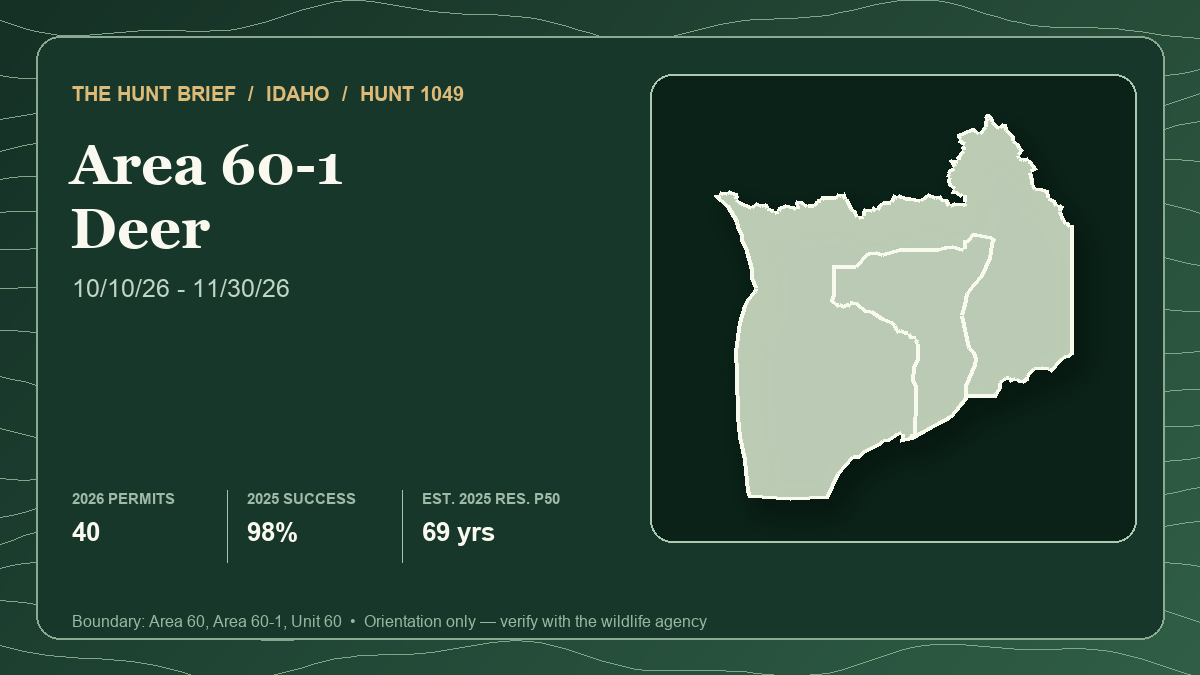
Idaho deer Hunt 1049 opens tomorrow, October 10, 2026, with one of the clearest supply-and-demand stories in the current Hunt Planner data. Idaho Fish and Game authorized 40 tags. The completed 2026 first drawing lists 3,430 first-choice applicants for those 40 awards, while the latest harvest table reports 39 deer from 40 hunters in 2025.
That combination explains the attention, but it does not make the hunt simple. Area 60-1 covers about 1.5 million acres across all of Units 60, 61 and 62A plus part of 60A. The official hunt page flags grizzly-bear country, land-management patterns vary sharply among the component units, and the 2025 hunters reported 413 total days afield—10.3 days per hunter—even with 98% success.
Start with the static Hunt Planner profile for Hunt 1049 and open Area 60-1 in the Hunt Planner 3D map. The card above uses the actual composite hunt boundary from the local dataset. It is an orientation graphic, not a parcel, road-status or navigation map.
The quick verdict
Hunt 1049 best fits a tag holder who can give a long season a patient, mobile plan. Its October 10–November 30 window spans changing weather and deer movement, but a long calendar is not the same as easy access. Build several lawful hunt systems across different habitat types, verify every road and parcel before entry, and treat bear-safe carcass recovery as part of the hunt plan rather than an afterthought.
For a future applicant, 2026 demand grew while the quota stayed at 40. Idaho uses a random controlled-hunt drawing, not preference points. A low historical percentage is evidence of competition; it is not a point threshold or a prediction for one future application.
What the 2026 tag covers
The current Idaho Hunt Planner lists Hunt 1049 as an any-weapon, antlered-deer season from October 10 through November 30. The tag is valid for an antlered mule deer or white-tailed deer in Area 60-1, and Idaho defines an antlered deer here as having at least one antler longer than three inches. The official area description includes all of Units 60, 61 and 62A, plus the part of Unit 60A beyond one mile north and west of the North (Henrys) Fork of the Snake River.
The 2026 rules booklet confirms the 40-tag quota and dates. It also tells hunters to use the controlled-hunt area descriptions because Area 60-1 includes multiple units and only part of 60A. Do not reduce that legal description to a unit label or an old saved boundary.
Hunt 1049 is not an over-the-counter fallback. A hunter must possess the controlled-hunt tag, and the current rules require the physical tag in the field. The rules also impose a one-year waiting period after drawing a limited antlered-only deer hunt before applying for another limited antlered-only deer hunt in the first application period. Recheck the current application rules before using this hunt in a future strategy.
Demand rose to 3,430 first choices
The 2026 resident/nonresident table lists 3,227 resident first-choice applicants and 39 resident awards. It lists 203 nonresident first choices and one nonresident award. Combined, that is 3,430 first choices for 40 awards, a raw quota-to-first-choice ratio of about 1.17%.
The agency displays both resident and nonresident first-choice success as whole percentages: 1% for residents and 0% for nonresidents. The zero is rounding, not proof that a nonresident could not draw; the same row records one nonresident award. Dividing awards by applicants gives roughly 1.21% for residents and 0.49% for nonresidents, but those are descriptive ratios from one completed drawing. Group applications, the nonresident cap, applicant eligibility and future demand affect individual outcomes.
In 2025, the corresponding first drawing showed 3,072 resident first choices and 163 nonresident first choices, or 3,235 combined, for the same 40-tag quota. Total first-choice demand therefore rose by 195 applicants, about 6.0%, in 2026. The direction is useful; it does not guarantee another increase.
The card's “69 yrs” label is an estimated P50 scenario built from the connected 2025 resident result in the local dataset. It is not a waiting period and should not be read like a preference-point forecast. In a random draw, repeated applications do not create a saved point balance.
Read 98% beside 413 hunter-days
Idaho's mandatory-report table shows 40 hunters, 39 deer and 98% success in 2025. All 39 harvested deer were antlered, 94% met the table's four-point-or-better measure, and none was reported as a white-tailed deer. The two preceding Hunt 1049 rows show 92% success in both 2024 and 2023.
Those are unusually strong historical results, but they describe the full area and season. They do not separate public from private land, opening week from late November, or one component unit from another. Nor does the 94% line guarantee antler size for a future hunter.
The effort column adds the needed friction. Hunters reported 413 days for 40 participants in 2025, compared with 347 days in 2024 and 316 in 2023. A 98% season can still demand repeated searches, weather resets and a long recovery plan.
One hunt area, four different access patterns
The agency does not publish one hunt-wide public-land percentage for Area 60-1. Its unit pages instead show materially different surface-management patterns. Unit 60 is listed as 37.14% Forest Service, 17.87% state and 11.91% BLM, with 31.02% private. Unit 60A is 43.74% private and 34.88% BLM, while the included portion is only part of that unit. Unit 61 is 70.88% Forest Service and 17.4% private. Unit 62A is 86.08% Forest Service and 9.5% private.
Those figures describe the whole component units, not legal-access percentages for Hunt 1049. They do not prove an open road, public crossing, parking place or retrieval route. Harriman State Park Wildlife Refuge is closed in Units 60 and 62A, and the Hunt Planner lists no current Access Yes property in Units 60, 60A, 61 or 62A.
Terrain also changes across the area. The official land-cover summaries characterize Unit 60 as roughly balanced between rangeland and forest, Unit 60A as predominantly rangeland, and Units 61 and 62A as predominantly forest. Use that contrast to organize broad searches around current forage, cover, elevation and weather. Do not publish or trade camps, bedding areas, precise glassing positions, private approaches or animal coordinates.
A practical plan for the opener and late season
- Verify the whole access chain. Check the current boundary, ownership, road authority, gate status, seasonal closure, parking and retrieval plan. A public parcel without lawful ingress is not a usable plan.
- Let current conditions replace the 98% headline. Idaho's 2026 outlook says the Island Park deer population is robust and increasing, but hot, dry conditions may change distribution. Test broad forage-and-cover patterns with fresh tracks, droppings and direct observation.
- Prepare for grizzly country. The hunt page carries an explicit grizzly warning. Carry accessible bear spray, hunt with partners when practical, watch for fresh sign and plan to remove meat promptly. Idaho's September 2026 guidance warns that drought-reduced natural foods may increase bear activity.
- Use the long season deliberately. An opening-week plan, a weather-change plan and a late-November plan should not depend on the same road or elevation band. Recheck closures and conditions before every move.
- Budget for recovery. Distance, deadfall, snow, mud and a carcass can turn a short approach into a long pack-out. Separate meat from the gut pile when required for bear safety, keep camp attractants secured and never leave a route decision until after the shot.
- Report the hunt. Idaho requires a mandatory report within 10 days of harvest, or within 10 days after the season closes if the hunter did not hunt or did not harvest.
Hunt 1049's most useful lesson is not that 98% success makes the tag easy. It is that thousands of applicants value a long, limited antlered season in a recovering Island Park deer population—and the hunters who draw still report substantial time afield. Treat the tag as a rare chance to solve a large, mixed-ownership, bear-country hunt carefully.
Sources and verification
- Idaho Fish and Game Hunt Planner: Hunt 1049 season, boundary, 2026 draw and 2025 harvest
- Idaho Fish and Game 2026 Big Game Seasons and Rules
- Idaho Fish and Game 2026 Deer and Elk Hunting Outlook
- Idaho Fish and Game 2026 Island Park deer management discussion
- Idaho Fish and Game Unit 60 access and land-cover profile
- Idaho Fish and Game Unit 60A access and land-cover profile
- Idaho Fish and Game Unit 61 access and land-cover profile
- Idaho Fish and Game Unit 62A access and land-cover profile
- Idaho Fish and Game September 2026 bear-country warning
- Idaho Fish and Game controlled-hunt information
Official seasons, boundaries, draw procedures, technology rules, land status, road conditions, closures, fire restrictions, weather and bear activity can change. The season, quota and draw evidence are from 2026; the latest completed hunt-level harvest is from 2025; the card's estimated resident draw scenario also uses the connected 2025 record. Unit-level surface-management shares are not a hunt-wide access percentage. Verify every source again before applying and immediately before hunting. This article uses official agency material only and presents no hunter report as representative evidence. It was prepared with AI-assisted research and drafting, then checked against the linked sources. Read Hunt Planner's methodology, editorial and AI policy and corrections process.