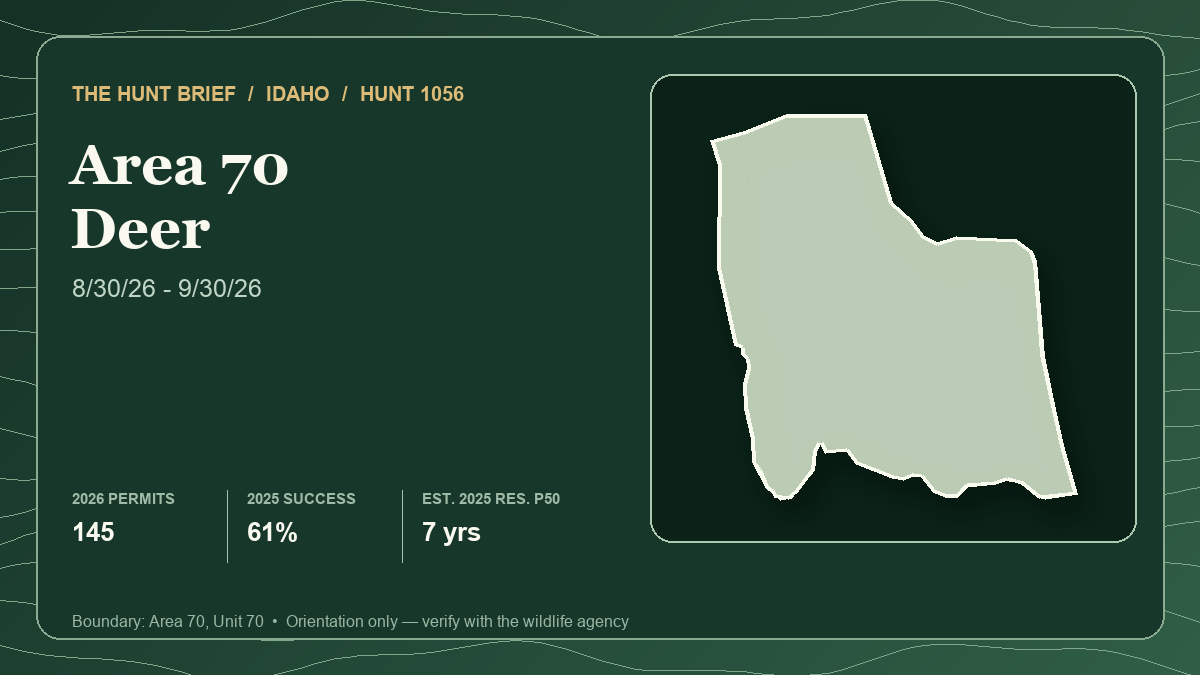
Idaho deer Hunt 1056 is not a single-season proposition. Idaho Fish and Game publishes a 145-tag antlered-deer hunt in Area 70 with an archery-only window from August 30 through September 30, 2026, then an any-weapon window from October 10 through October 31. For a permit holder on September 23, that creates two different planning problems: finish the archery window with current information, then decide what deserves a complete reset before the October return.
The tag is scarce but not statistically mysterious. IDFG's 2026 first drawing awarded 145 permits from 1,471 first-choice applications, a rounded 10% overall result. The latest completed harvest report lists 137 hunters, 84 antlered deer and 61% success in 2025. Neither percentage solves access in a unit where IDFG maps 40.6% private land and 21.1% Indian Reservation/Bureau of Indian Affairs management.
Start with the static Hunt Planner profile for Hunt 1056 and open Area 70 in the Hunt Planner 3D map. The profile brings both current season records together. The card above represents the current archery record and actual hunt boundary; it is not an ownership or navigation map.
The quick verdict
Hunt 1056 best fits a hunter who values two distinct opportunities, can maintain legal access to several separated habitat systems and is willing to rebuild the plan between methods. It is a poor fit for someone expecting a controlled tag to create an exclusive September hunt or assuming the October rifle window will preserve the same deer distribution.
The most useful number is not 61% harvest. It is the land pattern. Forest Service and BLM together account for about 36.2% of the unit, but public management color does not prove a public approach, an open road or lawful recovery. Private and tribal/BIA-managed ground make up a majority of the mapped surface. Every promising basin, ridge or agricultural edge needs a complete access audit.
One hunt number, two 2026 season records
IDFG's current Hunt Planner publishes Hunt 1056 as antlered mule and white-tailed deer in all of Unit 70. One official record is archery only from August 30–September 30. A second record uses any weapon from October 10–31. Both show the same hunt number, Area 70 and 145-tag allocation.
That structure makes the nine-day October 1–9 gap important. It is time to replace assumptions, not merely service equipment. The official Area 70 calendar also lists a muzzleloader deer hunt during that gap, and the September archery window overlaps a general archery deer season in Unit 70. A controlled permit therefore does not guarantee an empty landscape in either phase.
Confirm the exact legal equipment, tag conditions and open dates in the current 2026 rules before switching methods. The Hunt Planner pages are useful evidence, but the regulations and the tag in hand govern.
The 2026 draw held near 10%; the second drawing did not
In the 2026 first drawing, 1,471 first-choice applicants competed for 145 permits. IDFG breaks that into 1,379 resident first choices with 134 awards, a rounded 10% result, and 92 nonresident first choices with 11 awards, a rounded 12% result. All permits went to first choices; 373 second-choice applicants received none.
The second drawing was a different event. IDFG reports only two permits against 384 first-choice applications. Two of 375 resident first choices drew, while none of nine nonresident first choices did. The agency rounds the overall and resident result to 1%. Those two tags were unclaimed inventory, not evidence that Hunt 1056 becomes easier later.
Idaho uses a random controlled-hunt draw and does not award preference points. The card's estimated 2025 resident P50 is a repeated-odds scenario based on the local record's rounded 10% result; it is not a queue position or a forecast. The official 2026 table is the more current demand snapshot.
Read 61% success with the effort attached
The 2025 harvest table records 137 hunters, 84 antlered deer and 1,028 hunter-days. That is 61% success and about 7.5 days afield per hunter. IDFG also reports that 68% of harvested deer had at least four points and 1% were white-tailed deer. Those antler figures describe the reported harvest, not the whole herd and not a minimum expectation.
Recent history shows movement without a collapse: Hunt 1056 posted 65% success in 2024, with 100 deer harvested by 154 hunters over 842 days, and 57% in 2023, with 87 deer harvested by 152 hunters over 1,305 days. The methods and season structure attached to the same hunt number have changed across years, so treat those rows as context rather than a controlled experiment.
The effort line is the practical warning. A successful historical cohort still averaged more than a week afield in 2025. Weather, access, deer distribution, hunter overlap and time available can change the individual result far more than a three-year percentage band suggests.
Area 70 is an ownership-first hunt
IDFG maps Area 70 at 242,783 acres. Its current surface-management summary is 40.57% private, 25.18% U.S. Forest Service, 21.12% Indian Reservation/Bureau of Indian Affairs, 11.02% BLM and 2.11% State of Idaho. It lists no current Access Yes! property and no federally designated wilderness in the unit.
Those labels are not access permissions. Do not treat tribal/BIA-managed land as ordinary public land, cross private ground to reach a public parcel without authority or assume a mapped road is open to motor vehicles. Verify the parcel, the full approach, travel rules and recovery path with the responsible land manager or landowner before committing time to it.
The land-cover table helps organize scouting without producing a pin: 48.99% rangeland, 23.28% dryland agriculture, 16.11% forest, with smaller irrigated, riparian and urban categories. Idaho's mule deer plan places Unit 70 in the Bannock Data Analysis Unit. It describes mixed-conifer, aspen, sagebrush and mountain-shrub summer range, with lower sagebrush-steppe, shrub, juniper and agricultural winter range, and says Bannock mule deer are generally migratory.
That supports a transition-based plan, not a promise about elevation. Use fresh sign, forage condition, cover and weather to decide where deer are now. Do not carry a September sighting untested into October.
A two-window field plan
- Finish September narrowly. Recheck the best legal feed-to-cover transitions and current wind rather than expanding into every mapped acre during the final archery days.
- Build independent access systems. A public parcel without a legal entrance or recovery route is not a hunt plan. Keep alternatives on Forest Service, BLM or other ground where permission and travel rules are verified.
- Use the gap as a new scouting cycle. Check weather, road status, hunting pressure and fresh sign again before October 10. Assume deer can change daily use after archery pressure and overlapping seasons.
- Separate visibility from stalkability. Open rangeland and agricultural edges can reveal deer while offering no legal or concealed approach. Favor complete habitat systems with security cover and a lawful exit.
- Keep locations private. Record habitat patterns and decision points, but do not publish camps, private approaches, bedding pockets, glassing positions or animal coordinates.
For a 2026 permit holder, the decision is simple: use the remaining archery days only where current evidence and verified access justify them, then rebuild for October instead of extending the same plan with a rifle. For a future applicant, Hunt 1056 is attractive because one random draw can create two distinct windows, but its majority private-plus-tribal/BIA land pattern deserves at least as much attention as the 57%–65% recent harvest range.
Sources and verification
- IDFG Hunt 1056 archery record: August 30–September 30, 2026 season, quota, drawing tables and boundary
- IDFG Hunt 1056 any-weapon record: October 10–31, 2026 season and 2025 harvest table
- IDFG Area 70 calendar: current overlapping deer opportunities
- IDFG Unit 70: surface management, land cover, Access Yes! and wilderness status
- IDFG 2026 Big Game Seasons and Rules
- IDFG Idaho Mule Deer Management Plan 2020–2025: Bannock habitat and seasonal movement
- IDFG mandatory hunter reporting requirements
- IDFG June 17, 2026 controlled-hunt results announcement
Official seasons, methods, boundaries, access, roads and closures can change. The drawing figures are from 2026; the latest harvest and effort figures are from 2025, while the card's draw scenario also uses 2025 local data. This article uses official agency material only and presents no hunter report as representative evidence. It was prepared with AI-assisted research and drafting, then checked against the linked sources. Read Hunt Planner's methodology, editorial and AI policy and corrections process.