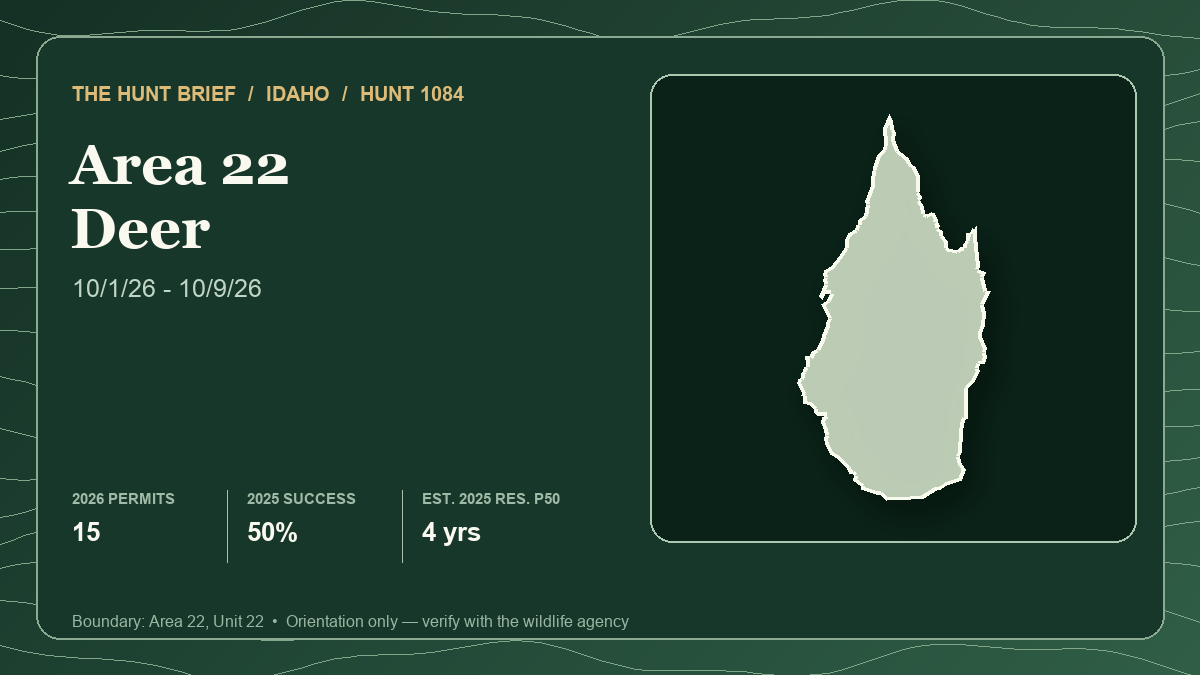
Idaho deer Hunt 1084 opens tomorrow, October 1, with nine days to solve a large Area 22 access problem using muzzleloader-only equipment. Idaho Fish and Game authorizes 15 tags for antlered mule deer or white-tailed deer through October 9. Its 2026 first-drawing table shows 90 first-choice applicants for those 15 permits, while the latest completed harvest report shows eight deer taken by 16 hunters in 2025.
The useful interpretation is not that a 50% harvest rate makes this an easy hunt. Area 22 covers 548,462 acres, about 26.4% of its mapped surface is private, no Access Yes! property is currently listed, and the season ends before a hunter can spend much time repairing an incomplete access plan. The short calendar makes preparation—not the historical percentage—the controlling variable.
Start with the static Hunt Planner profile for Hunt 1084 and open Area 22 in the Hunt Planner 3D map. The card above uses the actual local hunt boundary and structured record. It is an orientation graphic, not an ownership or navigation map.
The quick verdict
Hunt 1084 best fits a permit holder who already has a legal Idaho muzzleloader proven at conservative open-sight distance and several independently verified access options. It is a weaker fit for someone depending on one road, one private crossing or a modern muzzleloader configuration that has not been checked against Idaho's muzzleloader-only rules.
For a future applicant, Hunt 1084 is a random-draw opportunity with a stable 15-tag quota but no preference-point advantage. The 2026 applicant pool grew modestly while the displayed overall first-draw result slipped from 18% to 17%. That is current demand evidence, not a forecast.
What the 2026 permit authorizes
IDFG lists Hunt 1084 as a controlled, muzzleloader-only hunt across all of Unit 22 from October 1 through October 9, 2026. The tag covers antlered mule deer and white-tailed deer; under the current hunt record, an antlered deer must have at least one antler longer than three inches.
“Muzzleloader only” is narrower than a short-range-weapon season. IDFG's current equipment page requires at least .45 caliber for deer, a rifle or musket that loads only from the muzzle, open or peep sights, loose powder, an exposed ignition system and a flint, percussion cap or musket cap. A muzzleloader permit validation is required. Scopes, attached electronics, pelletized powder and 209 primers are prohibited under the standard muzzleloader-only rule.
Projectile details and disability accommodations have their own current language. Verify the complete equipment rule against the 2026 guidebook and IDFG's live rule page before entering the field; do not assume a setup that is legal in another state or in an Idaho short-range season is legal here.
First-draw demand moved from 84 to 90 applicants
The 2026 first drawing awarded all 15 permits from 90 first-choice applications, which IDFG reports as 17% overall. The resident table shows 80 first-choice applicants and 14 awards, or 18%; the nonresident table shows 10 applicants and one award, or 10%. Another 68 second-choice applicants received no permit because the quota was already filled.
In 2025, the same 15-tag quota drew 84 first choices and produced an 18% overall result. Resident demand rose from 76 to 80 while the 14 resident awards held constant. The nonresident pool moved from eight applicants to 10 for one permit, so its displayed result moved from 12% to 10%. Those nonresident percentages come from very small groups and should not be treated as a stable trend.
IDFG also reports one unclaimed permit in the 2026 second drawing. It drew 69 first-choice applications and went to one of 64 resident first choices, a rounded 2% resident result. None of five nonresident first choices drew. That one-tag event does not make the second drawing a dependable path.
Idaho does not use preference points for controlled hunts. The card's estimated resident P50 uses the local record's rounded 18% result from 2025 as a repeated-odds illustration; it is not a queue position, a waiting-time estimate or a promise about a future application.
Read 50% harvest with the sample and effort attached
The 2025 mandatory-reporting table lists 16 hunters, eight harvested antlered deer and 79 total hunter-days. That is 50% success and about 4.9 days afield per hunter. IDFG reports that 71% of the harvested deer had at least four points and none were white-tailed deer.
Every one of those figures has a small denominator. Four more or four fewer harvested deer would have shifted the percentage by 25 points. The 2024 Area 22 muzzleloader row lists three deer for 11 hunters, or 30%, while the 2023 row lists 10 for 15, or 67%; those earlier rows also carried a different hunt number. They provide broad area-and-method context, not a clean Hunt 1084 time series.
The 79 hunter-days are more useful for planning than the headline success rate. The average participant used more than half of this nine-day season. A hunter who loses two days to an illegal route, unsuitable equipment or a closure cannot recover that time from a favorable historical statistic.
Area 22 is public-heavy, not access-simple
IDFG maps 53.99% of Unit 22 under U.S. Forest Service management, 26.37% private, 11.12% State of Idaho, 7.67% Bureau of Land Management and 0.66% Bureau of Reclamation. It lists Payette and Nez Perce national-forest lands, no current Access Yes! property, and 18,175 acres of Hells Canyon Wilderness—3.31% of the hunt area—where motorized travel is prohibited.
Those percentages do not establish legal access. A public polygon can still sit behind private ground, a closed road or a travel restriction. State parcels have their own rules, and wilderness changes the transportation problem. Confirm the parcel, the full ingress, vehicle rules, parking and recovery route with the responsible land manager or landowner before leaving pavement.
IDFG's August 31 outlook says deer populations in Units 22, 32 and 32A are likely beginning to recover from the Lava, Paddock and Limepoint fires of summer 2024, which affected both summer and winter range. The agency says mild winters likely offset some impacts and planned an aerial survey for winter 2026 if conditions allow. That is a cautious regional assessment—not proof that a particular burn, elevation or drainage holds deer now.
Use fire history at habitat-pattern scale. Compare unburned security cover, recovering forage edges and connected forest-rangeland transitions, then let current sign and legal access decide where to spend time. Check current fire restrictions and closures before every trip; a 2024 perimeter or public-land label is not a current travel authorization.
A nine-day field plan
- Audit equipment before opening morning. Confirm caliber, sights, ignition, powder, projectile and permit validation against the live Idaho rule, then prove the complete system at realistic field distance.
- Build several complete access chains. Each option needs a lawful approach, parking location, foot route and recovery plan. A visible public parcel without legal ingress is not an option.
- Scout for current patterns, not old pins. Test broad cover-to-forage transitions and fire-recovery edges from durable observation positions without publishing beds, camps, glassing points or animal locations.
- Plan for nonmotorized reality. Wilderness and road restrictions can convert a short map distance into a long recovery. Match the plan to daylight, weather and the help available.
- Follow the new 2026 technology rules. From August 30 through December 31, Idaho bars thermal imaging, night vision, drones and transmitting trail cameras on public land for hunting or scouting covered game, subject to the official exceptions. Review the current rule rather than relying on last year's routine.
For a 2026 tag holder, Hunt 1084 is now an execution problem: legal equipment, verified access and current deer sign must align quickly. For a future applicant, the 17% first-draw result and 50% harvest headline are useful only when paired with the 15-tag sample, nine-day season and mixed ownership.
Sources and verification
- IDFG Hunt Planner: Hunt 1084 current season, quota, 2026 drawing tables, 2025 harvest and boundary
- IDFG 2026 Big Game Seasons and Rules
- IDFG muzzleloader-only equipment rules
- IDFG Unit 22: surface management, Access Yes!, national forests, wilderness and land-cover context
- IDFG 2026 Deer and Elk Hunting Outlook: Unit 22 fire and recovery context
- IDFG September 17, 2026 hunting-technology rule notice
- IDFG fire and fall-hunting guidance: verify current closures and restrictions
Official seasons, equipment rules, technology restrictions, boundaries, access, roads, fire conditions and closures can change. The draw figures are from 2026; the latest harvest and effort figures are from 2025, while the card's draw scenario also uses 2025 local data. Small samples and historical hunt-number changes limit year-to-year comparisons. This article uses official agency material only and presents no hunter report as representative evidence. It was prepared with AI-assisted research and drafting, then checked against the linked sources. Read Hunt Planner's methodology, editorial and AI policy and corrections process.