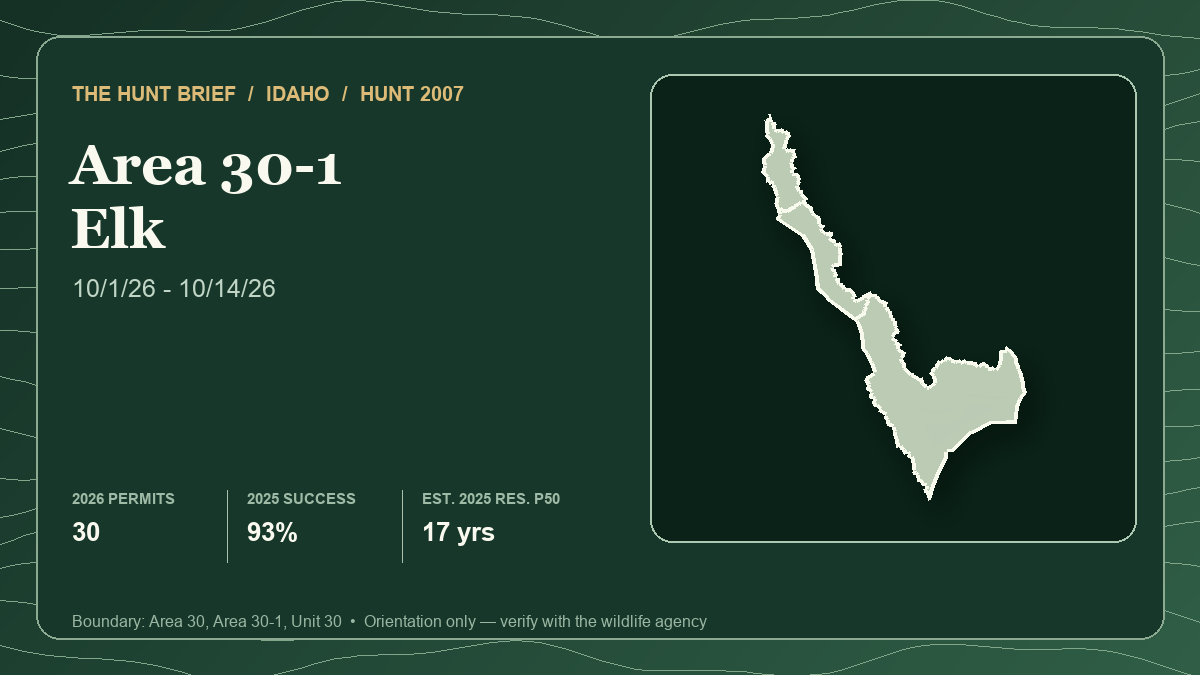
Idaho elk Hunt 2007 is halfway through a 14-day season that closes October 14, 2026. Idaho Fish and Game authorizes 30 antlered-elk tags across Hunt Area 30-1. The latest completed harvest report is attention-grabbing: 27 elk taken by 29 hunters in 2025, or 93% success. The current draw evidence is just as sharp in the other direction: 839 first-choice applications competed for the same 30 permits in 2026.
Those numbers answer different questions. The draw result describes access to the license; the harvest result describes a small group of successful applicants under 2025 conditions. Neither tells a 2026 tag holder where elk are today across 1.3 million acres and five game units.
Start with the static Hunt Planner profile for Hunt 2007 and open Hunt 2007 in the Hunt Planner 3D map. The card above uses the actual local hunt boundary. It is an orientation graphic, not an ownership or navigation map.
The quick verdict
Hunt 2007 best fits a tag holder who can treat a high historical success rate as a reason to prepare carefully, not a reason to simplify the hunt. The area is mostly federally managed, but public acreage does not solve road legality, private-land edges, seasonal distribution or retrieval. A strong plan needs several complete access systems across the broad Beaverhead Zone and a willingness to abandon preseason assumptions when current sign disagrees.
For a future applicant, this is a random-draw hunt with no preference-point advantage. The 2026 first-choice pool increased while the quota stayed at 30. A high harvest result can attract more demand, but it does not improve any applicant's place in a line because Idaho does not use preference points for controlled hunts.
What the 2026 permit authorizes
IDFG lists Hunt 2007 as an any-weapon, antlered-elk season from October 1 through October 14, 2026. The hunt covers all of Units 30, 30A, 58, 59 and 59A. Under the current rule, an antlered elk must have at least one antler longer than six inches, and the antlers must accompany the carcass in transit.
The 2026 brochure adds an important unit-level qualification to the Hunt Planner page's general motorized-rule flag: the Motorized Hunting Rule applies in Units 58, 59 and 59A for this hunt. IDFG's current motorized guidance says affected big-game hunters are restricted to established roadways legally open to full-sized automobiles, subject to listed exceptions and the land manager's separate rules. Units 30 and 30A are not named in the Hunt 2007 brochure note, but ordinary road, closure and land-manager restrictions still apply there.
First-choice demand rose to 839
The 2026 first drawing awarded all 30 permits from 839 first-choice applications, a displayed overall result of 4%. Another 243 second-choice applicants received no permit because first choices filled the quota. In 2025, the same quota drew 783 first choices. Demand therefore increased by 56 applications, or 7.2%, in one year.
Residency tables show where most of that increase occurred. Resident first choices moved from 645 in 2025 to 647 in 2026, with 27 awards in both years and a displayed 4% result. Nonresident first choices rose from 138 to 192—an increase of 39.1%—while awards remained at three and the displayed result remained 2% after rounding.
Those rounded percentages conceal small inventories. One nonresident permit is one-third of that pool, and applicant behavior can change quickly. Idaho's random controlled-hunt system means the 2026 table is a completed historical drawing, not a point threshold or forecast.
Read 93% harvest with 29 hunters attached
IDFG's mandatory-reporting table lists 29 hunters, 27 antlered elk and 156 total hunter-days in 2025. That is 93% success and about 5.4 days afield per hunter. The same report says none of the harvest was spike elk and 70% had six or more points.
The result is strong, but the denominator matters. Two additional unsuccessful hunters would have reduced the rate by more than six percentage points without changing the elk harvest. The preceding reports show 25 elk for 29 hunters in 2024, or 88%, and 24 for 30 in 2023, or 81%. That three-year sequence supports a history of high reported success for this hunt number, but it still does not control weather, access, animal movement or individual preparation in 2026.
The effort number is a better planning anchor than the percentage. The average 2025 participant used more than five days. A hunter arriving late in the current season should not compress a broad five-unit problem into one familiar road or one old elk location.
The Beaverhead movement problem
IDFG's 2024–2030 elk plan describes the Beaverhead Zone as variable mountain terrain: sagebrush-steppe at lower elevations and conifer forest on higher north slopes, with lower private agricultural lands within a mostly public zone. It also says elk use across the Idaho–Montana line has become less consistent, with some animals changing seasonal patterns from year to year.
The agency's August 31, 2026 outlook reinforces that caution. A January 2026 survey observed 5,272 elk, down from 6,537 in the 2016 survey, while IDFG characterized the current population as at or slightly above plan objectives. The agency also warns that frequent movement among the five Beaverhead units, Montana and Unit 63 makes the population unusually difficult to survey. That is zone-level context, not a hunt-location forecast.
Use the biology to test broad patterns. Compare connected sage-steppe forage, north-slope conifer security cover, public-to-private transitions and elevation bands that remain practical under current weather. Then let fresh tracks, droppings, feeding sign and direct observations replace the model. Do not publish or circulate exact camps, private approaches, bedding areas, glassing points, routes or animal coordinates.
Public-heavy does not mean access-ready
The current Hunt Planner estimates Area 30-1 at 43.48% Bureau of Land Management, 37.03% U.S. Forest Service, 14.79% private, 2.28% Department of Energy and 2.2% State of Idaho. It lists no current Access Yes! property and no federally designated wilderness inside the hunt.
Those are surface-management shares, not guarantees of legal ingress or motorized use. A public parcel can still depend on a closed road, a private crossing or a route restricted to another vehicle class. The absence of designated wilderness also says nothing about grade, distance, road condition or pack-out difficulty. Verify ownership, the entire access chain, parking, current Motor Vehicle Use Maps and retrieval authority with the responsible manager before committing a day.
A plan for the final week
- Recheck the live rules. Confirm the current boundary, antler definition, any-weapon provisions and the unit-specific Motorized Hunting Rule before moving between parts of the hunt.
- Build multiple complete access chains. Each option needs a lawful approach, parking location, foot route and recovery plan. Treat private agricultural edges as permission problems, not shortcuts.
- Use movement evidence carefully. Cross-state and cross-unit movement makes an old waypoint especially weak evidence. Update the plan with current sign and weather without publishing precise locations.
- Audit technology. From August 30 through December 31, 2026, Idaho restricts thermal imaging, night vision and drones for hunting or scouting covered game, plus transmitting trail cameras on public land, subject to official exceptions. Read the current rule before relying on any device.
- Check closures every trip. IDFG's 2026 fire guidance says temporary closures do not usually cancel an entire hunt. That does not make a closed road or fire area available; confirm local BLM and Forest Service notices before departure.
Hunt 2007's 93% result is real historical evidence. The useful conclusion is not that this season is automatic. It is that a scarce 30-tag hunt has recently rewarded prepared hunters, while 2026 demand, shifting elk distribution and access rules leave little room for a careless plan.
Sources and verification
- IDFG Hunt Planner: Hunt 2007 current season, quota, 2026 drawing tables, 2025 harvest, boundary and surface management
- IDFG 2026 Big Game Seasons and Rules
- IDFG 2026 Deer and Elk Hunting Outlook: Beaverhead survey and movement context
- IDFG Idaho Elk Management Plan 2024–2030: Beaverhead Zone habitat, movement and management
- IDFG motorized-vehicle hunting rule and road-map guidance
- IDFG September 17, 2026 hunting-technology rule notice
- IDFG 2026 fire and fall-hunting guidance
- BLM Salmon Field Office: current contacts and travel-management context
Official seasons, equipment rules, technology restrictions, boundaries, access, roads, fire conditions and closures can change. The draw figures are from 2026, while harvest and effort are from 2025; the management plan was published for 2024–2030 and the outlook reports a January 2026 survey. Each source answers a different question. This article uses official material only and presents no hunter report as representative evidence. It was prepared with AI-assisted research and drafting, then checked against the linked sources. Read Hunt Planner's methodology, editorial and AI policy and corrections process.