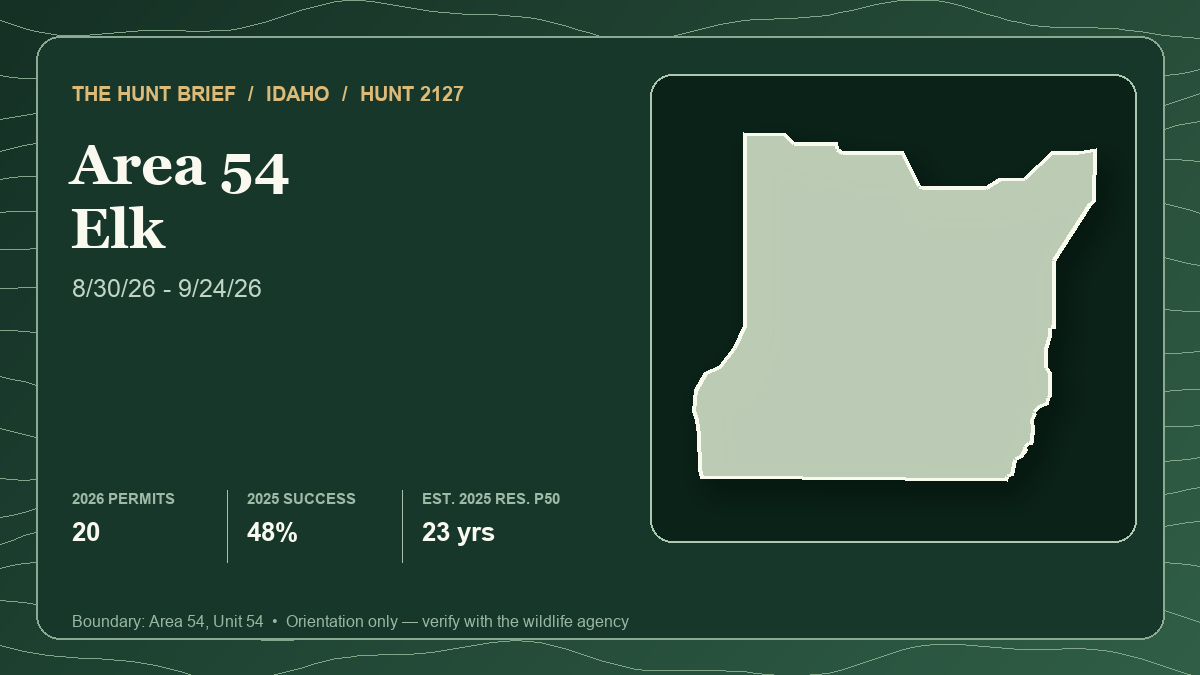
Idaho archery elk Hunt 2127 opened August 30 and runs through September 24, 2026. For a current tag holder, the useful story is a 26-day antlered-elk season across all of Unit 54. For a future applicant, it is the demand: Idaho Fish and Game reports 1,253 first-choice applicants for 20 tags in the 2026 drawing, up from 1,145 applicants for the same quota in 2025.
That increase does not make the hunt better or worse in the field. It shows that a scarce random-draw tag became more competitive while the latest completed harvest sample remained small. Start with the static Hunt Planner profile for Hunt 2127 and open Area 54 in the Hunt Planner 3D map. The card above is a boundary and data orientation aid, not a navigation or access map.
The quick verdict
Hunt 2127 best fits a bowhunter who already has the 2026 tag and can treat Unit 54 as several different landscapes rather than one mountain hunt. The official unit summary shows rangeland, forest and irrigated agriculture in meaningful proportions. The current elk plan describes the wider South Hills Zone as sagebrush steppe and canyon country mixed with aspen, dry conifer and higher-elevation subalpine fir.
The tradeoff is access. IDFG maps 40.72% of Unit 54 as private surface management and currently lists no Access Yes! property in the unit. A bull visible near agriculture is not automatically reachable, and a public parcel is not usable when the planned approach or recovery crosses posted, cultivated or irrigated private ground without permission.
What changed in the 2026 drawing
The current IDFG Hunt Planner row lists 728 resident first-choice applicants for 18 awards in 2026. The displayed resident success is 2% after rounding; the raw award-to-applicant ratio is about 2.47%. On the nonresident side, 525 first-choice applicants competed for two awards. IDFG displays 0% after rounding, while the raw ratio is about 0.38%.
Combined first-choice demand rose by 108 applicants, or 9.4%, from 2025 to 2026 while the quota stayed at 20. Resident demand increased by 14 applicants, or 2.0%. Nonresident demand increased by 94, or 21.8%, and accounts for most of the total change.
Those are historical drawing results, not personal odds for a future application. Idaho uses a random controlled-hunt drawing rather than a preference-point ladder. The card's “estimated 2025 resident P50” is a mathematical scenario based on the local record's rounded 3% resident result for 2025. It is not an IDFG forecast, a queue position or a promise that 23 applications will draw the hunt. Annual demand, eligibility, quota and group applications can change.
The 2026 rules also impose a one-year waiting period after a hunter draws a limited antlered-only elk controlled hunt. That affects the next first application period; the official rules describe separate exceptions for second drawings, leftovers, unlimited hunts and other programs. Read the current rule text before building a later application plan.
Read 48% harvest with the sample attached
The latest completed harvest row is 2025. IDFG reports 21 hunters, 10 antlered elk and 48% success for Hunt 2127. Those hunters reported 275 total days, or 13.1 days per hunter. The time-afield figure is the more useful planning warning: even successful-looking controlled hunts can demand most of the season rather than one opening weekend.
The preceding Area 54 archery rows show 44% success in 2024 and 53% in 2023, but both were published under Hunt 2121. They are neighboring context, not a clean three-year record for Hunt 2127. IDFG's elk plan also says the South Hills population is difficult to survey because elk are dispersed, nomadic and can move among Idaho, Nevada and Utah; managers rely heavily on harvest information to monitor the zone.
Do not translate 10 harvested elk into a population estimate or trophy forecast. A sample of 21 hunters can move sharply with only a few different outcomes, and weather, access, effort, shot opportunity and recovery all shape the result.
Unit 54 is a mixed-access elk problem
IDFG lists Hunt Area 54 as all of Unit 54, covering 873,344 acres. The unit page maps 34.59% as U.S. Forest Service management, 22.79% BLM, 1.85% State of Idaho, 0.04% U.S. military and 40.72% private. IDFG cautions that a government managing agency may not be the same as the owning agency. Those percentages describe a planning layer, not permission or guaranteed legal arrival.
The land-cover mix helps explain the field problem: 55.03% rangeland, 11.58% forest, 23.63% gravity-irrigated land and 2.86% sprinkler-irrigated land. The South Hills elk plan likewise identifies private-land and agricultural depredation as a central management challenge. Elk distribution can therefore create a hard boundary between seeing animals and having a lawful hunt plan.
Build multiple independent public-land systems before walking in. For each one, verify the parcel, the road or trail authority, any seasonal closure and a recovery route that remains on land where you may legally travel. IDFG lists no federally designated wilderness in Unit 54, but the absence of wilderness does not mean unrestricted motorized use.
A habitat-level September plan
Use the official habitat description to organize scouting without publishing sensitive locations:
- Pair open rangeland or meadow-like feed with nearby aspen, conifer or broken cover. A feeding opening without secure daytime cover is only half a system.
- Treat morning bugling as information, not a guarantee. Mark the broad habitat block, wind and likely cover transition before closing distance. September behavior changes through the season and pressure can quiet elk.
- Keep more than one approach for each area. Dry, open country exposes movement, while timbered folds can hide both the hunter and an unsafe wind shift.
- Separate a public-land plan from an agriculture-edge plan. Do not assume a visible animal, fence gap or mapped road grants access, and obtain explicit permission before entering private land for hunting or retrieval.
- Recheck fire restrictions and closures immediately before each trip. As of September 4, 2026, BLM's Idaho page still lists Stage 1 restrictions for the Twin Falls District; conditions and orders can change during the hunt.
The 2026 brochure lists Hunt 2127 as archery-only and requires archery permit validation. It also contains equipment, tagging, retrieval and mandatory-report rules. A current tag holder should review the full archery section rather than rely on a summary: legal minimums and prohibited equipment matter, and a hunter must submit the mandatory report within the applicable 10-day deadline.
The planning decision
For a 2026 tag holder, the strongest plan is time-rich and access-first. The 2025 average of 13.1 days afield argues for several hunt windows, while Unit 54's private-land share argues for written permission where needed and public-land alternatives that do not depend on one road or one herd crossing.
For a future applicant, Hunt 2127 is a deliberate long-shot choice. The 2026 drawing awarded only 20 tags from 1,253 first choices, and rising nonresident demand drove most of the year-over-year increase. Apply because the weapon, September calendar and mixed South Hills terrain fit your priorities—not because a rounded percentage or one harvest year creates a predictable wait.
Sources and verification
- IDFG Hunt Planner: Hunt 2127 current season, 2026 draw, 2025 harvest and boundary
- IDFG 2026 Big Game Seasons and Rules
- IDFG Unit 54: surface management, land cover, Access Yes! and wilderness summary
- IDFG Idaho Elk Management Plan 2024–2030: South Hills Zone
- IDFG controlled elk harvest statistics for 2025
- IDFG controlled-hunt drawing odds
- BLM Idaho fire restrictions and prevention orders
Official seasons, equipment rules, boundaries, ownership, road status, fire restrictions and private-land permission can change. The drawing figures are from 2026; harvest, time afield and the card's draw scenario are from 2025. This article uses official agency material only and presents no hunter report as evidence. It was prepared with AI-assisted research and drafting, then checked against the linked sources. Read Hunt Planner's methodology, editorial and AI policy and corrections process.