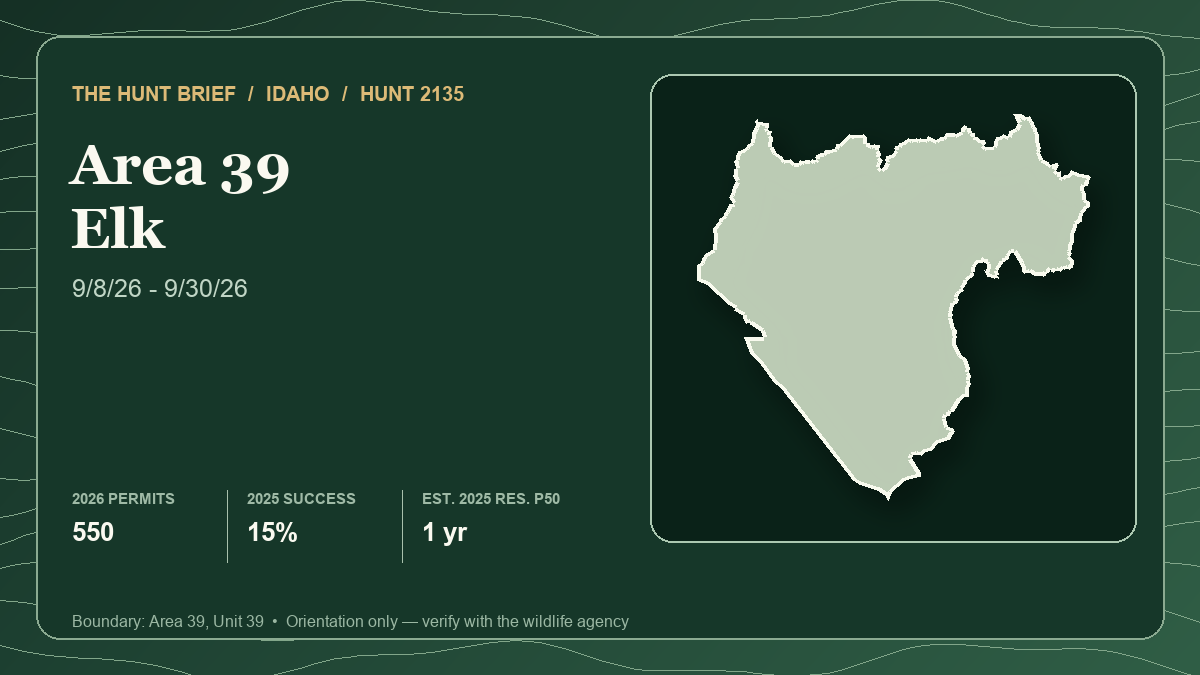
Idaho antlerless elk Hunt 2135 opened September 8 and runs through September 30, 2026. Its draw history looks unusually forgiving: Idaho Fish and Game awarded every first-choice applicant a permit in the first drawing. Its field history says something very different. The latest completed season produced 77 antlerless elk from 508 hunters, or 15% success in 2025.
That gap is the useful story. A tag can be accessible while the hunt remains difficult. Hunt 2135 gives 550 muzzleloader permit holders all of Unit 39, a 23-day season and a large public-land base, but it also asks them to find antlerless elk in a 1.56-million-acre unit while following Idaho's muzzleloader-only rules and adapting to overlapping hunters.
Start with the static Hunt Planner profile for Hunt 2135 and open Area 39 in the Hunt Planner 3D map. The card above is a boundary and data orientation aid, not an ownership or navigation map.
The quick verdict
Hunt 2135 best fits a hunter who values an attainable application path more than a high historical success rate, already owns legal Idaho muzzleloader equipment and can scout several habitat systems across Unit 39. It is not a shortcut to an easy elk hunt.
The latest three comparable harvest rows reinforce that point: 15% success in 2025, 17% in 2024 and 15% in 2023. The hunt number changed from 2129 in 2023–2024 to 2135 in 2025–2026, while the official history identifies Area 39 and a 550-permit quota in each of those years. Treat the earlier rows as area-level context, not an uninterrupted same-code series.
The 2026 first drawing was easy; the second was not automatic
In the 2026 first drawing, IDFG reports 286 first-choice applicants and 286 awards for Hunt 2135. The residency table breaks that into 266 residents and 20 nonresidents, with every first-choice applicant in both pools awarded a permit. Another 264 permits went to 442 second-choice applicants, filling the 550-tag quota.
That does not mean every later applicant received a tag. IDFG lists 89 permits in the 2026 second drawing, likely reflecting first-draw tags that were not claimed. Of 109 first-choice applications in that drawing, 89 were awarded, an agency-reported 82% overall result. Resident first choices went 87 for 107, or 81%; both nonresident first-choice applicants drew. The 46 second-choice applicants received no permits because the available inventory was exhausted by first choices.
Hunt 2135 does not appear on IDFG's current leftover elk list, last updated September 2, 2026. That is consistent with all 89 second-draw permits being awarded, but it is not proof that no tag could ever be returned. Use the live official inventory—not this article—when checking availability.
Idaho uses a random controlled-hunt drawing rather than preference points. The card's estimated 2025 resident P50 is a mathematical scenario built from a 100% rounded resident first-choice result. It is not a queue position or a promise about a future drawing. Choice order mattered in 2026: first choice was effectively certain in the first drawing, while second-choice demand exceeded the permits left after first-choice awards.
Attach effort to the 15% harvest result
The 2025 harvest report lists 508 hunters, 77 antlerless elk and 3,663 total days. That is 15% success and about 7.2 days afield per hunter. In 2024, 470 hunters harvested 78 elk for 17% success and averaged about 6.1 days. In 2023, 499 hunters harvested 74 for 15% success and averaged about 6.6 days.
Those results are stable enough to reject the idea that an accessible draw made the field outcome easy. They are not precise forecasts. Weather, elk movement, legal access, hunting pressure, time available and reporting all shape the annual result. Harvest success measures hunters who went afield; draw success measures applicants seeking a permit. Combining them into one “opportunity percentage” would hide the decisions each statistic actually informs.
Area 39 has public land—and an access puzzle
IDFG defines the hunt area as all of Unit 39. Its surface-management summary lists 58.5% U.S. Forest Service, 23.2% private, 9.1% BLM, 7.1% State of Idaho and 1.6% Bureau of Reclamation, with smaller categories making up the balance. The agency currently lists no Access Yes! property in the unit. It also identifies 89,011 acres of the Sawtooth Wilderness, 5.69% of the hunt area, where motorized vehicles are prohibited.
Management color is not legal access. Confirm ownership, road authority, seasonal closures and retrieval before committing to a drainage. A Forest Service parcel may require a designated-route approach; a visible elk on private ground still requires permission; a public parcel beyond a closed gate may demand a much longer pack than the map suggests.
The habitat mix is equally broad: IDFG maps Unit 39 as 60.89% forest and 36.71% rangeland. The 2024–2030 elk plan describes the Boise River Zone as roughly a 60:40 split between mixed conifer and sage-steppe grassland. It says summer elk are distributed throughout Unit 39 and most transitional and summer range used by migratory elk is public. That supports a public-land plan, but not a precise prediction for one September day.
A habitat-level September plan
Use the official habitat description to build options without broadcasting sensitive locations:
- Compare forest openings and rangeland feed with nearby secure cover. Antlerless groups need a complete feed-cover system, not simply green pixels on a satellite layer.
- Scout more than one elevation and access system. A 1.56-million-acre boundary makes a single trailhead or glassing basin a fragile plan.
- Treat elk seen during summer as a starting hypothesis. The elk plan describes seasonal movement, and hunting pressure can change daily use before winter migration begins.
- Mark every ownership transition and recovery line. Do not assume a road, fence opening or proximity to Boise creates permission.
- Recheck fire and closure pages immediately before travel. Stage 1 restrictions in the Boise Fire Restriction Area were lifted September 3, 2026, but officials warned that fire season continues and closures can remain separate from restrictions.
Overlapping seasons are a safety factor. IDFG specifically cautions archers and muzzleloader hunters that any-weapon elk hunts may be open in all or part of the same area. Confirm the exact seasons for the place and date, identify the target beyond doubt and do not use the controlled-hunt permit as an assumption about who else is afield.
Idaho muzzleloader rules are narrower than “modern inline”
Hunt 2135 is muzzleloader-only, not a short-range-weapons season. IDFG's current equipment page requires at least .50 caliber for elk, loose powder, an exposed ignition using a flint, percussion cap or musket cap, and open or peep sights. It prohibits scopes, electronics attached to or incorporated in the muzzleloader, pelletized powder, 209 primers and muzzleloading handguns. The hunter also needs muzzleloader permit validation.
Read the complete current rule before hunting or modifying equipment. IDFG's 2026 rules also require a mandatory report within 10 days after harvest; a hunter who does not hunt or harvest must report within 10 days after the season closes.
The planning decision
For a 2026 permit holder, the evidence argues for an effort-rich, access-first plan. The season is already open, the latest three success rates sit between 15% and 17%, and hunters averaged more than six days afield in each of those years. Prioritize several legal public-land systems, compliant equipment, fresh field sign and a realistic recovery over one preselected spot.
For a future applicant, Hunt 2135 is a useful reminder that draw ease and hunt ease are separate. Every 2026 first-choice applicant drew in the first drawing, yet only 15% of 2025 hunters harvested. Choose it because a September antlerless muzzleloader hunt in Unit 39 fits your objective and available time—not because 100% draw success sounds like 100% opportunity.
Sources and verification
- IDFG Hunt Planner: Hunt 2135 current season, 2026 draw, 2025 harvest and Area 39 boundary
- IDFG Unit 39: surface management, Access Yes!, wilderness and land cover
- IDFG 2026 Big Game Seasons and Rules
- IDFG muzzleloader-only equipment requirements
- IDFG Idaho Elk Management Plan 2024–2030: Boise River Zone
- IDFG controlled-hunt tag inventory
- IDFG mandatory hunter reporting
- BLM: Stage 1 fire restrictions lifted in southwestern Idaho on September 3, 2026
Official seasons, weapon rules, boundaries, ownership, access, closures, fire restrictions and tag inventory can change. The drawing figures are from 2026; harvest, effort and the card's draw scenario are from 2025. This article uses official agency material only and presents no hunter report as representative evidence. It was prepared with AI-assisted research and drafting, then checked against the linked sources. Read Hunt Planner's methodology, editorial and AI policy and corrections process.