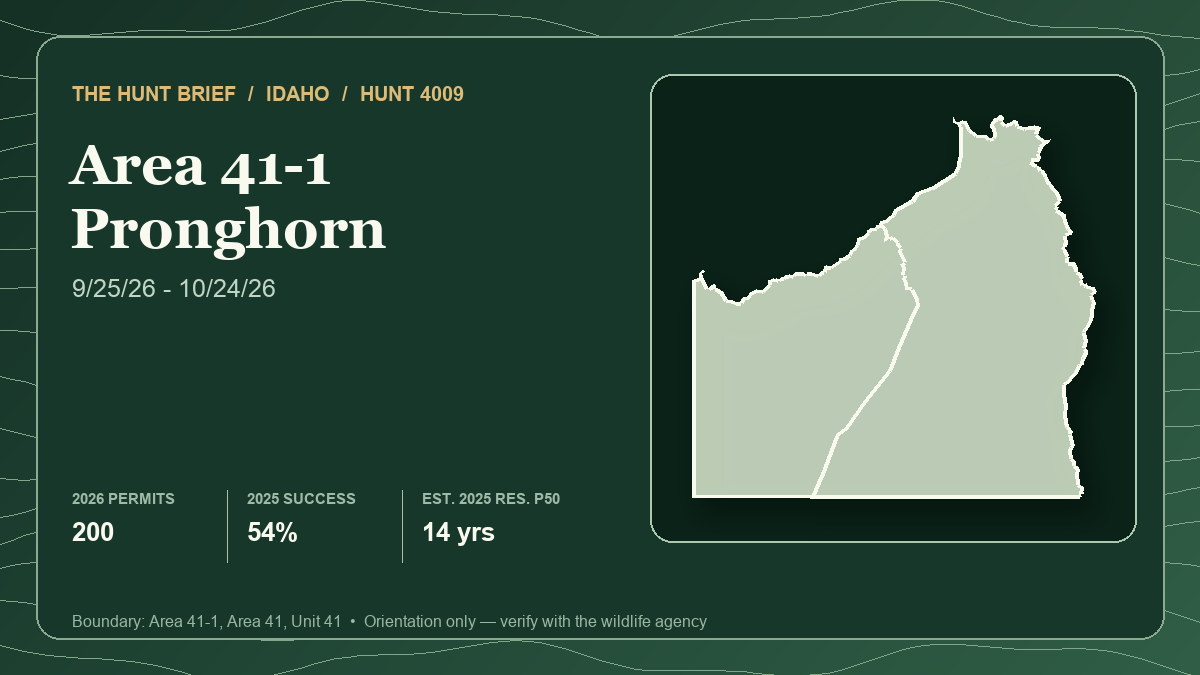
Idaho pronghorn Hunt 4009 enters the 2026 second drawing with 10 tags available. That is a timely second chance, not an easy tag. Idaho Fish and Game reports that all 200 permits were awarded from 4,260 first-choice applications in the first drawing. The newly listed inventory represents just 5% of the original quota, and the agency will not know the second-draw success rate until it knows how many hunters apply between August 5 and 15.
The hunt itself is an either-sex, any-weapon season running September 25 through October 24, 2026 in Area 41-1. Start with the static Hunt Planner profile for Hunt 4009 and open Hunt 4009 in the Hunt Planner 3D map. The card above shows the 2026 season and quota with the latest local structured harvest and draw snapshot. Its boundary is for orientation; verify the current agency boundary, ownership and travel rules before going afield.
The quick verdict
Hunt 4009 is worth a second-draw look for a hunter who wants a month-long rifle-capable pronghorn season, can build several public-land access options across a very large hunt area and accepts that 10 available tags say nothing about the number of competitors.
It is a poor choice for someone treating “leftover” as “low demand,” expecting a road hunt because Bureau of Land Management acreage is abundant, or counting on a specific water source or private crossing. The first drawing remained highly competitive, no Access Yes! property is currently listed, and almost one-quarter of the hunt area lies in designated wilderness where motorized vehicles are prohibited.
What the 2026 drawing actually says
IDFG's current Hunt Planner table lists 3,687 resident first-choice applicants for 180 resident awards in 2026, displayed as 5% success after rounding. The nonresident side lists 573 applicants for 20 awards, displayed as 3%. The unrounded award-to-applicant ratios are about 4.88% for residents and 3.49% for nonresidents. Idaho controlled hunts use a random draw rather than preference points, so an unsuccessful application does not create a better point tier next year.
Total first-choice demand declined from 4,478 applicants in 2025 to 4,260 in 2026, a decrease of 218 applicants, or 4.9%. The pools moved differently: resident demand fell 6.5%, from 3,944 to 3,687, while nonresident demand rose 7.3%, from 534 to 573. That is why the rounded resident result stayed at 5% while the rounded nonresident result moved from 4% to 3%.
Those percentages describe the first drawing, not the second. IDFG's August 4 inventory lists 10 Hunt 4009 tags for the August 5–15 application period. Because the first drawing awarded the full 200-tag quota, the later inventory is consistent with first-draw tags that were not claimed by the August 1 purchase deadline. The agency says second-draw results will be posted by August 25, with any tags still left after that scheduled for first-come, first-served sale at 10 a.m. MDT that day.
Recent history shows why the second chance should stay in perspective. Hunt 4009 had two tags in the 2025 second drawing, nine in 2024 and two in 2023. The 10 available in 2026 are more than in any of those three years, but the applicant count for this year's second drawing is not yet known. Do not turn a tag count into invented odds.
What the 2025 harvest report adds
The latest completed harvest row is 2025, one year behind the current season and drawing. IDFG reports 183 hunters, 98 harvested pronghorn and 54% success. Those hunters reported 741 total days, or about 4.0 days per hunter. The harvest included 93 horned and five hornless animals even though the permit was either sex.
The neighboring years were similar but not identical: 181 hunters harvested 105 pronghorn for 58% success in 2024, while 174 hunters harvested 87 for 50% in 2023. That three-year 50%–58% band is more useful than treating 54% as a forecast. Weather, animal distribution, legal access, time afield and hunter decisions all change individual outcomes.
Harvest success also applies only after someone obtains and hunts the tag. It cannot be combined with first-draw or second-draw probability into one honest “opportunity” percentage. The 2025 harvest sample and 2026 application pools answer different questions from different years.
Public acreage, wilderness and the usable map
IDFG defines Area 41-1 as the portion of Unit 41 west of State Highway 51 plus all of Unit 42, covering 1,681,883 acres. Its current surface-management summary lists 81.7% BLM, 7.6% private, 5.5% Indian Reservation/Bureau of Indian Affairs and 5.1% State of Idaho management.
That public-management headline is encouraging, but it is not a legal-access percentage. A public parcel can still require a long approach when the obvious road crosses private or tribal land. IDFG currently lists no Access Yes! property in the hunt area. Permission, route designation, seasonal closure and the vehicle being used all need separate confirmation.
The official hunt page also identifies four federally designated wilderness areas totaling about 397,000 acres, or 23.7% of Area 41-1: Owyhee River, Big Jacks Creek, Little Jacks Creek and Pole Creek. Motorized vehicles are prohibited there. For a pronghorn that moves into roadless canyon country, the practical question becomes whether the hunter can complete a lawful foot approach and retrieval within heat, daylight and water constraints—not whether the animal appears close on a flat map.
A practical September-to-October plan
Hunt 4009 spans 30 days, so one scouting picture should not be frozen into an opening-week assumption. Build the plan around broad habitat and access systems:
- Select several large observation zones with legal arrival routes instead of one named basin. Use terrain folds, low rises and broken rim country to keep the vehicle and skyline out of the approach.
- Verify land status on both sides of every fence and road. A fence can filter pronghorn movement, but it does not establish permission or a reliable crossing.
- Treat water as something to verify, not a guaranteed pattern. IDFG warns that blind construction must follow current rules and federal requirements; leaving blind material is littering, and digging pits on federal land is illegal.
- Carry a motorized plan and a nonmotorized plan. Large BLM acreage, wilderness boundaries and current route rules can produce very different retrieval distances.
- Recheck BLM Idaho advisories, closures and fire restrictions shortly before the hunt. A legal route during summer scouting may not remain open or safe in late September.
Keep every scouting note at the habitat-pattern level. Do not publish or trade exact water sources, camps, private approaches, glassing points or animal coordinates.
The decision for August 5–15
Apply if Hunt 4009 already fits your calendar, you can verify eligibility under the 2026 rules, and you are prepared to scout multiple access systems before September 25. The month-long any-weapon season, large public-management footprint and recent 50%–58% harvest band make it a coherent field opportunity even though the tag remains scarce.
Skip it if the only attraction is the phrase “10 tags available.” The current inventory is real; easy second-draw odds are not. A valid 2026 Idaho hunting license is required to apply, and IDFG accepts applications through its offices, license vendors, mobile app and GoOutdoorsIdaho. Verify the official list again before submitting because availability and administrative guidance can change.
Sources and verification
- IDFG Hunt Planner: Hunt 4009 current season, 2026 draw, 2025 harvest, boundary, surface management and wilderness
- IDFG unclaimed and leftover controlled hunts: 2026 second-draw inventory and dates
- IDFG controlled-hunt application information and application periods
- IDFG 2026 Big Game Seasons and Rules
- IDFG pronghorn hunting information: controlled-hunt and blind requirements
- BLM Idaho advisories and closures
- BLM Idaho fire restrictions
Official regulations, eligibility, tag inventory, drawing dates, boundaries, land status, road access, closures and fire restrictions can change. The first-draw figures are from 2026, while harvest evidence and the card's structured draw snapshot are from 2025; do not combine them into a single prediction. This article uses official agency material only, and no hunter report is presented as evidence. It was prepared with AI-assisted research and drafting, then checked against the linked sources. Read Hunt Planner's methodology, editorial and AI policy and corrections process.