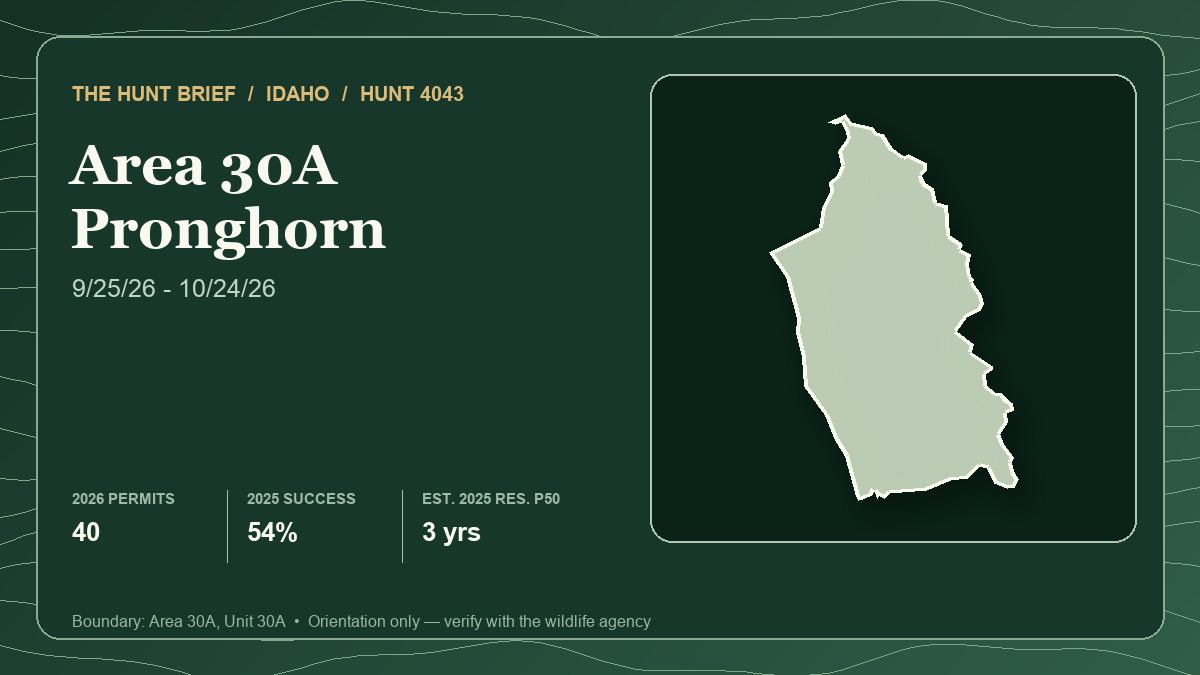
Idaho pronghorn Hunt 4043 opens today, September 25, with a combination that deserves more scrutiny than its public-land headline: 40 either-sex tags, a month-long muzzleloader-only season in Area 30A and rising application demand. Idaho Fish and Game's 2026 table shows 221 first-choice applicants for 40 awards, an 18% overall result. The latest completed harvest report shows 20 pronghorn taken by 37 hunters in 2025, or 54% success.
Those numbers describe different gates. The draw determines who gets to hunt; the harvest table describes the people who actually hunted. Neither makes the Idaho muzzleloader rules easier, proves a road is open or turns public management into guaranteed access.
Start with the static Hunt Planner profile for Hunt 4043 and open Area 30A in the Hunt Planner 3D map. The card above uses the actual local hunt boundary and structured record. It is an orientation graphic, not a navigation or ownership map.
The quick verdict
Hunt 4043 best fits a permit holder who has already proven an open-sight muzzleloader at realistic field distances and can build several legal approaches across open rangeland. It is a weaker fit for someone treating 84.7% federal management as 84.7% easy access or assuming a modern inline setup remains legal without modification.
For a future applicant, demand is the timely story. The quota stayed at 40 while first-choice applications rose 21.4% from 182 in 2025 to 221 in 2026. Idaho does not use preference points for controlled hunts, so another unsuccessful year does not move an applicant up a queue.
What Hunt 4043 authorizes in 2026
IDFG lists Hunt 4043 as an either-sex pronghorn controlled hunt in all of Unit 30A. The season runs September 25 through October 24, 2026, and the current regulation table authorizes 40 tags. It is specifically a muzzleloader-only hunt, with a muzzleloader permit required.
That equipment label is narrower than “short-range weapon.” For pronghorn, the rifle or musket must be at least .45 caliber and load only from the muzzle. During a muzzleloader-only season, IDFG requires open or peep sights, loose powder, a permitted projectile, an exposed ignition system, and flint, percussion caps or musket caps. Scopes, attached electronics, pelletized powder and 209 primers are prohibited under the standard rule. A muzzleloading handgun is not a substitute.
Check the current rule page and the tag in hand before hunting. Equipment that is lawful in an Idaho short-range-weapon season can still be unlawful in this muzzleloader-only season.
Demand rose while the quota held at 40
The official 2026 first drawing awarded all 40 tags from 221 first-choice applications, for IDFG's rounded 18% overall result. Second choices received no permits. The resident table shows 189 first-choice applicants and 36 awards, or 19%; the nonresident table shows 32 applicants and four awards, or 13%.
In 2025, the same 40-tag quota drew 182 first choices and produced a rounded 22% overall result. Resident demand increased from 148 to 189 applicants, up 27.7%, while resident awards remained 36. Nonresident demand moved from 34 to 32 while awards remained four, so its displayed result moved from 12% to 13% despite the smaller pool.
That split is why a single “odds” number needs a label. Residency matters, IDFG rounds the displayed percentages, and a future applicant pool can change again. The card's estimated three-year resident P50 uses the local dataset's rounded 24% result from 2025. It is a repeated-odds illustration, not a waiting period; the official 2026 resident result is now 19%.
What 54% harvest says—and does not say
IDFG's 2025 mandatory-reporting table lists 37 hunters, 20 harvested pronghorn and 165 total hunter-days. That is 54% success and about 4.5 days per hunter. The harvest included 17 horned and three hornless animals, which confirms that “either sex” did not translate into an even harvest split.
The preceding comparable rows need care because the hunt number changed. Area 30A's muzzleloader hunt posted 74% success in 2022 under Hunt 4045, then 54% in both 2021 and 2020 under earlier hunt numbers. Those rows describe the same broad area and method, but not a continuous Hunt 4043 time series. Season conditions, reporting cohorts and animal distribution differ.
The 2025 result also does not say where the successful hunters stood, how many used private access or whether a future hunter will see the same conditions. Read 54% as a completed cohort result with 4.5 days of reported effort—not a personal probability.
Unit 30A has public land, but access still needs proof
IDFG defines Hunt 4043 as all 176,155 acres of Unit 30A in the Lemhi River drainage. Its surface-management summary lists 52.34% Bureau of Land Management, 32.33% Forest Service, 11.78% private and 3.42% State of Idaho. It lists no current Access Yes! property and no federally designated wilderness in the unit.
The same page classifies 75.36% of the unit as rangeland, 17.81% as forest and 6.24% as irrigated-sprinkler land. Those figures support an open-country planning model, but they do not establish a legal approach. A BLM or Forest Service polygon can still depend on a closed route, seasonal restriction or private road. Irrigated ground can attract attention without granting permission.
IDFG's pronghorn plan emphasizes the importance of forbs and shrub-steppe habitat, movement connectivity and the effects of fences and transportation corridors. Use that biology at the pattern level: compare broad forage conditions, connected open terrain and several legal observation systems. Do not publish exact water, camps, fence crossings, glassing positions or animal coordinates.
A practical opening-week plan
- Prove the legal setup first. Confirm the .45-caliber minimum, ignition, sights, powder, projectile and permit validation against the current rule before leaving home.
- Use verified range, not optimism. Open sights and field wind reduce the value of a long view. Set a maximum distance from demonstrated groups, then choose terrain folds and cover that can shorten an approach.
- Audit the entire access chain. Confirm the parcel, road status, parking location and recovery route with the managing agency or landowner. Public management alone is not permission to cross private ground.
- Build alternatives. The 30-day season allows time to move among independently accessible habitat systems when pressure, livestock, weather or current sign changes.
- Keep recovery conservative. Mark the shot location and last sighting, allow appropriate time, and organize help before heat or fading light compounds the problem.
For a 2026 tag holder, the priority is a lawful, proven muzzleloader system attached to several complete access plans. For a future applicant, Hunt 4043 remains a coherent random-draw option, but the 2026 demand increase is more current than the card's 2025 estimate and should reset expectations.
Sources and verification
- IDFG Hunt Planner: Hunt 4043 current season, quota, 2026 drawing tables, 2025 harvest and boundary
- IDFG 2026 Big Game Seasons and Rules: Hunt 4043 and muzzleloader permit requirement
- IDFG muzzleloader-only equipment rules
- IDFG Unit 30A: boundary, surface management, land cover, Access Yes! and wilderness status
- IDFG Idaho Pronghorn Management Plan 2023–2028
- IDFG motorized-vehicle and hunting guidance: road and travel-map verification
Official seasons, equipment rules, boundaries, access, roads and closures can change. The draw figures are from 2026; the latest harvest and effort figures are from 2025, while the card's draw scenario also uses 2025 local data. The current 2026 regulation row for Hunt 4043 should control over older cached hunt pages if their restriction notes differ, but hunters must verify the official rules and contact IDFG when guidance conflicts. This article uses official agency material only and presents no hunter report as representative evidence. It was prepared with AI-assisted research and drafting, then checked against the linked sources. Read Hunt Planner's methodology, editorial and AI policy and corrections process.