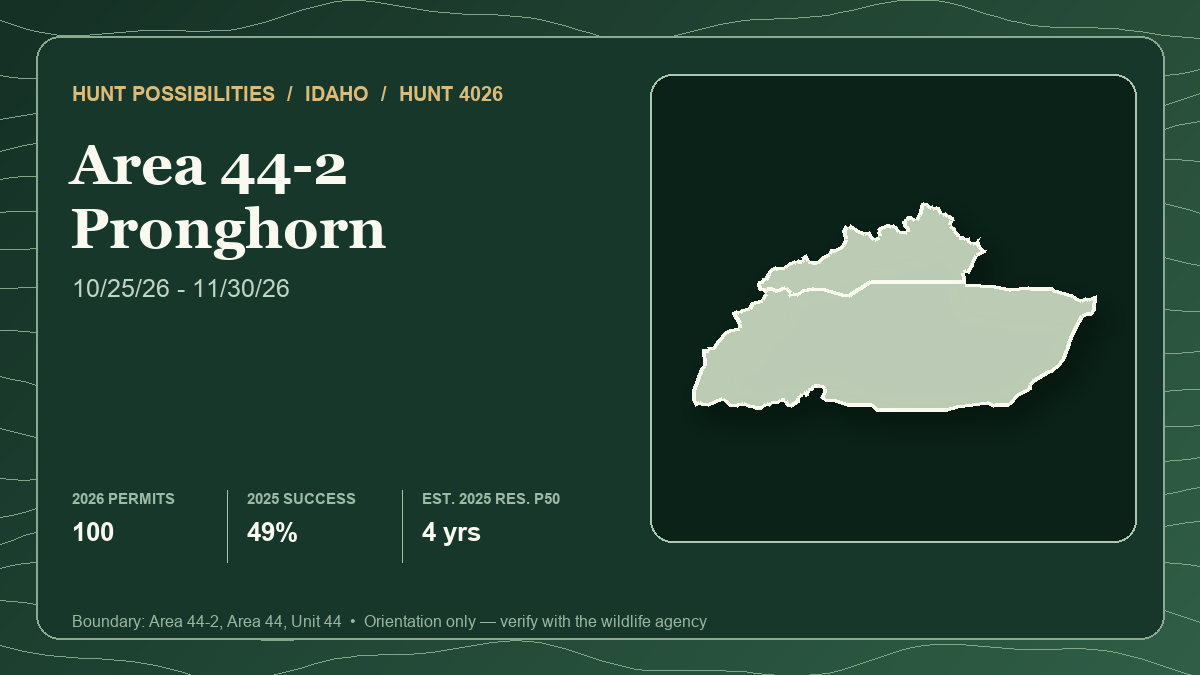
This guide is for a hunter who wants a late-fall doe-pronghorn opportunity and is willing to solve access, weather and draw risk before treating the hunt as a simple meat trip. That comparison matters now because the three 2026 seasons open within one week: Idaho 4026, Area 44-2 on October 25, Utah PD1035, Fillmore, Oak Creek South on October 31 and Wyoming 038-6, Hunt Area 38 on November 1.
All three allow an any-legal-weapon or any-weapon antlerless pronghorn harvest, but they are not interchangeable. Utah's permit is for a doe; Idaho and Wyoming allow a doe or fawn under their current definitions. Utah uses preference points, Idaho uses a random controlled draw, and Wyoming's reduced-price Type 6 license has separate resident and nonresident demand reports. The card above represents lead hunt Idaho 4026 only, not the full comparison.
Late fall changes the planning problem
Pronghorn are built for seeing danger in open country. In late fall, a hunter may also be watching animals adjust to shorter days, hunting pressure, drought, snow and the beginning of winter movements. Wyoming's species profile describes winter migration as a search for food, water and shelter. Utah's statewide plan cautions that movement and migration vary among populations. Those are reasons to plan for change, not permission to assume every group will move on a particular date.
The practical unit of scouting is a complete legal system: visible open habitat, dependable forage or water at a broad landscape scale, a lawful approach, a safe shot and a realistic recovery route. A group seen across a private parcel, beyond a closed road or inside a windblown road system is not yet a huntable opportunity.
Late season can improve visibility when animals aggregate or occupy more open winter habitat, but it can also expose the access problem. Wyoming's September 2026 forecast says severe drought in Hunt Areas 11, 34, 38 and 103 has made water scarce and may make pronghorn harder to locate. Idaho 4026 includes 1.7 million acres, yet its road rules and parcel pattern constrain how much of that headline area is practical. Utah publishes no hunt-level public-land percentage for PD1035 and explicitly does not guarantee access to public or private land.
Keep the draw systems separate
Utah's 2026 regular resident round for PD1035 listed 1,195 first-choice applicants for 22 permits. At eight preference points, 12 of 47 eligible applicants drew; all nine applicants at nine points and the single applicant at 10 points drew. The adopted allocation is 27 resident and three nonresident permits, while Utah separately reserves up to 20% of doe-pronghorn draw permits for qualifying youth. The regular-round table therefore does not describe every permit. In the nonresident regular round, three of 37 first-choice applicants drew: one of four at seven points and two of two at nine points.
Idaho does not use preference points for controlled hunts. Its 2026 first drawing shows 475 first-choice applicants and 100 awards for Hunt 4026, displayed as 21%. The residency table breaks that into 453 resident first choices for 94 awards and 22 nonresident first choices for six awards. A second drawing later awarded five returned or unclaimed tags from 208 resident and three nonresident first-choice applicants. That second event should not be blended into the initial draw percentage.
Wyoming's 2026 reduced-price doe/fawn reports list 18 resident licenses against 263 first choices and three nonresident licenses against 126 first choices for Area 38 Type 6. The final Chapter 5 season table lists a total quota of 25; public draw, landowner and other allocations are not one applicant pool. These rows show demand, not a single portable odds number.
Hunt 1: Utah PD1035 — a point-heavy 29-day window
- Current season and weapon: Doe pronghorn, any legal weapon, October 31-November 28, 2026. The adopted allocation is 27 resident and three nonresident permits.
- Tag path and latest draw demand: Utah antlerless preference-point draw. The 2026 regular resident round issued 22 first-choice permits from 1,195 first-choice applications; eight points produced 12 permits among 47 eligible applicants, and nine points cleared nine of nine. Youth-reserved permits are separate.
- Latest harvest result: In 2024, 20 hunters reported 16 pronghorn, 80% success and 2.3 average days afield. That small, two-season-old sample is useful history, not a forecast.
- Public-land/access pattern: The local record does not publish a hunt-level public-land percentage. Utah's 2026 guidebook warns that unit boundaries can include private property or excluded areas and that the division does not guarantee access. Written permission and lawful public ingress must be solved independently.
- Terrain character: Plan around open shrubland, agricultural interfaces and broad movement between forage, water and security. Utah's statewide plan identifies fences, roads, development, drought and cropland conflict as factors that can affect pronghorn distribution. Do not turn that statewide context into a unit-specific location claim.
- Principal tradeoff: PD1035 has the highest latest success headline and shortest average effort here, but also the most point-sensitive resident history and the oldest harvest year.
- Best for: A point-holder who can scout legal access before October 31 and wants a defined four-week window rather than a two-month winter hunt.
Open Utah PD1035 in the Hunt Planner 3D map.
Hunt 2: Idaho 4026 — the largest area, with road-rule friction
- Current season and weapon: Doe or fawn pronghorn, any weapon, October 25-November 30, 2026, with 100 tags. Idaho defines the legal animal for this season as one without a black cheek patch or with horns shorter than three inches.
- Tag path and latest draw demand: Idaho random controlled-hunt draw; no preference points. The 2026 first drawing awarded all 100 permits from 475 first-choice applications, displayed as 21% overall. Residency-specific awards were 94 of 453 resident first choices and six of 22 nonresident first choices.
- Latest harvest result: In 2025, 89 hunters reported 44 pronghorn, 49% success and 330 hunter-days, or about 3.7 days per hunter. The 2024 success rate was 72%, a reminder that one year should not become an expectation.
- Public-land/access pattern: Idaho's surface-management table estimates 49.8% BLM, 37.2% private, 7.7% Forest Service, 5% state and small remainder categories across roughly 1.71 million acres. No Access Yes property is currently listed. The Motorized Hunting Rule applies in Units 45 and 52 from August 30 through December 31, limiting applicable big-game hunters to established roadways legally open to full-size automobiles.
- Terrain character: The hunt includes all of Units 44, 45 and 52, so its scale is the defining terrain problem. Idaho's pronghorn plan identifies movement barriers, highways, fences, development and seasonal habitat connectivity as management concerns in this broader landscape. Narrow by current sign and legal route rather than trying to “cover” three units.
- Principal tradeoff: Idaho offers the cleanest point-free application and the largest mapped public-land share in this comparison, but a huge boundary, 37.2% private land and motorized restrictions can make the usable area much smaller.
- Best for: A hunter who wants an annual random chance and is comfortable building several legal glassing-and-recovery systems across a large area.
Open Idaho 4026 in the Hunt Planner 3D map.
Hunt 3: Wyoming 038-6 — longest season, least public land
- Current season and weapon: Type 6 doe or fawn pronghorn, any legal weapon, November 1-December 31, 2026. Chapter 5 lists a total quota of 25.
- Tag path and latest draw demand: Reduced-price limited-quota doe/fawn license. Wyoming's 2026 public reports list 18 resident licenses against 263 first choices and three nonresident licenses against 126 first choices. Keep those residency pools separate from the total season quota and from full-price preference-point antelope draws.
- Latest harvest result: The 2025 report lists 27 hunters, 14 pronghorn, 51.9% success and 11.1 average days. The long calendar can support more effort than Utah or Idaho, so average days are not directly comparable.
- Public-land/access pattern: The local Hunt Planner record estimates 11% public land. That is the smallest top-line public share here, and it does not prove legal ingress to any parcel. Wyoming's Hunt Planner also flags some antelope types for difficult public access; confirm the live type listing, parcels, roads and any permission program before applying.
- Terrain character: Area 38 is in the Laramie Region's grassland pronghorn country. The current 2026 forecast specifically identifies Area 38 as severely drought-affected and says scarce water may make pronghorn harder to locate. Water and green forage may also be on private land, so drought can intensify access constraints.
- Principal tradeoff: The two-month season provides the most calendar flexibility, but 11% estimated public land, heavy first-choice demand and current drought make it the clearest access-first decision.
- Best for: A hunter with verified private access or a proven public-land route who values time to wait for workable weather and animal distribution.
Open Wyoming 038-6 in the Hunt Planner 3D map.
A practical late-fall field plan
- Prove access before scouting animals. Mark public/private boundaries, legal roads, gates and the exact authority for crossing every parcel. Save agency and land-manager maps offline.
- Build three observation systems. Each should pair a legal parking point, a low-impact glassing approach, a safe shot zone and a recovery route. Separate them enough that one locked gate, muddy road or pressure wave cannot erase all three.
- Use weather as a decision input, not a migration guarantee. Snow and cold can change visibility and movement, but fresh tracks, repeated sightings and current road conditions outrank a calendar assumption.
- Treat water carefully. In drought country, water can concentrate wildlife and private-land dependence. Observe at landscape scale, avoid disrupting animals at limited water and do not publish exact sources or approaches.
- Identify the legal animal twice. Utah is a doe hunt; Idaho and Wyoming are doe-or-fawn hunts. Confirm each state's current definition, wait for an unobstructed view and account for animals behind the target.
- Protect meat quality. Keep hair and digestive material away from exposed meat, cool it promptly even on a cold day, and carry enough clean bags and ice capacity for an unexpectedly warm return trip.
- Budget for winter roads. A route open during dry scouting can become impassable or damaging after snow and thaw. Turning around early is part of the hunt plan.
Best fit by hunter priority
- For the strongest latest harvest headline: Utah PD1035 recorded 80% in 2024, but only 20 hunters were afield and the result is one year older than the Idaho and Wyoming records.
- For a point-free application: Idaho 4026. Its 2026 first-draw result was 100 awards among 475 first-choice applicants; future random draws can change.
- For the broadest public-land mix: Idaho's official table lists 49.8% BLM plus 7.7% Forest Service and 5% state land. Parcel continuity and motorized rules still control actual use.
- For the longest adjustment window: Wyoming 038-6 runs through December 31. Its 2025 hunters averaged 11.1 days, and current drought can make the extra time necessary rather than generous.
- For a hunter with substantial Utah points: PD1035 becomes more plausible around the latest clearing tiers, but 2026 history does not guarantee 2027 results.
- For solved private access: Wyoming's low public share may become manageable, while Idaho's 37.2% private component can also reward permission arranged before the draw.
There is no universal winner. Utah best fits the established point-holder who can scout a defined window. Idaho best fits the point-free applicant willing to solve a huge, road-regulated area. Wyoming best fits the hunter who already controls the access problem and wants calendar flexibility.
Verification checklist
- Confirm hunt number, legal animal, weapon, 2026 dates and quota in the current agency regulation and live hunt page.
- Keep Utah preference tiers and youth allocation, Idaho first and second drawings, and Wyoming resident/nonresident doe-fawn pools separate.
- Recheck license, application, tag, conservation-stamp and transaction costs immediately before applying or purchasing; this comparison does not normalize different fee stacks.
- Keep the evidence years visible: Utah harvest is 2024; Idaho and Wyoming harvest are 2025; seasons and cited demand are 2026.
- Verify parcel ownership, written permission, legal ingress, road status, seasonal closures and motorized rules after weather events.
- Confirm blaze-color, tagging, evidence-of-sex and harvest-reporting requirements for the state and season.
- Carry official maps, winter recovery gear and a conservative meat-care plan. Hunt Planner is an orientation tool, not field authority.
- Keep shared tactics at habitat-pattern level. Do not publish camps, private approaches, water sources, exact glassing positions or current animal locations.
The Hunt Planner methodology explains how state-specific records and evidence years are preserved, and the corrections page accepts source mismatches. This article was researched and drafted with AI assistance, then checked against the linked local records and official sources under the editorial and AI policy. No hunter anecdote is used as representative evidence.
Sources and verification
- Utah DWR 2026 Antlerless Application Guidebook
- Utah DWR Hunt Planner: PD1035 current boundary
- Utah 2026 interactive draw odds: PD1035 regular resident and nonresident rounds
- Utah DWR 2026 doe-pronghorn permit table
- Utah DWR 2024 antlerless harvest report
- Utah DWR Statewide Pronghorn Management Plan
- Idaho Fish and Game Hunt 4026: current season, demand, harvest, land and access
- Idaho Fish and Game 2026 Big Game Seasons and Rules
- Idaho Fish and Game Pronghorn Management Plan 2023-2028
- Idaho Fish and Game Motorized Hunting Rule
- Wyoming Game and Fish 2026 Chapter 5 Antelope Hunting Seasons
- Wyoming Hunt Planner: Area 38 current season, access and harvest context
- Wyoming 2026 resident doe/fawn antelope demand report
- Wyoming 2026 nonresident doe/fawn antelope demand report
- Wyoming Game and Fish 2026 hunt forecast: Area 38 drought context
- Wyoming harvest reports and surveys
- Wyoming Game and Fish American pronghorn species profile
Seasons, quotas, draw demand, costs, access, roads, drought and boundaries can change. Utah's harvest evidence is from 2024, while Idaho and Wyoming use 2025 harvest; all current seasons and cited draw-demand rows are 2026. The lead card retains the local profile's connected 2025 resident draw estimate even though the article cites Idaho's newer official 2026 demand. Verify every official source again before applying and immediately before entering the field.