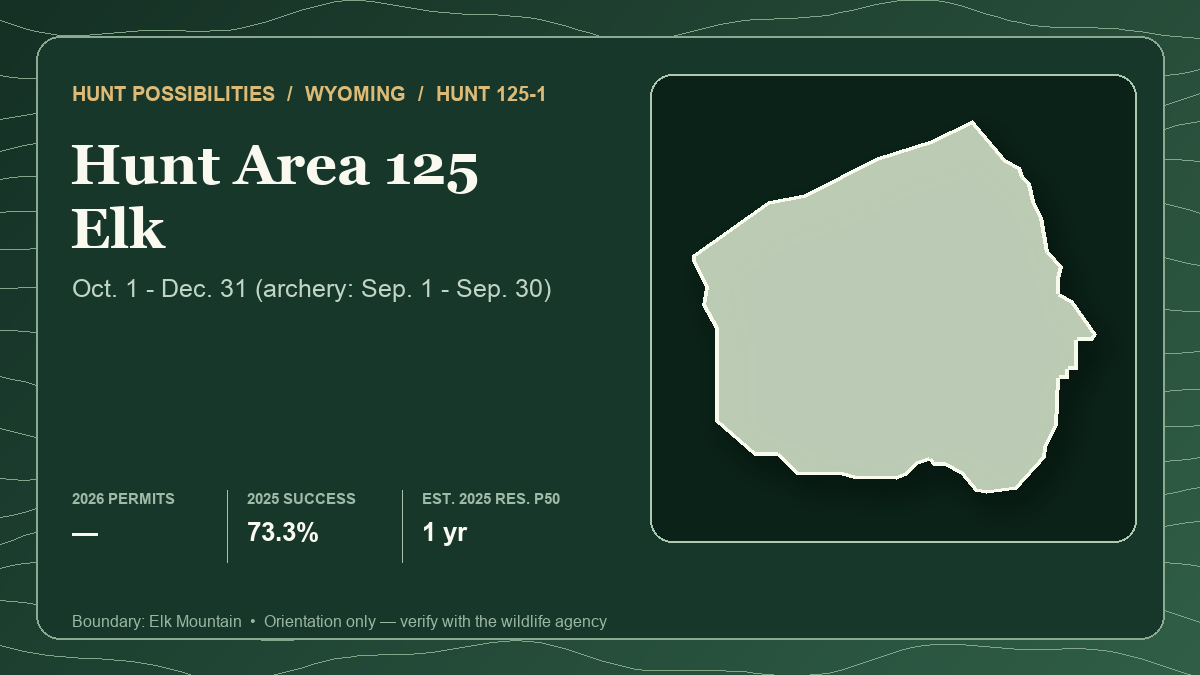
This guide is for a bull elk applicant who values a second plan more than a single ideal week. Utah EB3124 and Wyoming 007-1 and 125-1 all let a permit holder return after an early opportunity, but they do not buy the same thing. Utah changes legal weapon across five segments. Wyoming 007-1 changes from archery to any legal weapon and then restricts the final period to antlerless elk. Wyoming 125-1 keeps any elk open through December, then changes to antlerless elk for January.
The comparison matters on October 4, 2026. Utah EB3124, Wasatch Mountains and Wyoming 125-1, Hunt Area 125 are in any-legal-weapon periods now. Wyoming 007-1, Hunt Area 7 opens its regular season October 15. A long permit can absorb a missed week, weather change or pressure shift, but only if the later period still authorizes the animal, weapon and access system the hunter expects.
The card above represents lead hunt Wyoming 125-1 only, not the full comparison. Every hunt below exists in Hunt Planner's local structured datasets and links to its own profile and 3D boundary.
What a multi-window tag really buys
Calendar length is not the same as usable hunting time. A valuable long-window tag has three parts: a later legal opportunity, habitat that can still be reached under different weather, and enough access diversity to replace a failed plan. Lose any one of those and the printed season becomes mostly theoretical.
Elk distribution can change between September and December as breeding behavior fades, forage changes, snow accumulates and hunting pressure grows. Wyoming's Area 7 guidance is unusually candid: elk are often broadly available on public land during archery season, then can shift toward private land after rifle pressure. Utah's Wasatch plan likewise divides ownership by seasonal range rather than offering one unitwide access score. Those are reasons to rebuild the plan between periods, not reasons to assume a predictable migration date.
The three harvest reports are also season-wide. None separates archery success from rifle success or proves which period produced a bull. A hunter cannot read 73.3% for Wyoming 125-1 and conclude that the first October weekend carried those odds. The statistics describe all hunters and every legal period attached to the license.
Keep the draw systems and quotas separate
Utah uses bonus points and divides permits between maximum-point and regular rounds. Its completed 2026 portal lists 573 resident participants and 14 successful applicants for EB3124, split seven in each round. It lists 57 nonresident participants and two successful applicants, one in each round. A regular-round success at five, six, eight, nine, 19 or 20 points does not create a clearing threshold; the maximum-point and regular processes answer different questions.
There is a public-source discrepancy worth preserving. Utah's completed draw portal lists 14 resident plus two nonresident permits, while the current Utah Hunt Planner endpoint and Hunt Planner's local profile list 15 resident plus two nonresident permits. The sources do not explain the one-permit difference, so this guide does not reconcile it by assumption. Confirm the permit printed in the live state system before using any allocation count.
Wyoming separates residents from nonresidents and divides nonresident full-price licenses among regular and special preference and random pools. Its 2026 resident demand report lists a draw quota of 1,024 and 3,149 first-choice applicants for 007-1, compared with a quota of 208 and 103 first choices for 125-1. Those draw-pool quotas are not the same as the final Chapter 7 total season quotas of 1,500 and 250. Landowner allocations and nonresident pools prevent a clean one-line conversion from total season quota to personal odds.
Hunt 1: Utah EB3124 — five segments, three weapon rules
- Current season and weapon: Bull elk. Archery ran August 15–September 15, 2026. Any legal weapon was open September 16–20 and is open October 3–15, with another period November 7–15. Muzzleloader ran September 21–October 2. The state Hunt Planner says hunters may use the appropriate weapon during every limited-entry segment for this unit.
- Tag path and latest draw demand: Utah limited-entry bonus-point draw. The completed 2026 portal reports 14 resident successes among 573 participants and two nonresident successes among 57 participants. Maximum-point and regular-round results must remain separate.
- Latest harvest result: Utah's preliminary 2025 report lists 24 hunters, 16 bulls, 66.7% success and 14.9 average days. The local card/profile system still carries final 2024 data for this hunt, so use the newer preliminary row for planning and preserve its status.
- Public-land/access pattern: The official hunt page estimates 75–85% of summer and fall elk habitat as public, not 75–85% of the legal hunt boundary. Native American trust lands and elk CWMUs are excluded, private land requires written permission, and motor vehicles must follow the relevant Forest Service or DWR designated routes.
- Terrain character: The Wasatch unit plan describes high-elevation forest and aspen, mountain-brush transitions and much more private influence on portions of winter range. Public ownership differs sharply by subunit and season. A September access system may not follow elk or remain practical in November.
- Principal tradeoff: EB3124 offers the clearest weapon-by-weapon reset and a final November bull period, but the tag is scarce, equipment rules change with the calendar, and the latest hunters averaged nearly 15 days afield.
- Best for: A Utah point-holder who can maintain several legal access systems, verify equipment before every segment and commit enough time to treat each reopening as a new hunt.
Open Utah EB3124 in the Hunt Planner 3D map.
Hunt 2: Wyoming 007-1 — broad opportunity, pressure-sensitive access
- Current season and weapon: Type 1 full-price elk license. Special archery ran September 1–30. Any legal weapon is valid for any elk October 15–November 20; the license then remains valid for antlerless elk only November 21–December 31. The final 2026 regulation lists 1,500 total licenses.
- Tag path and latest draw demand: Wyoming limited-quota full-price draw. The 2026 resident report lists 1,024 resident draw licenses and 3,149 first-choice applicants. Nonresident applicants must read the separate regular/special and preference/random reports rather than borrowing the resident ratio.
- Latest harvest result: The 2025 Type 1 report lists 1,440 hunters, 756 elk, 52.5% success and 17.1 average days. It combines the license's periods and legal-animal changes; it is not a bull-only rifle rate.
- Public-land/access pattern: Wyoming reports approximately 28% public land, rates access “Fair” and flags the types for difficult public access. The agency says public-land elk availability can drop after the rifle opener, vehicle retrieval roads are limited, and many access-program properties primarily serve antlerless hunting.
- Terrain character: Agency guidance describes higher sagebrush flats, forest, limber pine/juniper and mountain-mahogany slopes during archery and early-to-mid rifle periods, followed by greater use of lower country that is largely private. Snow can also limit roads late in the long season.
- Principal tradeoff: Area 7 has the largest allocation and a long lawful reset, but high hunter numbers, concurrent seasons and movement toward private land can make later calendar days less usable for a public-land bull plan.
- Best for: A hunter who can scout multiple public blocks, tolerate company, pack farther from motorized retrieval routes and accept that the last six weeks are antlerless-only under Type 1.
Open Wyoming 007-1 in the Hunt Planner 3D map.
Hunt 3: Wyoming 125-1 — the longest bull window, with an access bill
- Current season and weapon: Type 1 full-price elk license. Special archery ran September 1–30. Any legal weapon is valid for any elk October 1–December 31, followed by an antlerless-only period January 1–31, 2027. The final regulation lists 250 total licenses.
- Tag path and latest draw demand: Wyoming limited-quota full-price draw. The 2026 resident report lists 208 resident draw licenses and 103 first-choice applicants. Nonresident regular and special pools still have separate preference and random reports; an easy resident first choice does not imply easy nonresident access.
- Latest harvest result: The 2025 Type 1 report lists 172 hunters, 126 elk, 73.3% success and 6.3 average days. That is the strongest success headline and shortest average effort here, but it does not separate bulls from antlerless elk or public from private harvest.
- Public-land/access pattern: Wyoming estimates 25% public land, rates access “Poor” and flags difficult public access. Its hunt page describes checkerboard ownership, large ranches and limited mature-bull permission. The listed HMA and walk-in program primarily improve antlerless access.
- Terrain character: The official profile spans approximately 6,700–11,100 feet, from sagebrush and grassland plains to aspen, lodgepole forest, mountain shrub, breaks and agricultural ground. That diversity creates several habitat hypotheses, but the agency says elk typically occur at low density on public land.
- Principal tradeoff: This is the longest any-elk period and the strongest latest harvest result, paired with the weakest access assessment. A four-month printed opportunity cannot substitute for a lawful route to elk.
- Best for: A resident who values maximum calendar flexibility or any applicant with private access solved before applying. It is a poor “figure it out after drawing” choice for a public-land-focused bull hunter.
Open Wyoming 125-1 in the Hunt Planner 3D map.
Build a reset before you need one
- Divide the permit into legal chapters. Write the date, weapon and legal animal for every period. Wyoming's late antlerless extensions do not preserve a bull opportunity; Utah's multiseason permit does not preserve one weapon rule.
- Build three complete access systems. Each needs lawful ingress, huntable habitat, a conservative shot and a realistic retrieval plan. A disconnected public parcel is not a backup.
- Re-scout after pressure changes. Use current tracks, repeated sightings, feeding sign and wind to test broad feed-cover-security patterns. Do not carry a September rut assumption into late October because the tag remains valid.
- Price private-land dependence honestly. Area 125's strongest harvest headline sits beside poor public access. Area 7's agency page warns that public availability can fall after the rifle opener. Permission must exist before the trip, not after elk cross a line.
- Plan retrieval before the shot. A later season may bring snow, shorter daylight and closed or damaged roads. Vehicle restrictions do not disappear because an elk is down.
- Keep locations private. Share habitat patterns and decision rules, not camps, wallows, private approaches, glassing points, current herd locations or coordinates.
Best fit by hunter priority
- For the most weapon flexibility: Utah EB3124. It is the only option here with archery, muzzleloader and any-legal-weapon segments under one permit.
- For the longest bull opportunity: Wyoming 125-1, where any elk remains legal through December 31. That advantage is conditional on access.
- For the broadest public-land headline: Wyoming 007-1 at 28%, narrowly above 125-1's 25%. Utah's 75–85% figure applies to summer and fall elk habitat rather than the whole boundary, so it is not an equivalent metric.
- For the strongest latest harvest headline: Wyoming 125-1 at 73.3% in 2025. Its poor access rating and mixed legal-animal periods make that an incomplete public-land bull forecast.
- For the easier current resident demand story: Wyoming 125-1 had fewer resident first choices than its 2026 resident draw quota. That says nothing about future demand or the nonresident pools.
- For a public-land hunter willing to work farther from roads: Wyoming 007-1 offers more public acreage than 125-1 and multiple access programs, but the agency warns that pressure can move elk toward private land.
There is no universal winner. EB3124 best fits the point-holder who wants several weapons and can reset repeatedly. Area 7 best fits the mobile hunter who understands pressure and has multiple public access systems. Area 125 best fits the hunter whose private access is already real and who wants the calendar to remain open.
Verification checklist
- Confirm hunt number, license type, legal animal, weapon and exact 2026–27 dates in the current state regulation and live hunt page.
- Keep Utah maximum-point and regular rounds separate; keep Wyoming resident, nonresident regular, nonresident special, preference and random pools separate.
- Recheck Utah's one-permit discrepancy between the completed draw portal and current Hunt Planner rather than choosing the more convenient number.
- Keep evidence years visible: all three current seasons and cited demand reports are 2026; harvest is preliminary 2025 for Utah and final 2025 for Wyoming.
- Verify parcels, written permission, legal public ingress, CWMU or tribal exclusions, access-program rules, designated routes, closures and current road condition.
- Confirm tagging, evidence-of-sex, conservation-stamp and harvest-reporting requirements. Recheck license and application costs directly before applying; this guide does not normalize unlike fee stacks.
- Carry official maps and a weather-safe retrieval plan. Hunt Planner's boundaries and 3D views are orientation tools, not field authority.
- Keep all tactics at the habitat-pattern level and never publish precise camps, routes or animal locations.
The Hunt Planner methodology explains how state-specific records and evidence years are preserved, and the corrections page accepts source mismatches. This article was researched and drafted with AI assistance, then checked against the linked local records and official sources under the editorial and AI policy. No hunter anecdote is used as representative evidence.
Sources and verification
- Utah DWR Hunt Planner: EB3124 current season, boundary and access notes
- Utah Draw System: 2026 Big Game, Limited-Entry Bull Elk, EB3124 results
- Utah 2026 Big Game Field Regulations
- Utah preliminary 2025 big-game harvest report: EB3124 row
- Utah 2023 Wasatch Mountains elk unit management plan
- Wyoming 2026 Chapter 7 final elk seasons and quotas
- Wyoming Hunt Planner: Area 7 Type 1 season, access, terrain and 2025 harvest
- Wyoming Hunt Planner: Area 125 Type 1 season, access, terrain and 2025 harvest
- Wyoming 2026 resident elk demand report
- Wyoming 2026 nonresident regular random elk report
- Wyoming 2026 nonresident special random elk report
- Wyoming draw reports: current preference, random, regular and special pools
- Wyoming 2025 harvest reports and surveys
Regulations, quotas, draw demand, access-program enrollment, ownership, roads and weather can change. Utah's 2025 harvest table is preliminary; Wyoming's is final. Hunt Planner's Utah profile and lead Wyoming card preserve the older connected fields described in their captions. Historical harvest and draw results do not predict an individual's outcome. Verify every official source again before applying and before hunting.