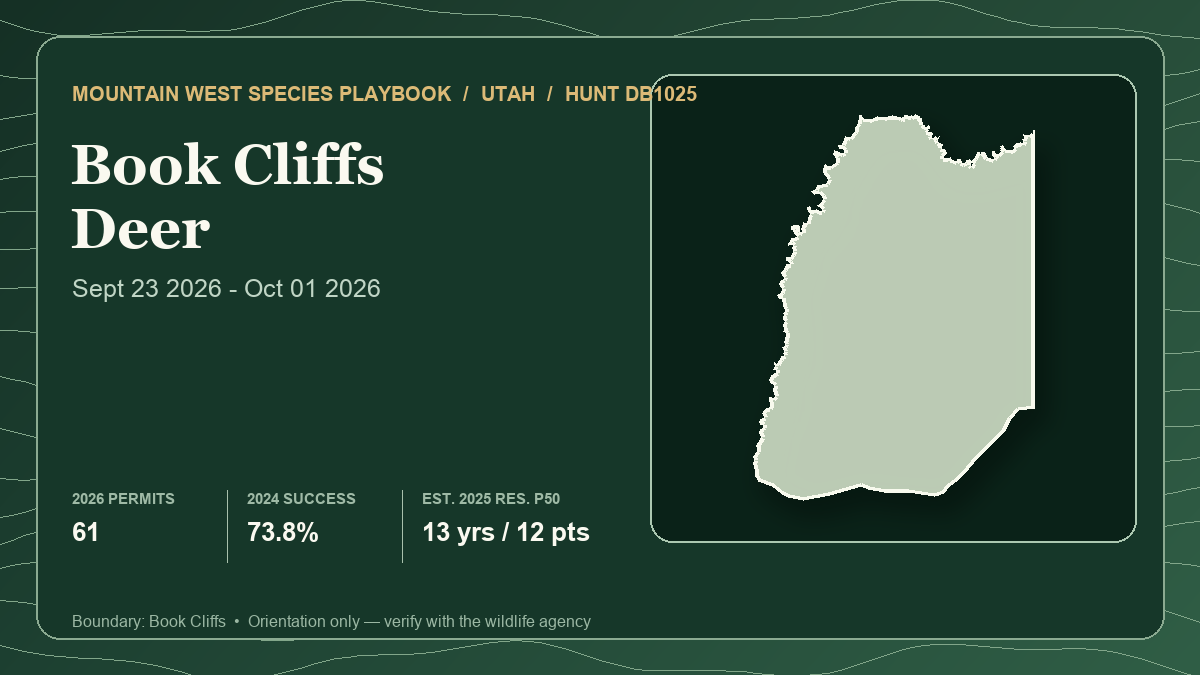
This guide is for a muzzleloader deer hunter who wants to plan around animal behavior instead of treating every special-weapon season as the same hunt. The practical question is: how should the field plan change when one season opens September 23, another October 1 and a third November 1?
That matters now because Utah DB1025 opens on September 23, 2026. Utah DB1025, Book Cliffs supplies the late-September lead hunt. Idaho 1089, Area 45 covers October 1–14, and Idaho 1093, Area 57 covers November 1–14. The card above represents DB1025 only, not all three hunts.
These are not trophy rankings or interchangeable draw choices. They are three examples of how season timing, terrain, access and state-specific muzzleloader rules change the work.
One weapon label, three biological windows
Utah's current statewide mule deer plan says bucks shed velvet in early September and the rut generally peaks in mid-November. It also describes most Utah mule deer as migratory, often faithful to the same seasonal ranges and corridors. Idaho's current movement summary likewise emphasizes seasonal migration and strong fidelity, while warning that some animals move locally and others travel more than 70 miles.
Those patterns do not make a calendar deterministic.
- Late September: DB1025 starts soon after velvet shedding. A hunter should begin with connected summer and transition habitat—quality feed, security cover and travel between them—rather than assume deer have entered a major migration.
- Early October: Hunt 1089 begins eight days later. Shorter daylight, weather and disturbance may change use, but “transition” is a hypothesis to verify with tracks, glassing and current conditions, not a guarantee that mature bucks have relocated.
- Early November: Hunt 1093 is closest to the broad mid-November rut peak. Weather or breeding movement can improve observability, but a late date cannot overcome inaccessible private ground, closed travel routes, a tiny quota or poor field execution.
Migration timing varies by individual, elevation and weather. Build several habitat systems across sensible terrain bands, then let fresh evidence decide which one receives time.
Equipment changes the practical range
Utah and Idaho both call these muzzleloader hunts, but the legal equipment is different.
Utah's 2026 field rules require a single barrel at least 18 inches long, one shot before reloading, loose black powder or a substitute, and a deer projectile of at least 130 grains—or 170 grains when using a sabot. Open sights, peep sights, red dots and fixed one-power scopes are allowed; magnification above one power and attached electronics are not.
Idaho's muzzleloader-only rules are narrower. For deer, the muzzleloader must be at least .45 caliber, use loose powder, have an exposed ignition and use an approved flint, percussion cap or musket cap. Pelletized powder, fire sticks, 209 primers, scopes and electronic sights are prohibited. A muzzleloader permit validation is required.
The useful consequence is not a universal distance number. Establish a personal maximum only after validating the exact legal setup from a cold barrel and realistic field positions. Confirm point of impact after travel and weather changes, carry a protected reload, and leave extra recovery margin. A visible buck beyond that tested standard is not an opportunity.
Read draw and harvest measures without false precision
Utah uses bonus points for limited-entry deer. Idaho's controlled-hunt draw does not use preference or bonus points. A Utah point row and an Idaho first-choice percentage therefore answer different questions.
The evidence years also differ. The lead card uses Hunt Planner's connected final 2024 Utah harvest row and 2025 draw history. A newer Utah preliminary 2025 report is available and is discussed below. Idaho's hunt pages currently provide 2025 mandatory harvest reports and 2026 application results.
Every sample is limited. Idaho 1093's 87% result is 13 deer from 15 hunters, while Idaho 1089's 28% is 10 deer from 36 hunters. Those figures are descriptive history, not a controlled comparison of weather, buck quality, effort or public-land success.
Hunt 1: Utah DB1025 — Book Cliffs in late September
- Current season and weapon: Limited-entry buck deer, muzzleloader, September 23–October 1, 2026. The approved allocation is 55 resident and six nonresident permits, 61 total.
- Tag path and cost components: Utah limited-entry deer bonus-point drawing. The 2026 guide lists a $10 resident or $21 nonresident application fee, plus a 2.2% transaction fee, and requires a valid hunting or combination license. The permit is $94 resident or $1,070 nonresident. A successful applicant enters a five-year limited-entry deer waiting period.
- Latest connected draw demand: The 2025 local record lists 473 eligible residents for 43 permits, an aggregate 1-in-11 ratio, and 115 eligible nonresidents for four permits, or 1-in-28.8. Aggregate ratios combine point levels and do not define a personal probability.
- Latest harvest result: Final 2024 data list 44 hunters, 32 deer, 73.8% success and 4.2 average days afield. Utah's newer preliminary 2025 table lists 50 hunters, 43 deer, 86% success and 3.8 days. Preliminary and final rows should remain separate.
- Public-land and access pattern: The 2020 Book Cliffs unit plan reports yearlong modeled deer range as 62% BLM, 14% state trust, 22% tribal and 2% private. Summer range has more tribal and trust-land representation. Those are management-plan habitat shares—not present-day legal-access percentages. DWR's June 2026 acquisition of a 50,608-acre Book Cliffs roadless parcel preserves additional public access, but hunters still need the current WMA boundary and travel rules.
- Terrain character: The management plan describes summer-range limitation plus fragmentation from roads, energy development and OHV use. Approach the unit as a patchwork of feed, cover and disturbance, not one undifferentiated block of “public land.”
- Principal tradeoff: The largest quota and strongest current local harvest history in this comparison come with the most expensive nonresident permit and a very scarce bonus-point drawing. Its early timing demands good preseason knowledge without promising migratory concentration.
- Best for: A Utah point holder who can scout several high-to-transition habitat systems, verify tribal and trust-land boundaries, and begin with a feed-and-security plan rather than a rut plan.
Open Utah DB1025 in the Hunt Planner 3D map.
Hunt 2: Idaho 1089 — Area 45 in early October
- Current season and weapon: Controlled Hunt 1089, antlered deer, muzzleloader, October 1–14, 2026, with 40 tags. Idaho's Motorized Hunting Rule applies.
- Tag path and cost components: Idaho controlled-hunt random drawing; no points. The 2026 guide lists no-price-lock resident adult components of $15.75 for a hunting license, $5 access fee, $6.25 application, $24.75 deer tag and $19.50 muzzleloader permit. Listed nonresident components are $185, $10, $18, $351.75 and $81.75 respectively; the guide warns listed nonresident prices may change. Vendor or transaction fees can also apply.
- Latest draw demand: Idaho's 2026 results list 167 resident first-choice applicants for 36 tags, or 22%, and 44 nonresident first choices for four tags, or 9%. That is one random draw, not a durable baseline.
- Latest harvest result: The 2025 mandatory report lists 36 hunters, 10 deer and 28% success across 270 hunter-days, or 7.5 average days. The report attributes no harvest to white-tailed deer and says 62% of measured antlered deer had four or more points per side; “points” there means antler classification, not draw points.
- Public-land and access pattern: The hunt page estimates 57.3% BLM, 35.8% private, 6.3% state and small federal remainder. It lists no Access Yes property. Those surface-management shares do not prove public ingress. From August 30 through December 31, the Motorized Hunting Rule restricts big-game hunters using motor vehicles to established roadways legally open to full-size automobiles.
- Terrain character: The public/private mix makes boundary discipline part of the hunt. Plan glassing and recovery from routes that remain legal under the motorized rule, then verify closures and ownership in the field.
- Principal tradeoff: This has more tags than Hunt 1093 and a less expensive resident path than DB1025, but recent success was lower and effort longer. The sizeable private share can invalidate a map-only route.
- Best for: A hunter comfortable with a low recent harvest rate, patient observation and a road-and-parcel plan built before opening day.
Open Idaho 1089 in the Hunt Planner 3D map.
Hunt 3: Idaho 1093 — Area 57 in early November
- Current season and weapon: Controlled Hunt 1093, antlered deer, muzzleloader, November 1–14, 2026, with 15 tags.
- Tag path and cost components: The same Idaho controlled-hunt random drawing and 2026 license, access-fee, application, deer-tag and muzzleloader-permit components described for Hunt 1089.
- Latest draw demand: Idaho's 2026 results list 87 resident first-choice applicants for 14 tags, or 16%, and 27 nonresident first choices for one tag, or 4%.
- Latest harvest result: The 2025 mandatory report lists 15 hunters, 13 deer and 87% success across 56 hunter-days, or 3.7 average days. No reported harvest was white-tailed deer. Thirteen deer are useful local history but far too few to make an 87% forecast.
- Public-land and access pattern: The hunt page estimates 30.4% Forest Service, 30.4% private, 23.7% BLM, 12.3% other federal land and small state and USDA shares. It lists no Access Yes property. Equal top-line public and private percentages say nothing about whether the public pieces connect to an open legal route.
- Terrain character: The mixed federal and private pattern rewards multiple access systems and disciplined recovery decisions. The later season adds potential weather and shorter-day constraints to every route.
- Principal tradeoff: The closest rut overlap and strongest recent harvest result in the comparison come with only 15 tags, the lowest current draw percentages and the smallest harvest sample.
- Best for: A hunter who values a later biological window, accepts low random-draw odds and can solve access, cold-weather reliability and short-day recovery before the hunt.
Open Idaho 1093 in the Hunt Planner 3D map.
A timing-first field framework
- Map three broad habitat systems. Connect feed, security cover and feasible travel in different elevation or exposure bands. One promising basin is not a resilient plan.
- Start from the season's behavioral hypothesis. For DB1025, test late-summer and transition use. For 1089, look for fresh evidence of shifting use without presuming migration. For 1093, include likely breeding and movement corridors without expecting the rut to manufacture deer.
- Glassing should answer a question. Use repeatable positions to learn when deer enter feed, which security cover they favor and how pressure changes movement. Move only when observation improves the next decision.
- Protect the first high-quality setup. Wind, skyline and unnecessary foot traffic can spend days of undisturbed behavior. Keep backup systems rather than forcing a dead basin.
- Validate the legal muzzleloader. Check the current state rule, ignition, projectile, sights and permit validation—not a forum summary—then reconfirm zero with the actual hunting load.
- Separate the shot from the recovery. Before committing, identify legal access, property transitions, daylight, weather exposure and the route a loaded hunter can safely reverse.
Best fit by hunter priority
- For more current tags: DB1025 has 61 permits, versus 40 for 1089 and 15 for 1093. It is still a difficult Utah bonus-point drawing.
- For lower resident cost components: Idaho is materially less expensive than Utah's nonresident DB1025 permit, but costs do not improve biological fit or access.
- For late timing: Hunt 1093 is closest to the broad mule deer rut peak. Its 2025 success came from only 15 hunters.
- For a longer recent effort signal: Hunt 1089's 2025 hunters averaged 7.5 days, twice Hunt 1093's 3.7. That does not prove it is twice as difficult.
- For stronger public-management shares: DB1025's 2020 yearlong habitat model and 1089's current hunt page both show substantial BLM representation. Neither grants access, and the underlying measures and years are different.
- For point-free annual chance: Idaho uses a random controlled draw. Utah bonus points reward persistence while retaining some random opportunity; neither structure makes these hunts easy to draw.
There is no single winner. DB1025 best fits the established Utah applicant who can scout an early window. Hunt 1089 best fits a hunter willing to trade recent success for a larger Idaho quota and an early-October experiment. Hunt 1093 best fits someone prioritizing late behavior and prepared for a tiny draw and harvest sample.
Verification checklist before applying or hunting
- Confirm hunt number, season, species and sex limitation, quota, residency pool and application deadline on the current agency listing.
- Match the muzzleloader, ignition, powder, projectile, sights and required validation to the state's current rules.
- Keep Utah bonus-point rows separate from Idaho random-draw percentages; keep preliminary harvest separate from final harvest.
- Carry the official hunt boundary with current parcel, tribal, WMA, road and Motor Vehicle Use Maps. Surface-management percentages do not authorize entry.
- Recheck fire restrictions, closures, road conditions, weather and land-manager notices immediately before travel.
- Confirm the personal cold-bore standard from field positions and establish a conservative recovery plan before pursuing an animal.
- Follow tagging, evidence-of-sex and mandatory reporting requirements, even when no animal is harvested.
- Use Hunt Planner for comparison and orientation; defer to current agency rules and field-ready official maps whenever they differ.
The Hunt Planner methodology explains how state-specific records and evidence years are preserved, and the corrections page accepts source mismatches. This guide was researched and drafted with AI assistance, then checked against the linked local records and official sources under the editorial and AI policy. No anecdotal hunter report is used as representative evidence.
Sources and verification
- Utah DWR Hunt Planner: DB1025 current boundary
- Utah DWR 2026 Big Game Application Guidebook: season, drawing and fee rules
- Utah DWR 2026 Big Game Field Regulations: muzzleloader, tagging and reporting rules
- Utah Wildlife Board's 2026 big-game permit approval
- Utah DWR big-game harvest reports: 2025 preliminary DB1025 results
- Utah DWR 2025 limited-entry drawing odds
- Utah statewide mule deer plan: seasonal habitat, migration and rut timing
- Utah 2020 Book Cliffs deer unit plan: habitat and ownership context
- Utah DWR 2026 Book Cliffs Roadless WMA acquisition
- Idaho Fish and Game 2026 Big Game Seasons and Rules
- Idaho Fish and Game muzzleloader-only equipment rules
- Idaho Fish and Game Hunt 1089: draw, harvest, land and motorized-rule data
- Idaho Fish and Game Area 45: current 2026 Hunt 1089 listing
- Idaho Fish and Game Hunt 1093: current season, draw, harvest and land data
- Idaho Fish and Game deer and elk movement and migration summary
- Idaho Fish and Game Motorized Hunting Rule
Official rules, costs, quotas, boundaries, land ownership, roads and closures can change. The lead card uses final 2024 Utah harvest and 2025 draw history; the text separately labels preliminary 2025 Utah harvest and 2025 Idaho mandatory reports. Utah and Idaho draw systems are not interchangeable, and small samples cannot rank hunt difficulty or predict an individual 2026 result. Verify every official source again before applying and before entering the field.