This guide is for the hunter who values a realistic October buck-deer tag path more than a famous unit name. The comparison matters in September 2026 because permit holders are making final access and carcass-care plans, while future applicants can now inspect complete 2026 draw demand instead of treating an easy historical draw as a promise.
The three local Hunt Planner records are Utah DB1631, Box Elder, Idaho Hunt 1007, Area 14 and Wyoming 036-1, Hunt Area 36. All three permit an October hunter to use a rifle, but they are not the same product. Utah offers five early-season days through its general-season preference drawing. Idaho offers 22 days through a random controlled draw. Wyoming offers a 17-day regular season through residency-specific limited-quota pools, plus a September special archery period.
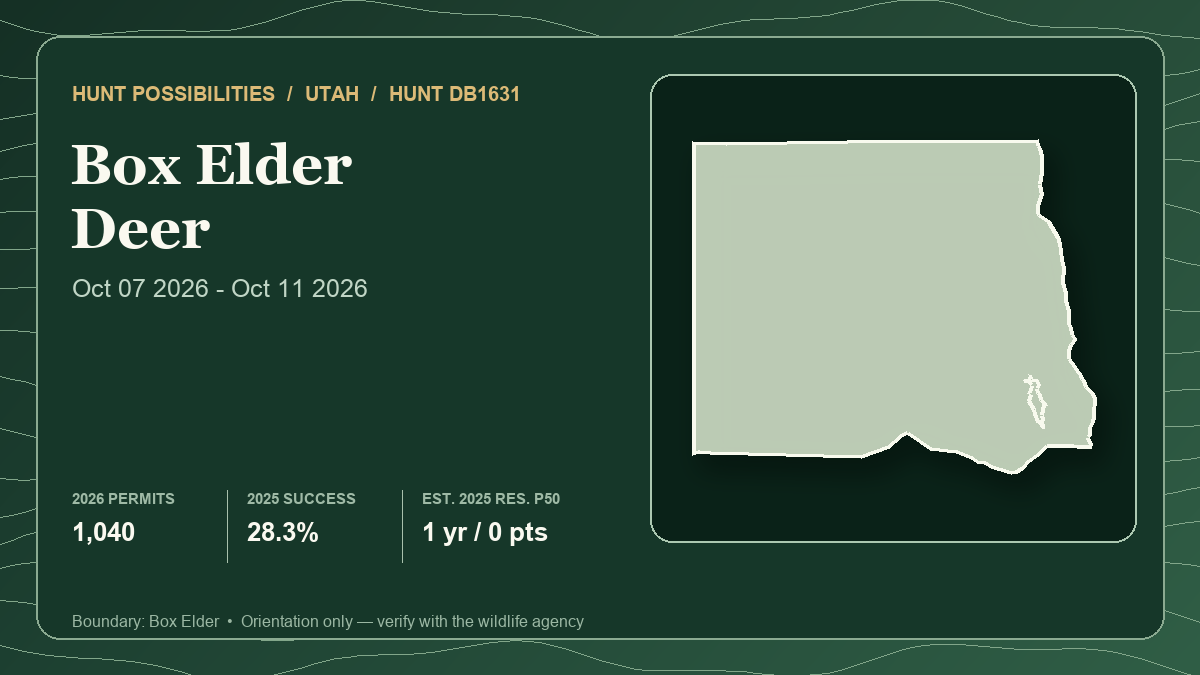
The card above represents lead hunt Utah DB1631 only, not the three-hunt comparison. It uses the connected 2026 season and quota, preliminary 2025 harvest report and 2025 draw history. The analysis below uses newer 2026 draw results for all three hunts. Keeping the card's connected data and the article's newer evidence labeled prevents an apparent same-year statistic from being manufactured.
What “easier to draw” should mean
Draw access is only the first gate. A useful October hunt also requires enough season days for the hunter's schedule, deer habitat that overlaps land the hunter can legally reach, and a recovery plan that works after the shot. These hunts show why those gates must stay separate.
Utah DB1631 was nearly certain for adults across its 2026 point rows, yet its latest reported success was 28.3%. Idaho 1007 awarded every resident first-choice applicant in 2026, but nonresident first-choice success was 31%, and the hunt carries mandatory chronic-wasting-disease testing and carcass-transport rules. Wyoming 036-1 had the strongest recent harvest percentage, but only about 42% of resident first-choice applicants could fit into its 2026 quota; the agency also marks it “Difficult Public Access” despite estimating 75% public land.
October itself does not erase those constraints. Before the main mule deer breeding period, daily movement is still strongly tied to current feed, bedding security, temperature, weather and disturbance. A cold front can change visibility and road conditions without producing a migration on demand. Hunting pressure can also move deer from an obvious public opening into thicker cover or a private corridor. Compare several habitat systems rather than anchoring the trip to a single preseason observation.
Hunt 1: Utah DB1631 — easiest recent draw, shortest season
- Current season and weapon: General-season buck deer, early any legal weapon, October 7-11, 2026. The current Hunt Planner record lists 1,040 permits.
- Tag path or draw system: Utah general-season buck deer preference drawing. Preference points matter when demand exceeds supply, but DB1631 has recently functioned as a low-barrier choice. Buying a remaining general-season permit forfeits general-season buck deer preference points, so the post-draw sale is not consequence-free.
- Latest draw demand: Utah's 2026 interactive report lists 622 adult resident participants across DB1631 point rows and 615 successful applicants; 478 of 482 adults at zero points succeeded. All 44 adult nonresident participants shown across the hunt's point rows succeeded. The agency also listed 34 DB1631 permits for the July 7 post-draw sale, but says that page is not updated after sales begin. Neither figure proves that a permit is available now.
- Latest harvest result: Utah's preliminary 2025 report lists 963 permits, 784 hunters afield, 222 bucks, 28.3% success and 3.1 average days. Preliminary data can change, and the 2026 quota is higher than the 2025 permit count in that report.
- Public-land and access pattern: The local hunt record does not publish a hunt-level public-land percentage. Utah's official 2017 Box Elder deer-unit plan reports that private land made up 73% of mapped yearlong range, 84% of summer range and 53% of winter range; BLM and Department of Defense land together accounted for 22%, 8% and 37%, respectively. Those are old habitat-range shares across the management unit, not current legal-access percentages for DB1631. Recheck current parcels, military restrictions, gates and roads.
- Terrain character: Box Elder is a broad basin-and-range problem. Shrub country, agricultural edges, broken foothills and higher cover can all matter, but the five-day date rewards a current elevation-and-cover hypothesis rather than a unitwide tour. Preseason scouting should produce several separated systems with legal ingress, not one animal pin.
- Principal tradeoff: The 2026 draw evidence is unusually forgiving, but the hunt supplies only five calendar days and the latest reported harvest percentage is the lowest of this comparison. A tag acquired easily can still demand the most disciplined schedule.
- Best for: A resident or nonresident applicant who wants a low-point Utah buck option, can scout before October 7 and is comfortable rejecting ground that depends on private or restricted access.
Open DB1631 in the Hunt Planner 3D map.
Hunt 2: Idaho 1007 — random opportunity with a CWD logistics test
- Current season and weapon: Antlered mule deer or white-tailed deer, any weapon, October 10-31, 2026, with 190 tags. Idaho defines “any weapon” here to include rifle, archery, muzzleloader, shotgun or handgun.
- Tag path or draw system: Idaho random controlled hunt; the state does not use preference points. The first-choice and second-choice tables describe drawing outcomes, not a point ladder.
- Latest draw demand: IDFG's current 2026 table shows 78 resident first-choice applicants and 78 permits awarded, or 100%. Nonresidents received 19 permits from 61 first-choice applicants, or 31%. Across residencies, 97 of 139 first-choice applicants drew, and another 57 permits were awarded to second-choice applicants in the first drawing. The resident result does not transfer to a nonresident application.
- Latest harvest result: IDFG reports 165 hunters, 78 deer and 47% success in 2025 over 1,012 hunter-days, about 6.1 days per hunter. Seventy-seven harvested deer were antlered, one was antlerless and 6% were white-tailed deer. The legal opportunity covers both species, but the harvest mix was overwhelmingly mule deer.
- Public-land and access pattern: IDFG's Unit 14 surface-management summary lists 59.27% U.S. Forest Service, 33.29% private, 3.9% State of Idaho and 2.99% BLM. Management is not necessarily ownership. The unit page lists no current Access Yes! property and 27,097 acres of Gospel Hump Wilderness, 7.38% of the unit, where motor vehicles are prohibited.
- Terrain character: IDFG describes Clearwater mule deer density as strongest along the Snake and Salmon river breaks. Unit 14's land-cover summary is 69.22% forest, 18.64% rangeland and 12.03% dryland agriculture. That combination favors deliberate observation of edges and breaks while treating timber, steepness, private blocks and road rules as separate filters.
- Principal tradeoff: Idaho provides the longest season and a fresh random chance every year. It also imposes the most explicit after-the-shot obligation: all harvested deer in Unit 14 require a CWD sample within 10 days, and whole carcasses may not leave the CWD Management Zone.
- Best for: A hunter who rejects point systems, wants more calendar flexibility and will build CWD sampling, carcass breakdown, legal disposal and transport compliance into the trip before hunting.
Open Idaho 1007 in the Hunt Planner 3D map.
Hunt 3: Wyoming 036-1 — stronger field result, harder tag math
- Current season and weapon: Antlered mule deer or any white-tailed deer, any legal weapon, October 15-31, 2026. Wyoming's final Chapter 6 sets 125 licenses and also provides a September 1-30 special archery period.
- Tag path or draw system: Wyoming residents use the limited-quota resident draw. Nonresidents choose regular or special pools, each with preference and random components. Those pools must remain separate because price, quota and demand differ.
- Latest draw demand: Wyoming's 2026 resident report lists 85 licenses against 201 first-choice applicants, about 42.3%. In the nonresident regular preference pool, all licenses were gone at eight points and 61 applicants below eight received none. The regular random pool listed three licenses against 61 first-choice applicants, about 4.9%. A special-random result of two licenses for two first-choice applicants came from a tiny pool and is not a stable forecast.
- Latest harvest result: The 2025 voluntary survey estimates 103 active Type 1 hunters, 71 deer, 68.9% success and 6.2 days per harvest. Because the Type 1 license allows antlered mule deer or any white-tailed deer and includes the special archery opportunity, this is neither a mule-deer-only nor rifle-only success rate.
- Public-land and access pattern: The current Hunt Planner estimates 75% public land and rates access to public land “Good,” while the season table simultaneously carries a “Difficult Public Access” marker. Its access note explains the tension: arid southern habitat limits deer distribution, and many stream and river corridors are private. Public acreage is therefore not a count of accessible deer.
- Terrain character: Area 36 is Badwater country: dry, broken uplands cut by greener drainage corridors. The useful comparison is not “public versus private” at unit scale, but whether current deer habitat, a legal approach and a recoverable route overlap on the same side of every boundary.
- Principal tradeoff: Wyoming supplies the strongest latest harvest percentage and more time than Utah, but the resident draw is materially less forgiving and the nonresident regular path still demanded substantial points or a small random chance in 2026.
- Best for: A Wyoming resident—or a nonresident with an appropriate point or random-pool strategy—who values a 17-day season and will solve the private-corridor problem before treating 75% public as an advantage.
Open Wyoming 036-1 in the Hunt Planner 3D map.
An October scouting system that transfers
Begin with three independent legal access systems for the hunt you actually hold. Each should have a verified arrival route, an observation plan, a terrain-hidden approach and a recovery line that stays on land where you may travel. A public parcel without legal ingress is not a backup, and a road visible in an app is not automatically open to a vehicle.
Next, compare cover and feed at the scale deer use. In open Box Elder country, that may mean glassing broad transitions before deciding where to walk. In Idaho's forest-and-break mosaic, it may mean giving small openings and timber edges enough observation time to reveal movement. In Wyoming's arid country, a green corridor may concentrate deer while remaining private. The habitat signal and the permission signal have to be evaluated separately.
Build pressure into the plan. The first easy pullout, open knob or public boundary crossing will attract other hunters. Move to another verified system when normal deer movement has shut down instead of repeatedly entering the same cover. No tactic justifies publishing camps, water sources, bedding pockets, observation positions, private approaches or coordinates.
Finally, make the recovery plan state-specific. Warm October afternoons can narrow the meat-care window. Idaho 1007 adds mandatory sampling and transport restrictions; Utah and Wyoming still require their own tagging, evidence-of-sex and carcass-import checks. Decide how the animal will be cooled, processed and legally moved before choosing a shot opportunity.
Best fit by hunter priority
- For the lowest recent point barrier: Utah DB1631 is the clearest fit. Nearly every 2026 adult resident participant succeeded, every adult nonresident row participant shown succeeded, and some permits remained for the July sale. The cost is a five-day season and a 28.3% preliminary 2025 success rate.
- For a random draw with no point debt: Idaho 1007 is the cleanest choice. Resident first-choice success was 100% in 2026, while the nonresident result was 31%; residency changes the answer.
- For the longest regular season: Idaho runs 22 days, Wyoming 17 and Utah five. Time helps only if legal access and current deer distribution survive opening pressure.
- For the strongest latest harvest headline: Wyoming's 68.9% survey estimate leads Idaho's 47% and Utah's 28.3%. Different species permissions, survey methods and season structures prevent calling that a quality ranking.
- For the clearest public-land percentage: Wyoming publishes 75%, then immediately qualifies it with difficult-access and private-corridor warnings. Idaho supplies a more detailed management breakdown. Utah's older unit plan is habitat-range context, not a current hunt-access score.
- For a hunter who cannot manage carcass restrictions: Do not choose Idaho 1007 until the CWD sampling and transport plan is workable. Compliance is part of hunt fit, not an administrative detail for later.
There is no universal winner. Utah minimizes the recent draw barrier, Idaho removes point accumulation and maximizes season length, and Wyoming pairs the strongest field result with the hardest resident and regular nonresident tag math. Choose the hunt whose weak side you can actually manage.
Verification checklist before applying or hunting
- Reopen the current agency listing and confirm hunt number, species, sex limitation, legal weapon, season dates, quota and boundary.
- Confirm the correct residency and draw pool. Keep Utah adult and youth rows separate, Idaho first and second drawings separate, and Wyoming resident, regular, special, preference and random results separate.
- Recheck current parcels, legal public ingress, gates, easements, road closures, fire restrictions and land-manager travel rules close to the hunt.
- For Idaho 1007, read the current CWD Management Zone rules, identify a sampling location and plan which carcass parts may legally leave the zone.
- Build at least three access systems; none should depend on an unverified private crossing, military access, closed road or motorized wilderness travel.
- Verify tagging, evidence-of-sex, hunter-orange, weapon, harvest-reporting and carcass-import rules for every state the animal will enter.
- Keep terrain advice at the habitat-pattern level. Do not publish camps, water, beds, private routes, glassing positions or animal coordinates.
- Use Hunt Planner for comparison and orientation, then carry the current agency boundary and a field-ready ownership source.
The Hunt Planner methodology explains how state-specific records and data years are preserved, and the corrections page accepts source mismatches. This article was researched and drafted with AI assistance, then checked against the linked local records and official sources under the editorial and AI policy. No hunter reports are used as evidence.
Sources and verification
- Utah DWR Hunt Planner: DB1631 current season, quota and boundary
- Utah Draw System: 2026 interactive drawing odds
- Utah DWR 2025 preliminary general-season buck deer harvest report
- Utah DWR 2026 remaining-permit notice: DB1631 post-draw inventory and point warning
- Utah DWR Box Elder deer-unit plan: habitat-range ownership context
- Utah DWR statewide mule deer plan, effective through 2030
- IDFG Hunt Planner: Hunt 1007 season, 2026 draw and 2025 harvest
- IDFG 2026 Big Game Seasons and Rules
- IDFG 2026 deer and elk outlook: Clearwater mule deer and Unit 14 planning
- IDFG 2026 CWD requirements for Unit 14
- IDFG Unit 14: surface management, wilderness and land cover
- Wyoming Game and Fish final 2026 Chapter 6 deer seasons
- Wyoming Game and Fish Hunt Planner: Area 36 season, access and 2025 harvest
- Wyoming Game and Fish 2026 draw reports and odds
- Wyoming 2026 resident deer demand report
- Wyoming 2026 nonresident regular preference report
- Wyoming 2026 nonresident regular random report
Official seasons, draw rules, permit availability, CWD requirements, closures, roads and access can change. Draw evidence is from 2026, while harvest is preliminary 2025 for Utah and final or survey-based 2025 for Idaho and Wyoming. Idaho harvest counts come from mandatory reports; Wyoming's result is a voluntary survey estimate; Utah's report is preliminary. Those figures should not be combined into a single score or used to predict an individual hunt.