This guide is for a hunter who wants an any-weapon cow elk hunt in October, but needs to decide which problem is manageable: a short preference-point season, a nominally easy random draw with severe private-access friction, or a longer public-land hunt with heavier demand. That comparison matters now because the three 2026 seasons begin between October 3 and October 10, while their application and access stories could hardly be more different.
The three local records are Utah EA1021, Nebo, Idaho 2054, Area 13 and Wyoming 032-4, Hunt Area 32. Each permits an antlerless elk with any legal weapon during at least part of October. None is a universal “best” meat hunt.
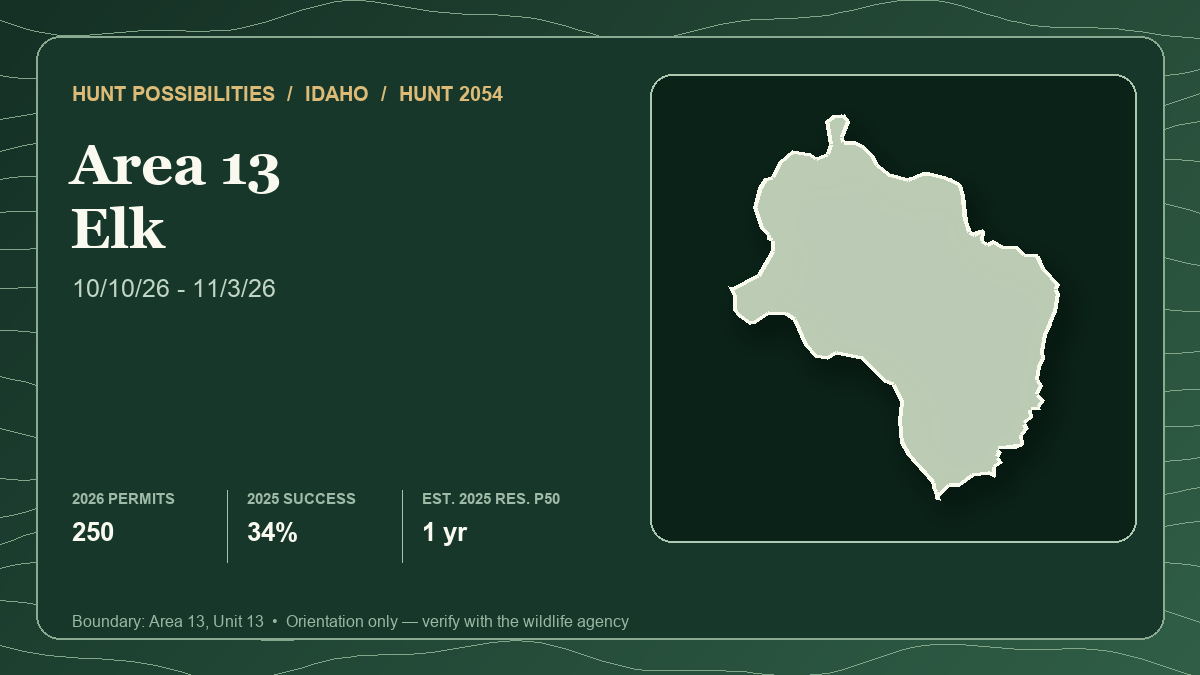
The card above represents lead hunt Idaho 2054 only, not the full comparison. Its boundary and statistics do not describe Utah or Wyoming.
What October asks of a cow-elk hunter
October can hold summer-like afternoons, first meaningful snow or both in the same hunt. Cow groups are shifting from the breeding season toward fall and winter patterns, but weather, pressure, feed and private-land refuge can change the pace. A useful plan follows habitat systems rather than a remembered pin.
Start with connected forage, security cover and low-cost travel between them. Utah's Nebo plan identifies aspen summer habitat, mountain-brush transition range and sagebrush parks affected by pinyon-juniper encroachment. Idaho's current elk plan emphasizes summer, winter and transition habitat plus movement between them. Those are planning categories, not promises that elk will occupy one elevation on opening morning.
Pressure is part of the habitat picture. Idaho 2054 overlaps concurrent deer and either-sex elk seasons, and Wyoming 032-4 shares Area 32 with an any-elk Type 1 season. The first road, obvious opening or easy public boundary can change animal use quickly. Build several legal observation-and-recovery systems before the season, then let fresh sign and repeated sightings decide where to spend time.
Keep the three draw systems separate
Utah uses preference points for general-season antlerless elk. The 2026 standard draw shows no EA1021 resident permits at zero points, 39 permits among 137 eligible applicants at one point, and all 117 eligible applicants receiving permits at two points. Utah also reserves 20% of antlerless elk permits for qualifying youth, so the standard point table is not the entire permit story. A two-point result is history from one draw, not a future guarantee.
Idaho uses a random controlled-hunt draw and no preference points. Its live 2026 row shows all 28 resident and all 19 nonresident first-choice applicants receiving 2054 permits in the first drawing. That does not make the hunt easy in the field: it says demand was below the 250-tag quota at that stage.
Wyoming Area 32 Type 4 is a full-price limited-quota license. Residents draw randomly; nonresident full-price licenses use separate regular and special preference and random pools. The 2026 resident demand report lists 84 licenses against 145 first-choice applicants. One 2026 nonresident random report lists three licenses against 41 first choices. Neither row is a single all-applicant probability, and neither should be combined with Utah's point tiers or Idaho's random result.
Hunt 1: Utah EA1021 — short season, point-sensitive draw
- Current season and weapon: Antlerless elk, any legal weapon, October 3–15, 2026. The connected current record lists 252 resident and 28 nonresident permits.
- Tag path and verified cost: Utah's antlerless preference-point drawing. A valid hunting or combination license is required. The 2026 general-season antlerless elk permit is $56 resident or $649 nonresident, excluding the license and transaction costs.
- Latest draw demand: The 2026 standard resident table lists 522 eligible applicants for 205 permits: none at zero points, 39 of 137 at one point and 117 of 117 at two points. The nonresident table lists 19 applicants for 18 permits, including 14 of 14 at zero points. Youth-reserved permits are reported separately.
- Latest harvest result: The 2024 report lists 185 hunters afield, 68 antlerless elk, 37.1% success and 4.1 average days. The result is two seasons older than the current dates.
- Public-land/access pattern: The local record does not publish a hunt-level public-land percentage. Utah's current guidebook says the division does not guarantee access to public or private land and that unit boundaries can contain private property or excluded areas. The legal boundary and complete ingress matter more than a unit name.
- Terrain character: The 2023 Nebo plan describes aspen summer habitat, mountain-brush transition range and sagebrush parks on winter range, with development, roads and recreation affecting distribution and security.
- Principal tradeoff: EA1021 offers the earliest opener and a clean 2026 point table, but only 13 days to adapt to weather, pressure or access failure.
- Best for: A hunter who can scout before October 3, has enough Utah preference history for the desired risk and can field multiple legal plans inside a compressed calendar.
Open Utah EA1021 in the Hunt Planner 3D map.
Hunt 2: Idaho 2054 — easy draw history, hardest access warning
- Current season and weapon: Antlerless elk, any weapon, October 10–November 3, 2026, with 250 tags across all of Unit 13. Idaho defines antlerless here as no antlers or antlers shorter than six inches.
- Tag path and verified cost: Idaho's random controlled drawing; no points. The 2026 application fee is $6.25 resident or $18 nonresident, excluding the required license, access fee, tag and transaction costs.
- Latest draw demand: In the 2026 first drawing, all 28 resident and 19 nonresident first-choice applicants received permits. The same official table shows second-choice demand and a later second drawing, which should not be blended into first-choice odds.
- Latest harvest result: In 2025, 215 hunters reported 74 elk, 34% success and 1,201 hunter-days, or about 5.6 days per hunter. The sample is large enough to be useful history, but not a forecast.
- Public-land/access pattern: IDFG labels the hunt “very limited access due to private property” and “very limited access because of few roads and private property.” Its surface-management table estimates 71.5% private, 10.2% BLM, 8.8% Forest Service, 8.4% state and 0.7% other land. It lists no current Access Yes property in the hunt area.
- Terrain character: IDFG classifies about 53.4% of the area as forest and 46.5% as rangeland. That near-even split can create useful feed-cover edges, but parcel geometry and roads determine which edges a hunter can lawfully reach.
- Principal tradeoff: The strongest current first-choice draw result in this comparison comes with the clearest agency access warning.
- Best for: A hunter who already has written private permission or a fully verified public-land route—and who will not interpret an unfilled quota as proof of easy elk access.
Open Idaho 2054 in the Hunt Planner 3D map.
Hunt 3: Wyoming 032-4 — longest window, strongest public-land headline
- Current season and weapon: Type 4 antlerless elk, any legal weapon, October 6–December 31, 2026. The adopted Chapter 7 regulation lists a quota of 100. A special archery season precedes it September 1–30.
- Tag path and verified cost: Wyoming full-price limited-quota drawing. The current fee list shows $57 plus a $5 application fee for a resident elk license; nonresident regular elk is $692 and special elk is $1,950, each with a $15 application fee. Verify conservation-stamp and other requirements separately.
- Latest draw demand: The 2026 resident demand report lists 84 resident licenses and 145 first-choice applicants. The 2026 nonresident random report lists three licenses and 41 first-choice applicants; nonresident preference and special results remain separate. The connected local profile still displays 2025 draw history, so the article uses the newer official 2026 reports for demand.
- Latest harvest result: The 2025 report lists 142 hunters, 79 elk, 55.6% success and 13 average days. That higher percentage came with more than twice Idaho 2054's average effort, and the long season can inflate effort relative to a short hunt.
- Public-land/access pattern: The Hunt Planner estimates 88% public land. That is the strongest top-line public share here, but ownership is not an open-road guarantee. Confirm parcels, land-manager travel rules, seasonal closures and legal retrieval before treating any block as usable.
- Terrain character: Area 32 is part of the South Rock Springs herd, which Wyoming manages under special guidelines while balancing elk objectives with the area's mule deer herd. Use broad feed, cover and transition patterns; do not convert a management description into an animal-location claim.
- Principal tradeoff: The broadest calendar and public-land estimate come with materially heavier 2026 first-choice demand and the most complex nonresident draw structure.
- Best for: A hunter who values time and public-land planning flexibility enough to accept draw complexity and a potentially long search.
Open Wyoming 032-4 in the Hunt Planner 3D map.
A practical October field plan
- Prove access before locating elk. Save the current hunt polygon, parcel layer and land-manager travel map offline. Trace a legal route from public road to hunting ground and back with a loaded pack.
- Build three habitat systems. One should fit warm, dry conditions; one should cover a weather-driven transition; one should remain workable after pressure closes the obvious option.
- Glass first, then spend boot leather. Use durable observation positions to test feed-cover connections and travel bands. Repeated sightings and fresh sign deserve more weight than a generic elevation rule.
- Expect other seasons. Verify every overlapping deer and elk season, wear legally required or prudent visibility clothing and avoid forcing a plan through concentrated pressure.
- Budget recovery backward. Set a latest-shot decision from daylight, temperature, distance, steepness and available help. A cow elk is not a solo “drag it to the road” animal.
- Cool meat, even in October. Open or quarter promptly as conditions require, keep meat clean and ventilated, and do not treat a cold forecast as automatic refrigeration.
Best fit by hunter priority
- For the earliest opening: Utah EA1021 starts October 3, but its October 15 close leaves the least recovery time after a scouting miss or access surprise.
- For the easiest current first-choice draw history: Idaho 2054. Every 2026 first-choice applicant drew, while access—not tag demand—is the controlling risk.
- For the strongest public-land headline: Wyoming 032-4 at an estimated 88%. Idaho's official table is 71.5% private, and Utah publishes no comparable hunt-level percentage.
- For the longest adjustment window: Wyoming 032-4 runs through December 31. That flexibility can also mean more days afield; the 2025 average was 13.
- For the simplest draw mechanics: Idaho's random draw has no point tiers. “Simple” does not mean predictable from year to year.
- For a hunter with verified private access: Idaho 2054 can turn its largest apparent weakness into an advantage, but permission must exist before the application—not after the tag arrives.
There is no universal winner. Utah rewards a prepared, point-aware hunter who can work quickly. Idaho rewards solved access. Wyoming rewards time, draw literacy and broad public-land planning. Choose the hunt whose hardest constraint is already inside your control.
Verification checklist
- Confirm hunt number, sex definition, weapon, 2026 dates and quota in the current agency regulations and live hunt page.
- Keep Utah preference tiers, Idaho random results and Wyoming resident/nonresident pools separate.
- Recheck license, application, tag, conservation-stamp and transaction costs immediately before applying or purchasing.
- Keep the data years visible: Utah harvest is 2024; Idaho and Wyoming harvest is 2025; the seasons and cited demand are 2026.
- Verify parcels, written permission, legal public ingress, road status, seasonal closures and retrieval authority.
- Check overlapping seasons, blaze-orange requirements, evidence-of-sex rules, tagging and mandatory harvest reporting.
- Carry official maps and weather/emergency equipment; Hunt Planner is an orientation tool, not field authority.
- Keep tactics at the habitat-pattern level. Do not publish camps, private approaches, beds, glassing points, current herd locations or coordinates.
The Hunt Planner methodology explains how state-specific records and evidence years are preserved, and the corrections page accepts source mismatches. This article was researched and drafted with AI assistance, then checked against the linked local records and official sources under the editorial and AI policy. No hunter report or anecdote is used as representative evidence.
Sources and verification
- Utah DWR 2026 Antlerless Application Guidebook
- Utah DWR Hunt Planner: EA1021 current season, quota and boundary
- Utah 2026 antlerless draw results
- Utah DWR 2024 antlerless harvest report
- Utah DWR 2023 Nebo Elk Unit Management Plan
- Idaho Hunt Planner: Hunt 2054 season, restriction, draw and harvest
- Idaho Hunt Planner: Area 13 land management and habitat cover
- Idaho 2026 Big Game Seasons and Rules
- Idaho Elk Management Plan 2024–2030
- Wyoming 2026 Chapter 7 Elk Hunting Seasons
- Wyoming Hunt Planner: Area 32 current season, access and harvest context
- Wyoming 2026 resident elk demand report
- Wyoming 2026 nonresident random elk demand report
- Wyoming harvest reports and surveys
- Wyoming current license fee list
- Wyoming elk management overview: South Rock Springs herd
Rules, fees, quotas, access, roads, weather and boundaries can change. Utah's latest connected harvest result is from 2024, Idaho and Wyoming use 2025 harvest, and all current seasons are 2026. The Idaho card retains the local profile's connected 2025 draw label even though the official hunt page now publishes 2026 results. Verify every source again before applying and before hunting.