This guide is for a rifle elk hunter trying to make good decisions after the loudest part of September has passed. The practical question is not whether every bull has suddenly stopped rutting. It is: how should a hunter rebuild the search when vocal behavior becomes less dependable and October pressure, feed, cover and legal access begin to matter more?
The comparison matters now because Idaho Hunt 2007, Area 30-1 opens October 1, 2026; Utah EB3187, Mt Dutton opens October 3; and Wyoming 001-1, Hunt Area 1 opens October 15. They are all limited-entry any-weapon hunts, but their season length, draw system, terrain and access problem are materially different.
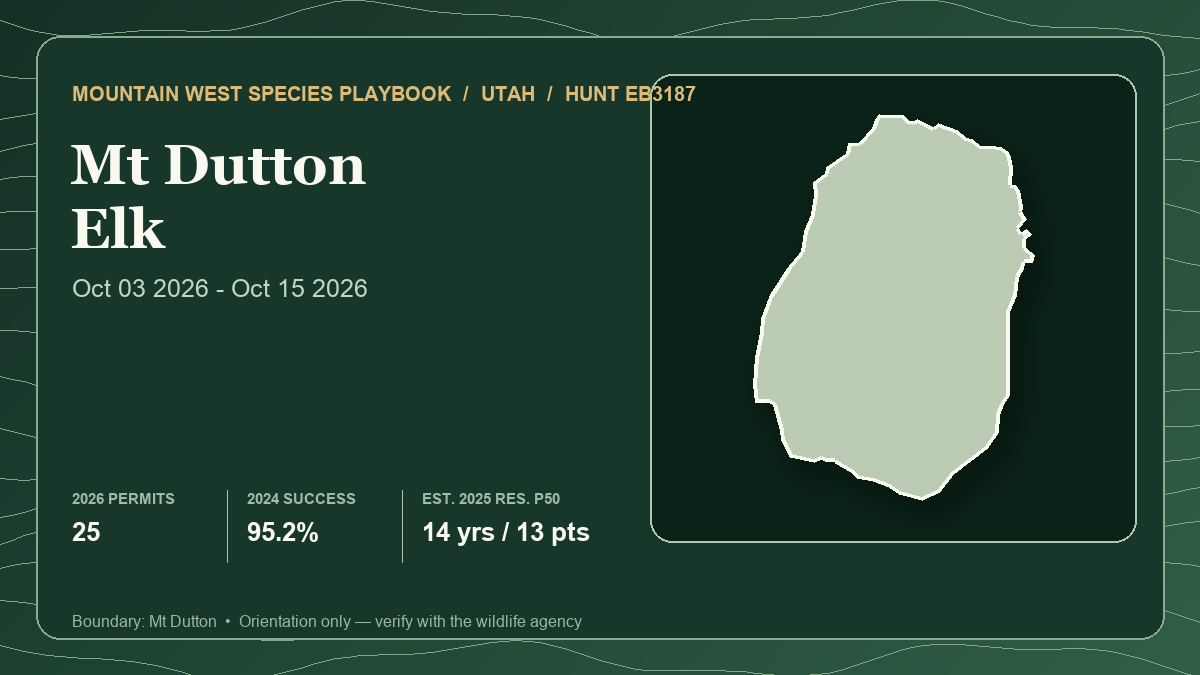
The card above represents lead hunt EB3187 only, not all three hunts. None of these hunts is a universal “best unit,” and their percentages cannot be combined into a fair ranking.
“Post-rut” is a planning label, not a switch
Calendar labels can make elk behavior sound more orderly than it is. In October, some bulls may still be with cows or respond vocally; others may separate, move toward dependable feed, or use cover that reduces daylight visibility. Weather, elevation, disturbance and local herd timing can all change the picture. Treat a bugle as information, not the entire search method.
A durable post-rut plan connects three broad habitat functions:
- Recoverable feed. Utah's Greater Plateau plan emphasizes forage across summer and winter range, aspen restoration, open understory and drought-resilient vegetation. Idaho describes the Beaverhead Zone as sagebrush-steppe at lower elevations with conifer forest on higher north slopes. Those are starting patterns, not promises that elk will occupy a named meadow or slope.
- Security from disturbance. Utah's plan specifically supports vehicle-access management to maintain refuge areas. Idaho Hunt 2007 is under the Motorized Hunting Rule. Wyoming says fall pressure and human activity in the Black Hills can quickly displace elk toward private land. A road can improve retrieval while simultaneously making nearby habitat less secure.
- A lawful, reversible approach. Public-land percentages do not prove public ingress, an open road, a safe shot or a legal recovery route. Build several complete systems from legal entry to pack-out before opening day.
Use fresh tracks, droppings, feeding sign and actual sightings to test the model. Do not interpret one quiet morning as proof the elk migrated, and do not publish precise camps, bedding pockets, glassing positions, private approaches or animal coordinates.
Keep the evidence systems separate
Utah allocates limited-entry bull elk through a bonus-point system with both bonus and regular permits. Idaho uses a random controlled-hunt drawing without preference points. Wyoming separates resident demand from nonresident regular and special pools, then divides nonresident licenses between preference and random drawings.
Their harvest measures also come from different years. The local Utah profile and lead card use final 2024 harvest. Idaho and Wyoming publish 2025 harvest results. Current season structures are 2026. A 2024 Utah success rate, a 2025 Idaho mandatory report and a 2025 Wyoming survey are historical descriptions—not a common-year experiment.
Current license and application costs are intentionally omitted. The three states bundle required licenses, applications, points and residency treatment differently; a partial dollar comparison would be less useful than directing applicants to each current official fee schedule.
Hunt 1: Utah EB3187 — Mt Dutton, October 3–15
- Current season and weapon: Limited-entry mid-season bull elk, any legal weapon, October 3–15, 2026. The approved table lists 22 resident and three nonresident permits, 25 total—one more than 2025 because the nonresident allocation increased from two to three.
- Tag path and latest connected draw evidence: Utah limited-entry bull elk bonus-point drawing. The 2025 local record lists 287 eligible resident applicants for 21 permits, an aggregate 1-in-13.7 ratio, and 108 eligible nonresidents for two permits, or 1-in-54. The lowest resident point level receiving a regular permit was two; that does not make two points a threshold. Bonus and regular outcomes were spread across point levels.
- Latest harvest result: Final 2024 data list 22 hunters, 21 bulls, 95.2% success and 5.9 mean days hunted. Twenty-one animals are a small sample, and the percentage does not isolate public-land success or forecast 2026 conditions.
- Public-land and access pattern: Utah's 2023 Greater Plateau plan reports approximate elk-habitat ownership across four management units, not EB3187 alone. Yearlong habitat was 85% Forest Service, 9% BLM, 5% SITLA and 2% private; winter habitat shifted to 43% Forest Service, 36% BLM, 11% SITLA, 6% private and 4% National Park Service. These rounded, overlapping regional habitat shares are context—not a legal-access percentage for Mt Dutton.
- Terrain character: The plan identifies high-elevation conifer and aspen systems, pinyon-juniper encroachment on winter range, migratory corridors and extensive habitat treatments. In early October, compare current feed-and-cover transitions across elevation bands rather than assuming every bull has begun a winter movement.
- Principal tradeoff: The strongest recent harvest headline in the comparison comes with the most point-dependent tag path and only 13 hunt days. A high success rate does not remove the need for verified roads, parcel status and a pack-out plan.
- Best for: An established Utah applicant who can scout multiple feed-security systems before the short season and resist treating the 95.2% result as a guarantee.
Open EB3187 in the Hunt Planner 3D map.
Hunt 2: Idaho 2007 — Area 30-1, October 1–14
- Current season and weapon: Controlled Hunt 2007, antlered elk, any weapon, October 1–14, 2026, with 30 tags. The area includes all of Units 30, 30A, 58, 59 and 59A—about 1.3 million acres—and the Motorized Hunting Rule applies.
- Tag path and latest draw demand: Idaho random controlled-hunt draw; no preference points. The live 2026 table lists 839 first-choice applicants for 30 awards, displayed as 4%, plus 243 second-choice applicants and no second-choice awards. The older residency split connected to the local profile is 2025: 645 resident first choices for 27 permits and 138 nonresident first choices for three permits.
- Latest harvest result: The 2025 mandatory report lists 29 hunters, 27 antlered elk and 93% success over 156 hunter-days, or about 5.4 days per hunter. Seventy percent of measured bulls were reported in the six-or-more-points class. That antler measure is not a drawing-point statistic.
- Public-land and access pattern: Idaho's current area page estimates 43.48% BLM, 37.03% Forest Service, 14.79% private, 2.28% Department of Energy and 2.2% state land. Surface management does not establish public ingress. From August 30 through December 31, big-game hunters subject to the Motorized Hunting Rule may use motor vehicles only on established roadways legally open to full-size automobiles.
- Terrain character: Idaho's 2024–2030 elk plan describes the Beaverhead Zone as mostly public, variable mountain terrain with lower sagebrush-steppe, higher north-slope conifer and private agriculture at low elevation. It also says seasonal distributions across the Idaho-Montana line have become less consistent, so a remembered migration schedule is a weak substitute for current sign.
- Principal tradeoff: A point-free annual chance and strong recent harvest history are attractive, but demand is intense, the area is very large, and motorized restrictions make route selection part of the hunt rather than a last-minute logistics detail.
- Best for: A hunter comfortable with random odds who can narrow a vast five-unit area through current sign, legal road status and several prebuilt recovery options.
Open Hunt 2007 in the Hunt Planner 3D map.
Hunt 3: Wyoming 001-1 — Black Hills, October 15–November 30
- Current season and weapon: Limited-quota Type 1 any elk, any legal weapon, October 15–November 30, 2026, after a September 1–30 special archery season.
- Tag path and latest draw demand: Wyoming limited-quota drawing. The 2026 resident demand report lists 83 licenses against 975 first-choice applicants. The nonresident regular random pool offered one license for 375 first choices; the special random pool offered one for 77. In the preference pools, regular applicants at 17 points drew four of five while special applicants at 15 points drew five of eight. Those pool-specific results cannot be collapsed into one personal odds number.
- Latest harvest result: The 2025 local record lists 97 hunters, 65 elk, 67% success and 20 average days. The long season makes “days” unlike Idaho's 14-day window, and the record does not isolate bulls or public-land outcomes from an any-elk license.
- Public-land and access pattern: Wyoming's Hunt Planner estimates 97% public land for the area, yet the agency's Black Hills guidance says fall pressure and human activity can move elk quickly onto private land. The current 2026 forecast also warns that public-land hunter numbers can reduce elk success relative to private land. The 97% headline therefore describes ownership, not where elk will remain available after pressure.
- Terrain character: This is the Black Hills rather than an open high-desert hunt. Think forest cover, edge feed, road density and pressure displacement. Hunt Area 1 is also a 2026 CWD sample-request area, so confirm current sampling locations and carcass-transport rules before travel.
- Principal tradeoff: The longest season and largest public-land headline come with the lowest recent success rate here, a 20-day effort signal and extremely competitive nonresident pools. Public acreage does not solve pressure-created private-land refuge.
- Best for: A hunter who values time and public-land extent, can adapt as pressure redistributes elk, and has the patience to treat access and CWD sampling as core logistics.
Open Wyoming 001-1 in the Hunt Planner 3D map.
A pressure-first field framework
- Build three complete hunt systems. Each should connect a legal entrance, a low-impact observation method, plausible feed, security cover and a safe recovery route. A waypoint without lawful ingress is not a system.
- Use the first morning to test assumptions. Look for sign age, feeding recency and whether human traffic is changing use. Update the model instead of forcing the place that looked best at home.
- Glass edges, then protect cover. Observation should answer when and how elk leave security—not justify repeated entries into it. Keep one high-quality approach unspent for favorable wind and conditions.
- Let pressure explain movement before invoking migration. A road opening, camp concentration or repeated calling can alter daylight use quickly. Verify broad elevation changes with tracks and sightings rather than a calendar.
- Separate shot opportunity from extraction. Before committing, account for property transitions, daylight, weather, meat cooling and the return trip under current motor-vehicle rules.
- Keep backup days genuinely different. A second ridge above the same road is not independent. Use different access, disturbance and habitat patterns so one closure or pressure wave does not erase the plan.
Best fit by hunter priority
- For the earliest opening: Idaho 2007 begins October 1, Utah EB3187 on October 3 and Wyoming 001-1 on October 15. Earlier does not mean more vocal or easier elk.
- For the longest adjustment window: Wyoming runs 47 days. Its 2025 hunters averaged 20 days, a reminder that length and ease are not synonyms.
- For a point-free application: Idaho's controlled draw has no preference system. Its 2026 first-choice table still shows only 4%.
- For the strongest recent success headline: Utah recorded 95.2% in 2024 and Idaho 93% in 2025. Both samples were fewer than 30 hunters and came from different years.
- For the largest published public-land figure: Wyoming shows 97%, but its own guidance warns that pressure can displace elk to private land. Idaho supplies a detailed 80.51% combined BLM/Forest Service surface-management estimate. Utah's figures describe the four-unit Greater Plateau habitat complex, not the hunt.
- For pre-season scouting focus: Utah's short season rewards concentrated reconnaissance. Idaho demands aggressive geographic narrowing. Wyoming rewards a flexible pressure-response plan across a long season.
There is no single winner. EB3187 best fits the established Utah applicant who can prepare for a short, high-expectation hunt. Idaho 2007 best fits the annual random-draw applicant willing to solve a very large motorized-rule area. Wyoming 001-1 best fits the hunter who wants time and public land but understands that pressure, private refuge and draw-pool scarcity remain decisive.
Verification checklist before applying or hunting
- Confirm hunt number, species/sex limitation, season dates, weapon rules, quota and residency pool on the current agency listing.
- Keep Utah bonus/regular permits, Idaho random percentages and Wyoming resident, special, regular, preference and random pools separate.
- Recheck the official boundary against current parcels, roads, closures, travel management, fire restrictions and land-manager maps.
- Verify the Idaho Motorized Hunting Rule and every road used by a full-size vehicle; a mapped line is not proof of legal motorized use.
- Confirm Utah SITLA, National Park Service and private boundaries; the regional habitat table is not an access layer.
- Check Wyoming CWD sampling requests, carcass-transport rules and current sample locations before the trip.
- Build a conservative shot and meat-care plan for warm afternoons, steep ground and long recoveries.
- Keep all shared tactics at habitat-pattern level. Do not publish camps, private approaches, bedding pockets, exact glassing positions or animal coordinates.
The Hunt Planner methodology explains how state-specific evidence is preserved, and the corrections page accepts source mismatches. This article was researched and drafted with AI assistance, then checked against the linked local records and official sources under the editorial and AI policy. No anecdotal hunter report is used as representative evidence.
Sources and verification
- Utah DWR Hunt Planner: EB3187 current boundary
- Utah DWR 2026 Bull Elk Permit Tables: EB3187 allocation
- Utah DWR 2026 Big Game Field Regulations
- Utah DWR 2024 Big Game Annual Report: final EB3187 harvest
- Utah DWR 2025 limited-entry big-game drawing odds
- Utah DWR 2023 Greater Plateau Complex Elk Management Plan
- Idaho Fish and Game Hunt 2007: current season, 2026 demand, harvest and restrictions
- Idaho Fish and Game Beaverhead Zone: surface management and access context
- Idaho Elk Management Plan 2024–2030: Beaverhead habitat and movement
- Idaho Fish and Game Motorized Hunting Rule
- Wyoming Game and Fish 2026 Elk Hunting Seasons
- Wyoming Hunt Planner: resident Elk Area 1 season, land and harvest data
- Wyoming 2026 resident elk demand report
- Wyoming 2026 nonresident regular random elk demand report
- Wyoming 2026 nonresident regular preference elk demand report
- Wyoming Game and Fish 2026 hunt forecast: Casper elk and CWD notes
- Wyoming Black Hills elk guidance: pressure and private-land displacement
Official seasons, quotas, draw reports, access, roads, closures and disease guidance can change. Utah harvest and draw evidence are from 2024 and 2025; Idaho uses 2025 harvest with 2026 demand; Wyoming uses 2025 harvest with 2026 demand. Those measures describe different systems and years. Verify every official source again before applying and immediately before entering the field.