This guide is for a hunter who has drawn, or is deciding where to keep applying for, a rare Rocky Mountain bighorn ram permit and needs to answer a practical question: how should the plan change when one season ends before the rut, another spans the transition and a third opens as breeding behavior builds?
That comparison matters now because the 2026 seasons are final and the three local records offer genuinely different timing. Utah RS6708, North Slope, Three Corners runs from September into late November. Utah RS6721, Oquirrh-Stansbury, West is a late October-November hunt. Wyoming 001-1, Hunt Area 1 provides an August archery period and a September-October regular season.
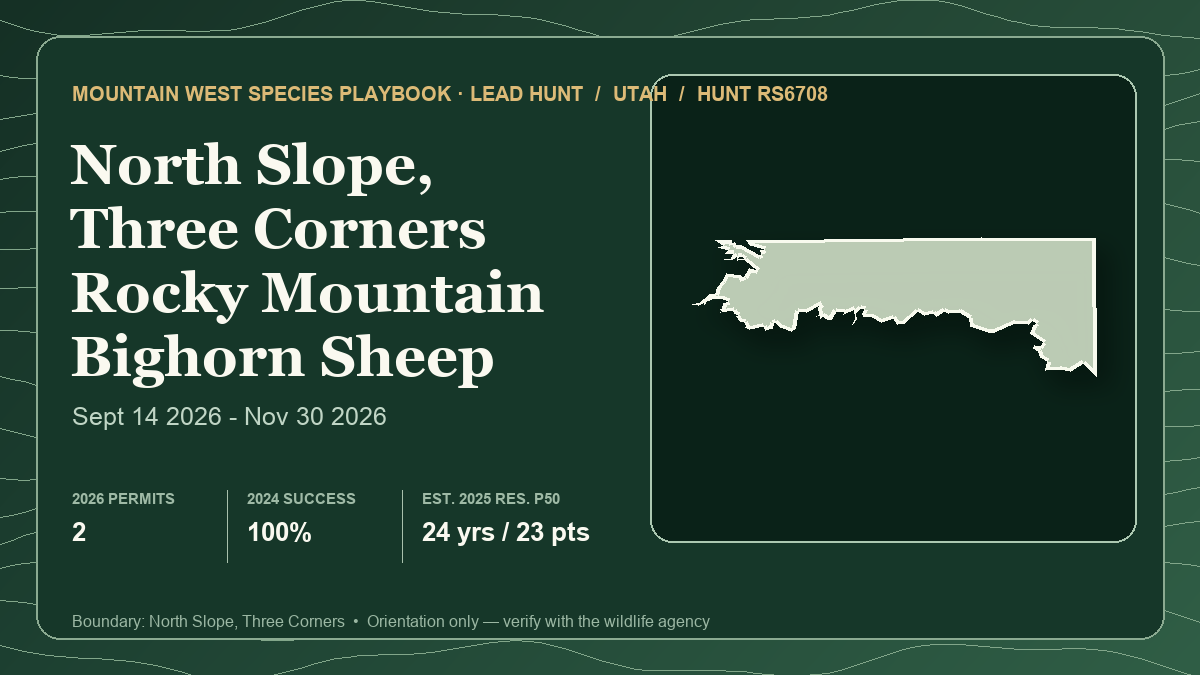
The card above represents lead hunt Utah RS6708 only, not the full comparison. Its 100% success figure is two successful hunters in final 2024 data, and its 24-year/23-point P50 is a Hunt Planner estimate from 2025 resident point history—not a promise of when an applicant will draw.
Start with the bighorn habitat triangle
Utah's statewide plan describes the durable bighorn pattern: open habitat next to steep, rocky escape terrain. Grasses and forbs make up most of the diet, with shrubs used seasonally. The Uinta Mountains unit plan adds four map-level filters—steep slopes, forage, ruggedness and horizontal visibility. Wyoming's recent explanation of bighorn adaptations reinforces why those pieces travel together: specialized hooves, balance and broad vision help sheep evade predators in difficult rock.
The useful scouting unit is therefore a triangle, not a waypoint:
- Forage: open benches, broken grass-and-forb slopes and recent openings that can support feeding.
- Visibility: enough horizontal openness for sheep to detect movement before danger reaches them.
- Escape terrain: cliffs, ledges, talus or sharply broken ground close enough to provide security.
A huge cliff with little adjacent forage can be poor daily habitat, while an open slope far from secure rock can miss the safety requirement. Dense conifer can interrupt visibility; both agencies describe conifer removal as a habitat tool.
Use that triangle broadly. Identify connected bands of open forage and broken rock, then test them from durable observation positions. Do not publish precise beds, mineral sites, travel routes or coordinates.
Timing changes which social pattern matters
Utah places Rocky Mountain bighorn breeding from October into early December. Rams normally separate from ewe-and-lamb groups outside that period, then join breeding groups and establish dominance. Season date is a behavioral filter, not a quality score.
Before the rut, ram and ewe groups may answer different habitat needs. Wyoming 001-1 closes October 31, so most of its regular season precedes or reaches the front edge of the breeding window. Emphasize repeated forage-and-security use, patient classification and time to relocate a group after weather or disturbance.
Across the transition, RS6708 opens September 14 and closes November 30. Early observations can establish ram-group terrain; later effort can account for seasonal movement and association with ewes. The 77-day calendar is not an ease score: two successful 2024 hunters averaged 18.5 days.
During the rut, RS6721's October 31-November 30 season overlaps breeding most directly. Rams may become more visible around ewe groups, but weather, terrain and access can still make a visible ram unreachable or legally unusable.
Read the draw and harvest numbers without false precision
Utah and Wyoming do not publish interchangeable draw measures. Utah uses bonus and regular permits; Wyoming separates preference and random components by residency. A Utah regular-permit point result is not a threshold, and a Wyoming random percentage is not a preference forecast.
Utah's latest hunt-level records are final 2024 reports; Wyoming's is a 2025 survey estimate. Samples are small: two RS6708 hunters, four RS6721 hunters and 14 active Wyoming 001-1 hunters. They cannot rank the difficulty of finding a chosen ram, weather or recovery.
Hunt 1: Utah RS6708 — the full timing spectrum
- Current season and weapon: Male-only Rocky Mountain bighorn sheep, any legal weapon, September 14-November 30, 2026. The approved 2026 allocation is two resident permits and no nonresident permit.
- Tag path or draw system: Utah once-in-a-lifetime Rocky Mountain bighorn bonus-point drawing. Bonus permits reward high point totals, while regular permits preserve a random path.
- Latest draw demand: In 2025, 386 eligible residents sought three permits, an aggregate ratio of one permit per 128.7 applicants. Two bonus permits went at 24 and 23 points; one regular permit appeared at 14 points. That 14-point outcome was random history, not a repeatable threshold. There was no nonresident allocation in the connected 2025 report.
- Latest harvest result: Final 2024 data list two hunters afield, two rams, 100% success and 18.5 average days. The 2026 quota is also two, but the matching number does not turn the old result into a forecast.
- Public-land and access pattern: The hunt record does not publish a hunt-level public-land percentage. The broader Uinta Mountains management plan says modeled bighorn habitat is 65.3% National Forest, 14.6% BLM, 8.5% private and 4.4% tribal, with smaller categories making up the remainder. Those are unit-habitat shares—not legal-access percentages for RS6708. The same plan notes rugged country, limited roads near sheep habitat and a motorized closure at Bare Top.
- Terrain character: The unit plan describes steep rocky canyons and hillsides plus high alpine habitat above timberline. Three Corners includes the Bare Top and Goslin Mountain subpopulations, so hunters need to verify the current hunt boundary, closures and ownership rather than generalize from the larger Uinta unit.
- Principal tradeoff: The longest timing window in this comparison can support an early-season ram-group plan and a later rut plan, but the 18.5-day 2024 average and lack of a hunt-specific access percentage argue against treating that flexibility as ease.
- Best for: A Utah resident already committed to Rocky Mountain bighorn bonus points who can keep multiple travel windows open and adjust after weather, movement and current access checks.
Open Utah RS6708 in the Hunt Planner 3D map.
Hunt 2: Utah RS6721 — a compact late-season test
- Current season and weapon: Male-only Rocky Mountain bighorn sheep, any legal weapon, October 31-November 30, 2026. The approved allocation is three resident permits and no nonresident permit.
- Tag path or draw system: The same Utah once-in-a-lifetime Rocky Mountain bighorn bonus-point system, with bonus and regular permit paths.
- Latest draw demand: In 2025, 383 eligible residents sought three permits, an aggregate ratio of one permit per 127.7 applicants. Two bonus permits went among applicants at 22 points; the regular permit appeared at seven points. The seven-point result documents random opportunity, not seven-point predictability. No nonresident permit was allocated.
- Latest harvest result: Final 2024 data list four hunters afield, four rams, 100% success and 10 average days. That four-hunter sample came under a different year's permit level than the three permits approved for 2026.
- Public-land and access pattern: The Oquirrh-Stansbury unit plan reports modeled bighorn habitat as 41.7% BLM, 37% National Forest, 14.6% private and 6.2% Utah trust land, plus a small tribal share. Again, those are habitat-model ownership shares across the management unit, not a promise of public ingress, open roads or hunt-wide access.
- Terrain character: The unit plan applies the same steep escape-terrain, forage, ruggedness and horizontal-visibility model across the range. Its discussion of conifer treatment, water improvement and Wilderness or Wilderness Study Area coordination shows why a current land-manager map must sit beside the wildlife boundary.
- Principal tradeoff: The entire season overlaps the agency-described October-early December breeding period, but the shorter 31-day window leaves less room to postpone for weather or rebuild an access plan.
- Best for: A Utah resident who values late-season behavior and can devote a concentrated block to repeated glassing, boundary verification and a conservative recovery margin.
Open Utah RS6721 in the Hunt Planner 3D map.
Hunt 3: Wyoming 001-1 — an early mountain hunt with a logistics premium
- Current season and weapon: Any ram. Wyoming's final 2026 Chapter 9 lists a special archery period August 15-31 and a regular season September 1-October 31. The chapter lists a quota of 15. The separate 2026 allocation sheet lists 13 resident and one nonresident license and notes that select totals may be adjusted for SuperTag licenses; verify the live Hunt Planner rather than silently treating 14 and 15 as the same figure.
- Tag path or draw system: Full-price limited-quota bighorn license with resident and nonresident preference and random components. Wyoming describes the full-price license as once in a lifetime. The current Hunt Planner says 25% of quota in areas with sufficient licenses can enter the random draw.
- Latest draw demand: The local 2025 record shows three resident random licenses among 335 applicants, or 0.90%. On the resident preference side, 20 points showed 87.5% and lower tiers did not draw. The nonresident regular preference side issued one license at 25 points at 20%; the nonresident random pool issued none among 46 applicants.
- Latest harvest result: Wyoming's 2025 survey lists 14 active hunters, 12 rams, 85.7% success and 7.3 days per harvest. It is a survey estimate from a different year and method than Utah's final 2024 rows.
- Public-land and access pattern: The local record does not publish a public-land percentage. Wyoming's official Hunt Planner warns that many sheep occupy remote designated wilderness and that nonresidents hunting big game in federal wilderness need a licensed guide or resident companion. Do not assume that rule applies to every possible position in Area 1; overlay the current hunt boundary, ownership, wilderness and motor-vehicle maps before choosing an access system.
- Terrain character: Wyoming describes bighorn hunting as high-elevation, rugged and pack-in intensive. This season's early position makes durable ram-group observations, heat management and recovery planning more important than expecting rut activity to simplify the search.
- Principal tradeoff: Area 1 has the only dedicated archery period and the largest current allocation in this comparison, but the regular season closes as Utah's late hunt begins, and wilderness logistics can materially change a nonresident plan.
- Best for: A Wyoming applicant with substantial point history—or a low-odds random strategy—who can solve guide, wilderness, travel and recovery questions before investing field time.
Open Wyoming 001-1 in the Hunt Planner 3D map.
A terrain-first field framework
- Build several habitat complexes, not one favorite basin. Join open forage, long visibility and nearby broken escape terrain at a scale that remains useful when sheep move.
- Match the social search to the date. Classify ram groups before the rut; later, account for movement toward ewes without assuming every group contains a mature legal ram.
- Let weather change the layer, not the standard. Shift elevation or aspect hypotheses after snow, heat, smoke or wind while keeping the habitat triangle connected.
- Observe before adding foot traffic. Durable glassing positions reveal whether a slope is only attractive on a map; repeated intrusion can surrender wind, skyline the hunter and displace sheep.
- Separate spotting from recovery. A visible ram across cliffs, private land, wilderness or a closed route is not automatically a workable opportunity. Confirm legal ingress, the route a loaded team can actually reverse, communications and daylight margin before a shot decision.
- Protect the herd and the record. Do not use protected collar or GPS data, harass sheep for a closer look or share sensitive locations. Follow each state's check, reporting and horn-plugging requirements exactly.
Best fit by hunter priority
- For maximum date flexibility: Utah RS6708 spans pre-rut, transition and rut dates, but only Utah residents received 2026 permits and 2024 hunters averaged 18.5 days.
- For the strongest rut overlap: Utah RS6721 puts its full season inside the broad October-early December breeding window. It gives up RS6708's early reconnaissance option.
- For an archery-first plan: Wyoming 001-1 is the only compared hunt with a dedicated August special archery period, subject to current archery requirements.
- For some low-point mathematical chance: Both states retain random opportunity, but none of the 2025 figures makes a low-point application likely. Utah regular-permit point levels and Wyoming random-pool percentages describe different mechanisms.
- For the clearest ownership context: The Utah unit plans publish modeled-habitat ownership shares. Those are more useful than no land signal, but still do not prove access to either hunt. Wyoming's local record has no comparable percentage.
- For a nonresident: The two Utah hunts carried no 2026 nonresident allocation. Wyoming's sheet lists one Area 1 nonresident license, while wilderness guide or resident-companion requirements may add a major logistical dependency.
There is no universal winner. RS6708 best fits the resident who can exploit a long season and adapt across phases. RS6721 best fits a concentrated late-season plan built around breeding timing. Wyoming 001-1 best fits a point-holder or random-draw applicant prepared for an earlier ram-group hunt and the state's wilderness logistics.
Verification checklist before applying or hunting
- Reopen the current agency hunt listing and confirm hunt number, boundary, sex or horn limitation, season, legal weapon and final quota.
- Confirm the correct residency pool, once-in-a-lifetime rule, bonus or preference treatment, archery credential and application deadline.
- Keep Utah bonus and regular results separate; keep Wyoming resident, nonresident, preference and random pools separate.
- Carry the agency boundary plus current ownership, wilderness and Motor Vehicle Use Maps. A public or modeled-habitat share does not grant legal ingress or motorized retrieval.
- Recheck closures, fire restrictions, road and trail conditions, weather and land-manager alerts immediately before travel.
- Build several observation systems and a conservative recovery plan without publishing camps, routes, mineral sites, beds, glassing points or coordinates.
- Verify mandatory harvest reporting, inspection and horn-plugging rules before leaving the field.
- Treat Hunt Planner as comparison and orientation; defer to the current agency regulation and field-ready official map whenever they differ.
The Hunt Planner methodology explains how state-specific records and data years are preserved, and the corrections page accepts source mismatches. This article was researched and drafted with AI assistance, then checked against the linked local records and official sources under the editorial and AI policy. No hunter reports are used as evidence.
Sources and verification
- Utah DWR 2026 Big Game Application Guidebook: Rocky Mountain bighorn season table and access warning
- Utah DWR April 2026 RAC packet: approved RS6708 and RS6721 permit allocations
- Utah DWR 2025 once-in-a-lifetime drawing odds
- Utah DWR final 2024 once-in-a-lifetime harvest report
- Utah DWR statewide bighorn sheep plan: breeding timing, diet, migration and habitat
- Utah DWR Uinta Mountains unit plan: RS6708 habitat, ownership and movement context
- Utah DWR Oquirrh-Stansbury unit plan: RS6721 habitat and ownership context
- Utah DWR Hunt Planner: RS6708 current boundary
- Utah DWR Hunt Planner: RS6721 current boundary
- Wyoming Game and Fish final 2026 Chapter 9 bighorn sheep seasons
- Wyoming Game and Fish 2026 bighorn resident/nonresident allocation
- Wyoming Game and Fish bighorn Hunt Planner: tag system, wilderness context and Area 1 tools
- Wyoming Game and Fish 2025 draw results and odds
- Wyoming Game and Fish harvest reports and surveys
- Wyoming Game and Fish 2026 bighorn adaptations and escape-terrain explanation
- Wyoming Game and Fish wilderness guide requirement FAQ
Official quotas, application rules, closures, travel designations and access can change. Utah's latest connected harvest rows are final 2024 data, while Wyoming's is a 2025 survey estimate. Tiny samples, different draw systems and different report methods prevent a defensible numerical ranking, and no historical result predicts an individual 2026 hunt. Verify every official source again before applying and before entering the field.