This guide is for the hunter who has drawn—or is deciding whether to keep applying for—a rare Shiras bull-moose permit and needs to answer one practical question: how should a September rut plan change when the tag, terrain and recovery problem are different?
That comparison matters now because Utah and Wyoming have finalized their 2026 seasons, and both hunts below cover the late-September breeding peak described by Utah biologists. The local records are Utah MB6006, North Slope, Summit and Wyoming 024-1, Hunt Area 24. Each hunt also links to its Hunt Planner 3D map.
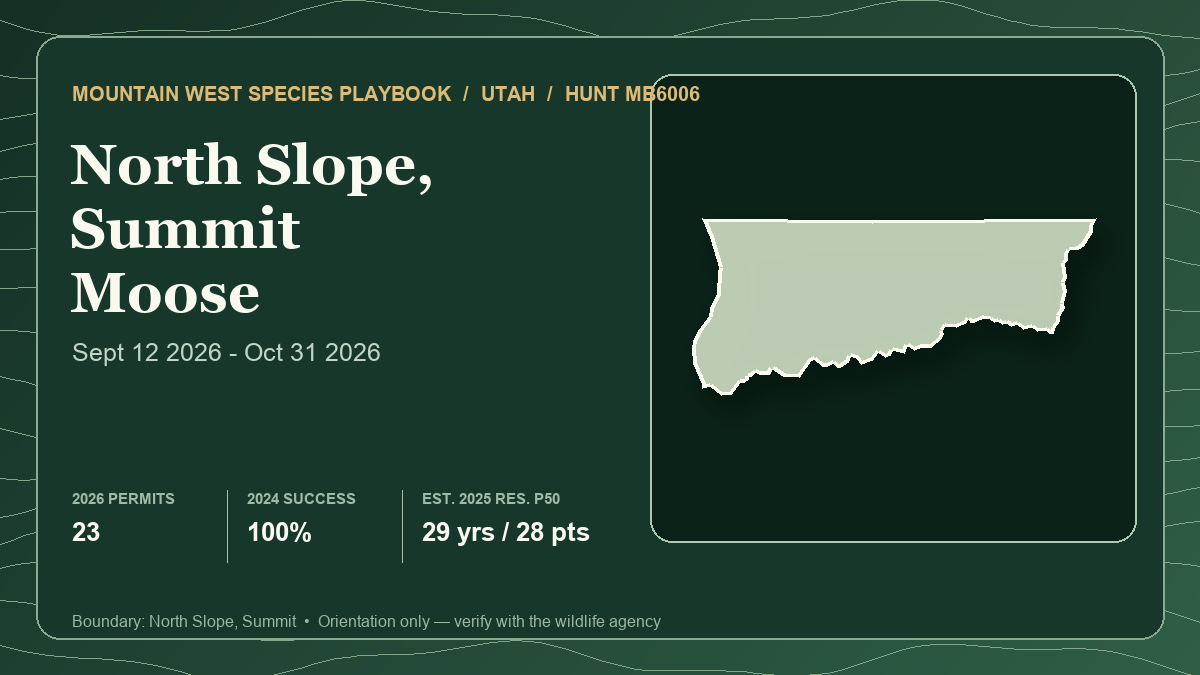
The card above represents lead hunt Utah MB6006 only, not the two-hunt comparison. It uses the current 2026 season and quota, 2025 draw history and the final 2024 harvest row connected to the static profile. Wyoming's latest connected harvest is from 2025. Those years remain separate because combining them into one ranking would create false precision.
The Shiras moose problem: find browse, cover and a recovery line
Utah DWR identifies Shiras as the only moose subspecies in Utah and the western United States. Its statewide plan says the Utah rut begins in early September and peaks in late September. Bulls use antlers for dominance displays and fighting; both sexes vocalize and can be aggressive during the breeding season.
Rut timing is useful, but it does not replace habitat. Moose are browsers. Utah's plan associates North Slope animals with riparian habitat while emphasizing that they are not limited to it. Shrubs, young deciduous trees, aspen, high-elevation shrub communities, burned conifer edges and dense conifer used for shelter all belong in the search image. Wyoming Game and Fish similarly highlights places where forest meets open land and areas with productive willow, aspen and birch growth.
The planning unit is therefore a connected habitat sequence, not a single wet meadow: daytime cover, nearby browse, a travel edge and a legal recovery route. A meadow without secure cover may hold fresh sign but little daylight use. Thick timber without browse may offer bedding cover but inefficient observation. The best map candidates put several of those pieces close enough that a hunter can listen and glass without walking through all of them.
Heat matters even in September. Dark-bodied moose often use shade during warm daylight hours. Start with cool periods and north-facing or shaded cover edges, then treat midday as a time to reassess sign, wind and extraction—not permission to force a noisy grid search through bedding cover.
Timing and calling without turning the hunt into a script
Utah MB6006 opens September 12 and Wyoming's regular Area 24 season opens September 15. Both are active by the agency-described late-September peak. Wyoming license holders who meet the state's archery requirements also have a September 1–14 special archery period, which starts before that peak and ends as the regular season begins.
Calling can expose a bull that is already within hearing range, but it is not a guarantee that every bull will cross open ground. Use a call as a test, then wait long enough to listen for brush movement, grunts or antler contact. Repeatedly advancing and calling can surrender the wind, move the hunter into poor shooting geometry and crowd an animal at close range.
Three modes cover most of the season:
- Early-rut reconnaissance: favor fresh tracks, browse and repeated use of cover-to-feed edges. A response may be subtle, and a silent bull is still possible.
- Peak-rut patience: call from a position with visibility, a stable wind and physical cover. Expect a bull to approach from an angle that tests the wind rather than the route that looks easiest on a map.
- Post-peak adjustment: keep using habitat and fresh sign after vocal activity softens. Shift attention from producing a response to intercepting travel between browse and secure cover.
Safety is part of the calling plan. Utah DWR's current moose-safety guidance lists lowered head, raised neck hair, snout licking and pinned ears as warning signs. A caller should have a solid barrier and a retreat direction, keep generous distance and avoid placing another person in the likely approach lane. This is habitat-level guidance, not a recommendation to provoke a close encounter.
A fair reading of two rare tags
The draw figures below describe different systems. Utah uses bonus points while retaining regular permits that create some random opportunity. Wyoming separates preference and random components, and resident and nonresident reports must be read independently. A point-tier result is not an annual guarantee, and the random-draw percentage is not the same thing as the preference threshold.
Harvest percentages also need sample sizes. Utah's 100% connected result represents 27 hunters in 2024. Wyoming's 94.1% represents 17 active hunters in 2025. Both are strong historical results, but neither measures the difficulty of locating a particular bull, weather disruption or the work of moving hundreds of pounds of meat.
Hunt 1: Utah MB6006 — a long North Slope season with random opportunity
- Current season and weapon: Bull moose, any legal weapon, September 12 through October 31, 2026. Utah lists 23 permits: 20 resident and three nonresident.
- Tag path or draw system: Utah once-in-a-lifetime bonus-point drawing. The 2025 report awarded both high-point bonus permits and regular permits, so points improve historical position without eliminating random opportunity.
- Latest draw demand: In 2025, 3,339 eligible residents sought 19 permits, an aggregate ratio of one permit per 175.7 applicants. The nonresident pool had 2,917 eligible applicants for three permits, or one per 972.3. Resident regular permits appeared at multiple point levels, including three points; that demonstrates a random path, not a repeatable three-point threshold.
- Latest harvest result: The final 2024 report connected to the local record lists 27 hunters afield, 27 bull moose, 100% success and 6.1 average days. This is a historical result, not a forecast for the 23 permits issued in 2026.
- Public-land and access pattern: The local record does not publish a unitwide public-land percentage. Relevant Uinta-Wasatch-Cache National Forest travel maps show designated vehicle routes and seasonal restrictions, but the hunt boundary itself does not create public ingress. Verify parcel status, the current Motor Vehicle Use Map, road condition, closures and retrieval authority before treating any drainage as usable.
- Terrain character: North Slope riparian corridors, high-elevation shrub communities, aspen and conifer edges create many small habitat pockets. That favors listening and glassing several connected basins over assuming the largest meadow holds the bull.
- Principal tradeoff: The September 12 opener and October 31 close cover the rut and a substantial post-rut window, with an excellent 2024 harvest result. The draw is extremely restrictive—especially for nonresidents—and access cannot be reduced to one public-land headline.
- Best for: A hunter already invested in Utah's bonus-point system who wants a long any-legal-weapon season and can pre-plan several legal road and recovery options.
Open Utah MB6006 in the Hunt Planner 3D map.
Hunt 2: Wyoming 024-1 — an archery prelude and Bighorn public-land scale
- Current season and weapon: Antlered moose. The 2026 special archery period is September 1–14, followed by the regular season September 15 through October 31. A hunter using the special archery period must satisfy Wyoming's separate archery requirements.
- Tag path or draw system: Limited-quota Type 1 moose license with preference and random components. Wyoming's Hunt Planner calls Type 1 moose once in a lifetime and allows only one moose hunt-area choice on the application.
- Latest draw demand: In the 2025 resident report, the random pool issued four licenses among 292 applicants, displayed as 1.37%. In the resident preference side, 16 points showed 72.73%, while lower tiers did not draw. The 2025 nonresident regular preference side issued two licenses at 24 points; the nonresident random pool issued none among 17 applicants. These pool-specific outcomes are history, not one blended “Area 24 odds” number.
- Latest harvest result: Wyoming's 2025 report lists 17 active hunters, 16 antlered moose, 94.1% success and 10.1 days per harvest. The state report is based on a voluntary survey and estimates license-holder results, so it is not directly identical to Utah's reporting process.
- Public-land and access pattern: The local WGFD-derived record lists 95% public land. That is an unusually strong planning signal, not proof that a parcel is reachable by vehicle. The Bighorn National Forest directs users to its Motor Vehicle Use Map for legal motorized travel; weather, seasonal designations, road condition and any wilderness boundary still govern the real retrieval plan.
- Terrain character: Bighorn forest openings, aspen and willow-bearing drainages fit the forest-edge habitat described by WGFD. Elevation, steep sidehills and the distance between an open road and a downed bull can turn apparently simple public access into a multi-trip packout.
- Principal tradeoff: Area 24 offers two tactical windows and a 95% public-land summary, plus a strong 2025 harvest result. Its point structure remains steep, and 10.1 days per harvest is a warning against treating high success as quick success.
- Best for: A hunter with Wyoming moose-point history who values an optional archery start, extensive public-land context and enough schedule flexibility for a deliberate search and recovery.
Open Wyoming 024-1 in the Hunt Planner 3D map.
A seven-day field framework
Build the hunt around phases rather than a single waypoint list.
- Before arrival: Identify several legal access systems, not several spots along one road. For each, mark broad browse-and-cover complexes, a listening position, nonmotorized reach and a recovery route that remains legal after weather changes.
- Days one and two: Confirm current sign and eliminate empty habitat. Watch from outside the cover, note wind changes and resist calling from a place with no safe visibility or retreat.
- Days three and four: Revisit the best sign at different light and wind. Use restrained calling, then wait. A bull that does not answer immediately may still use the edge after the caller leaves.
- Days five and six: Expand to the second access system before repeating an unproductive loop. Compare browse condition, track freshness and rut sign rather than covering distance for its own sake.
- Day seven and beyond: Protect recovery margin. A last-light opportunity far from a legal route is not automatically a responsible shot, especially if warm weather or limited help will delay meat cooling.
For every possible shot location, answer four questions in advance: Can the team reach the animal without crossing unsafe water or private land? How many loaded trips are realistic? Where can meat cool? What road, weather or daylight change would make the recovery unacceptable? A high harvest percentage answers none of them.
Best fit by hunter priority
- For the applicant wanting some random opportunity: Both systems preserve a random component, but Utah's 2025 regular permits appeared across several point levels while Wyoming publishes a distinct random pool. Neither makes a low-point bull-moose application likely.
- For the longest single weapon-flexible window: Utah MB6006 runs September 12–October 31 under an any-legal-weapon listing.
- For a dedicated archery opening: Wyoming 024-1 provides September 1–14 before the regular season, subject to current archery requirements.
- For the clearest public-land headline: Wyoming's local profile lists 95% public. Utah's record does not supply a comparable percentage, so assigning Utah an invented number would be misleading.
- For the hunter comparing harvest evidence: Utah's 27-of-27 result is final 2024 data; Wyoming's 16-of-17 result is estimated 2025 survey data. Both support optimism after drawing, but the different year, sample and method prevent a defensible numerical winner.
- For the schedule-constrained hunter: Neither should be treated as a short hunt. Wyoming reported 10.1 days per harvest in 2025, while Utah's successful 2024 hunters averaged 6.1 days. Travel, scouting and recovery add time beyond those field measures.
The practical conclusion is not that one hunt is universally better. Utah best fits an established Utah bonus-point strategy and a hunter who wants one long season structure. Wyoming best fits established Wyoming point holders who can use either the early archery option or the regular season and solve the public-land recovery problem before arrival.
Verification checklist before applying or hunting
- Reopen the official 2026 hunt listing and confirm hunt number, boundary, quota, season dates, legal weapon and antler restriction.
- Confirm current once-in-a-lifetime, preference or bonus-point, archery-license and application rules for the correct residency.
- Keep each draw pool separate. Do not translate one point tier, a random pool or an aggregate applicant ratio into guaranteed future odds.
- Carry the agency boundary plus current ownership and Motor Vehicle Use Maps; public land does not guarantee motorized access or public ingress.
- Recheck fire restrictions, closures, weather, road status and land-manager alerts immediately before travel.
- Build a communication, meat-cooling and multi-trip recovery plan sized for a bull moose before selecting a shooting position.
- Give rutting moose space, watch warning behavior and keep physical cover available when calling.
- Use Hunt Planner for comparison and orientation, then defer to current agency regulations and field-ready official maps.
The Hunt Planner methodology explains how state-specific records and data years are preserved. The editorial and AI policy describes the research disclosure, and source mismatches can be reported through the corrections page. No hunter reports are used as evidence in this article.
Sources and verification
- Utah DWR Hunt Planner: MB6006 current boundary and hunt record
- Utah DWR April 2026 RAC packet: MB6006 weapon and 20-resident/3-nonresident quota
- Utah DWR 2025 once-in-a-lifetime drawing odds
- Utah DWR final 2024 once-in-a-lifetime harvest report
- Utah statewide moose management plan: Shiras biology, rut and North Slope habitat
- Utah DWR 2026 moose-safety guidance and warning behavior
- Uinta-Wasatch-Cache National Forest current motorized-travel guidance and MVUM links
- Wyoming Game and Fish 2026 Chapter 8 moose seasons
- Wyoming Game and Fish 2026 resident/nonresident moose quota allocation
- Wyoming Game and Fish 2025 draw results and odds
- Wyoming Game and Fish 2025 moose harvest report
- Wyoming Game and Fish moose Hunt Planner and application rules
- Wyoming Game and Fish moose habitat and behavior profile
- Bighorn National Forest maps and Motor Vehicle Use Map
Official quotas, draw rules, closures, travel designations and access can change. Utah's latest connected harvest row is final 2024 data, while Wyoming's is a 2025 survey estimate. Their draw systems and report methods differ, and neither historical success rate predicts an individual 2026 hunt. Verify every official source again before applying and before entering the field.