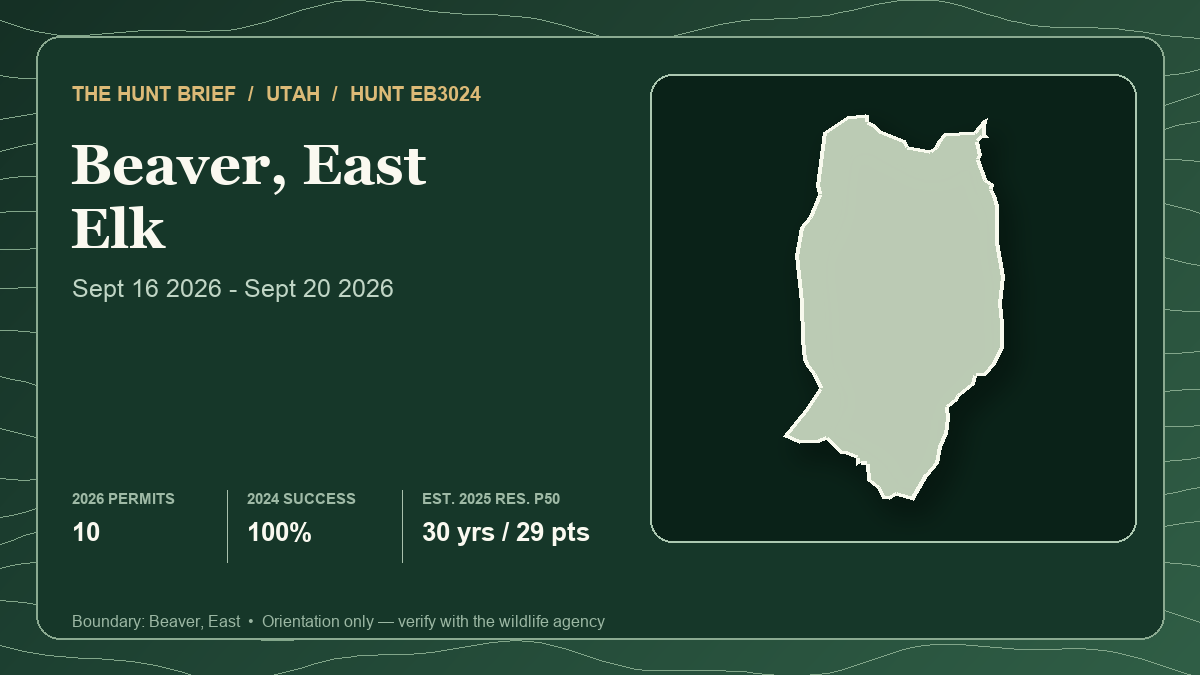
Utah early any-legal-weapon bull elk Hunt EB3024 opens September 16, 2026, for five days on Beaver, East. The newest official harvest dashboard reports that 10 of 11 hunters took a bull in 2025, or 90.9% success. That is strong history, but the completed 2026 drawing supplies the more sobering number: 1,958 resident first-choice applications competed for nine permits, while 1,450 nonresident first choices competed for one.
This is a scarce, short-window hunt positioned in Utah's mid-to-late September rut period. It is not a 91% promise. Eleven hunters are a small sample, weather can rewrite a five-day plan, and neither a hunt boundary nor a large public-habitat share guarantees a legal route.
Start with the static Hunt Planner profile for EB3024 and open Beaver, East in the Hunt Planner 3D map. The map and card are orientation tools, not parcel, road or field-navigation authority.
The quick verdict
EB3024 best fits a tag holder who has several verified access systems ready before opening morning, can use elk sound without letting bugles dictate unsafe or boundary-blind movement, and has enough recovery margin to finish a pack-out inside a compressed season.
For a future applicant, treat this as an aspirational choice rather than an efficient way to obtain an elk permit. The 2026 first-choice success figures were 0.46% for residents and 0.07% for nonresidents. Bonus points influenced the distribution, but they did not turn the drawing into a simple cutoff.
What the 2026 permit authorizes
Utah's current application guidebook lists EB3024 as a limited-entry, early any-legal-weapon bull elk hunt on Beaver, East from September 16 through September 20, 2026. The approved local quota is nine resident permits and one nonresident permit, 10 total.
“Any legal weapon” is a weapon category, not permission to hunt outside the printed unit, dates or bull-elk limitation. Match the permit to EB3024 and review the current field rules before hunting. Utah now allows paper tagging or an electronic option; download and verify any e-tag before losing service.
Every Utah big-game permit holder must file a harvest report within 30 days after the season ends, even without a harvest. For EB3024, that makes reporting part of the plan, not an optional postscript.
The 2026 draw was scarcer than the harvest headline suggests
Utah's new official draw portal reports nine resident first-choice permits against 1,958 first-choice applications for EB3024: 0.46% overall first-choice success. Five permits went through the maximum-point side—four of 12 applicants at 29 points and the lone applicant at 30 points. The other four appeared in the regular random allocation at 8, 16, 19 and 21 points.
The nonresident table reports one permit and 1,450 first-choice applications, or 0.07%. That permit came from the regular random allocation at 25 points, where one of 17 applicants drew.
Those point rows need restraint. A permit at eight resident points was not a cutoff, and the single nonresident result at 25 points does not forecast next year. Utah's regular permits retain a random path. Quota, point distributions and applicant choices can all change.
The card uses the repository's connected 2025 draw record because that is the structured dataset behind the site. The figures above come from the newer 2026 official portal. They should not be merged into one estimated threshold.
Two strong harvest years still make a small sample
The latest DWR dashboard reports 11 permits, 11 hunters afield and 10 bulls harvested for EB3024 in 2025. Success was 90.9%, hunters averaged 2.5 days afield and satisfaction was 3.9 on the agency survey scale.
The local Hunt Planner record connects to the final 2024 report: 11 permits, 11 hunters and 11 bulls, or 100% success, with 2.9 average days afield and 4.8 satisfaction. Across those two years, 21 of 22 participating hunters reported a harvest. That is useful evidence of recent performance, but 22 hunters remain too few to erase annual variation.
Neither percentage isolates opening-day success, public-land success, calling success, antler size or recovery difficulty. Preseason scouting and post-shot work are also outside a simple days-afield average.
Why the season timing matters
Utah's statewide elk plan places the rut from early September into early October, with the usual peak in mid-to-late September. EB3024 sits squarely in that biological window. Bulls may be vocal and associated with cow groups, but the calendar is not a guarantee that a particular drainage will hold a responsive elk.
The Beaver unit plan adds the management reason for this limited-entry structure. Beaver, East is managed for a three-year average harvested-bull age of 6.5–7.0 years. In 2022, the plan reported an 8.6-year average and an 8.4-year three-year average, both above the then-current objective, after which bull-permit opportunity increased. Those are management measurements, not a prediction of the age or antler size of a bull encountered in 2026.
Use the rut as a locating signal, then verify with current evidence. Listen from durable positions, confirm tracks and fresh sign, and protect the wind before moving. If vocal activity collapses, shift to connected feed, security cover and shaded timber edges rather than forcing calls into one basin. Keep at least three broad plans so one closure, access problem or pressure change does not consume the five-day season.
Public habitat does not settle access
The 2023 Beaver elk plan maps approximately 433,066 acres of Beaver, East elk habitat: 65% Forest Service, 24% BLM, 8% private and 3% Utah trust land. Its seasonal tables are even more informative. Modeled summer range is 90% Forest Service and 6% private, while modeled winter range is 36% Forest Service, 49% BLM, 9% private and 5% trust land.
Those are habitat-model ownership shares, not a current hunt-level access calculation. They do not show open roads, legal ingress or September elk distribution. The plan also excludes CWMUs and Native American trust lands from its described boundary.
Build the access plan in layers:
- Confirm the current EB3024 boundary and every ownership transition.
- Use the current Forest Service motor-vehicle map and BLM travel information rather than assuming a visible two-track is open.
- Carry a dry-weather route and a conservative alternate that does not depend on one steep road.
- Recheck wildfire notices, closures and land-manager restrictions immediately before travel. Utah DWR's August 2026 guidance specifically warns hunters that wildfire conditions can change access.
- Keep all scouting notes at the habitat-pattern level. Do not publish camps, wallows, private approaches, bedding areas, glassing points or animal coordinates.
Verification checklist
- Match the permit to EB3024, Beaver, East, limited-entry bull elk and September 16–20, 2026.
- Review current weapon, tagging, evidence-of-sex and transport rules in the 2026 field guidebook.
- Verify the boundary, ownership, public ingress, motor-vehicle designations, road condition, fire status and closures.
- Download any electronic permit and offline maps before leaving service.
- Leave enough daylight and physical margin for retrieval in steep country.
- Submit the required harvest report within 30 days after the hunt ends.
- Keep 2024 harvest, 2025 harvest and the 2026 draw and quota in their correct evidence years.
Sources and verification
- Utah Hunt Planner: EB3024 current boundary and hunt record
- Utah 2026 Big Game Application Guidebook: EB3024 season and permit type
- Utah 2026 Big Game Field Regulations: tagging, reporting, access and weapon rules
- Official Utah 2026 draw-odds portal: filter Big Game, 2026, Limited-Entry Bull Elk and EB3024
- Utah DWR big-game harvest dashboard: 2025 EB3024 results
- Utah 2024 limited-entry harvest report: final data used by the card
- DWR Beaver Elk Herd Unit #22 management plan: age objective, habitat and ownership
- Utah Statewide Elk Management Plan: rut timing and limited-entry framework
- Utah DWR 2026 deer and elk season guidance: wildfire, scouting and reporting reminders
- Fishlake National Forest data and maps
- BLM Utah travel and transportation maps
Official rules, seasons, boundaries, permit numbers, access, roads, fire conditions and closures can change. The habitat and age context comes from a 2023 unit plan using older surveys; harvest results are from 2024 and 2025; draw and quota figures are from 2026. Historical success does not predict an individual outcome. This article uses official sources only, presents no hunter report as representative evidence, and was prepared with AI-assisted research and drafting before source and build checks. Read Hunt Planner's methodology, editorial and AI policy and corrections process.