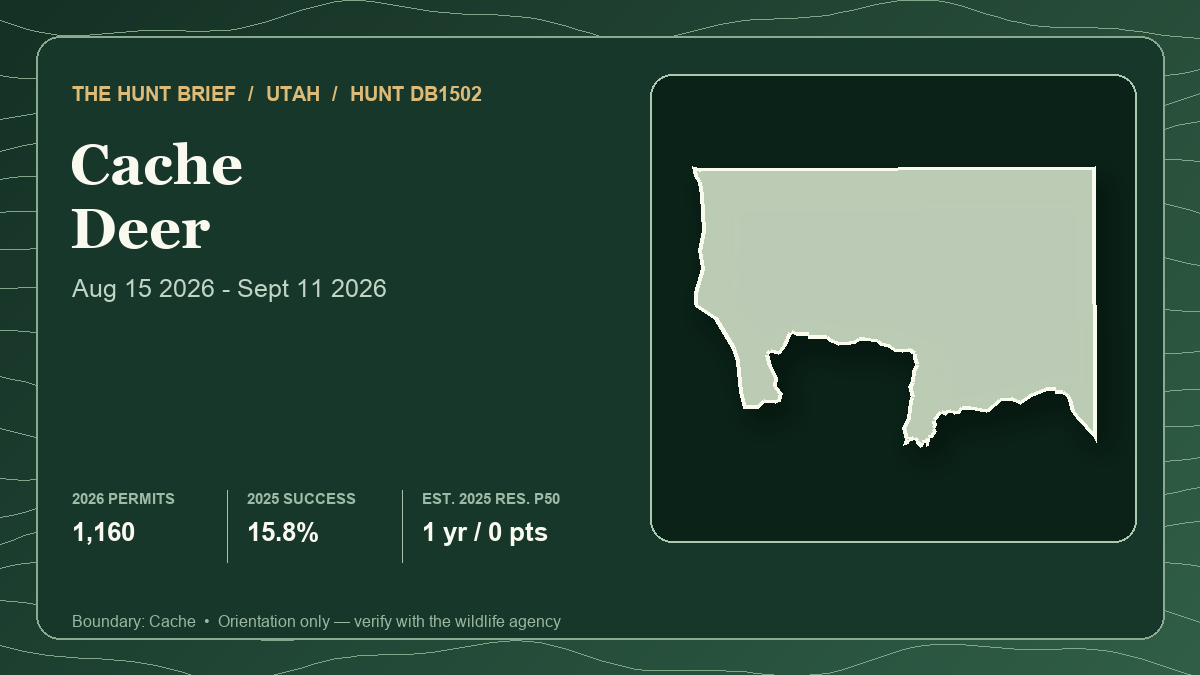
Utah's 2026 Cache archery deer hunt opens August 15 and runs through September 11. Hunt DB1502 looks accessible in the latest draw table, but its latest harvest report tells a different story: drawing the permit and converting it into a buck are separate problems.
Start with the static Hunt Planner profile for DB1502 and open the Cache hunt in the Hunt Planner 3D map. The map and card are orientation tools, not substitutes for Utah's current boundary, land-ownership layers or travel restrictions.
The quick verdict
DB1502 best fits an archery hunter who values a relatively attainable Utah deer draw and can devote repeated days to scouting and hunting steep summer range. It is not a shortcut to an easy harvest. Utah's preliminary 2025 report lists 755 hunters afield, 119 deer harvested and 15.8% success. Hunters averaged 8.2 days afield, so the low success rate did not come from a uniformly brief effort.
The practical lesson is to budget time before worrying about a single “best” terrain feature. A hunt with broad public-land summer range can still be constrained by private lower country, trailhead pressure, heat, smoke, changing fire access and deer shifting between feeding and security cover.
What the 2026 permit covers
Hunt Planner's current Utah record lists DB1502 as a general-season buck deer archery hunt with 1,160 total permits for August 15 through September 11, 2026. Utah's 2026 field guide confirms those statewide general-season archery dates and says an archery permit authorizes one buck deer within the unit and dates printed on the permit.
This is not a restricted-archery hunt. Hunters still need to follow Utah's general archery-equipment rules, including the guidebook's minimum 30-pound bow pull and broadhead requirements. The guidebook is the controlling planning reference; equipment, tagging, transport and reporting rules should be rechecked immediately before the hunt.
What the 2025 draw actually says
The 2025 general-season deer draw report recorded 1,002 eligible resident applicants and 814 permits, an aggregate ratio of one permit for every 1.2 applicants. At zero preference points, 680 eligible residents competed for 495 permits, shown as one in 1.4. The nonresident table recorded 41 eligible applicants and 40 permits, an aggregate ratio of one in 1.0.
Those figures describe the 2025 applicant pool, not a guaranteed 2026 or 2027 result. They also should not be blended with the 1,160-permit 2026 total as if all years and allocation categories were identical. The useful conclusion is narrower: recent draw access was much less restrictive than the latest harvest outcome.
The harvest reality
Utah's preliminary 2025 general-season buck deer report lists 931 DB1502 permits, 755 hunters afield, 119 deer harvested, 15.8% success, 8.2 average days and 3.3 average satisfaction. These are survey results for 2025; they are not a forecast for 2026 weather, pressure or deer distribution.
The year labels matter. The season and 1,160 permits are current 2026 planning fields, while draw demand and harvest are 2025 evidence. The card keeps those years visible rather than presenting them as one same-year score.
Access and terrain: read the percentages correctly
Utah's Cache deer-unit management plan divides the unit into Wellsville, Cache and Rich areas and describes a sharp transition between higher summer range and lower winter range. Its ownership table estimates the unit's summer range—not the whole hunt boundary—at 55% Forest Service, 9% Bureau of Land Management, 5% state trust land, 1% DWR and 30% private. The same plan describes steep topography in parts of the unit and says much of the lower country is privately owned.
That distinction is central to an August archery plan. A large public share of summer habitat does not grant access across private parcels, open every road or eliminate crowded approaches. Confirm the exact parcel, legal access route and motor-vehicle status for each candidate area. Treat state trust land, wildlife management areas and federal land as separate rule sets rather than one generic “public” category.
A terrain-level scouting plan
Use habitat patterns, not precise locations:
- Begin with higher-elevation summer range where broken forest, aspen, brush and small feeding openings meet secure bedding cover.
- Build glassing plans around several faces and elevation bands. Morning visibility, afternoon thermals and smoke can make one planned viewpoint ineffective.
- Mark the public-private boundary before marking an approach. A promising basin is not useful if the only practical access crosses land without permission.
- Look for connected food, water and cover rather than assuming deer must visit one obvious source on a predictable schedule.
- Prepare at least three hunt plans with different access and wind exposures. Opening-weekend pressure can change use faster than a preseason image suggests.
- Check current fire closures, temporary road restrictions and agency notices again during hunt week. A valid hunt boundary does not override an emergency closure.
The Cache plan says much of the herd uses higher elevations in summer. That is a unit-level starting hypothesis, not a promise that a particular slope holds a buck. Confirm current sign on the ground and avoid turning broad biological guidance into a precise location claim.
Who should choose DB1502
Choose this hunt if recent draw accessibility matters, you can scout before August 15 and you are comfortable treating a low historical success rate as a planning warning rather than a verdict. The season rewards hunters who can return after an unproductive opening and adjust to pressure, wind and changing deer use.
Look elsewhere if your priority is a high historical harvest percentage, simple vehicle access or a hunt that can be reduced to one weekend. The latest evidence supports opportunity to participate, but it does not support calling DB1502 easy.
Verification checklist
- Reopen the official DB1502 Hunt Planner boundary and compare it with the boundary printed on the permit.
- Read the current 2026 field guide, including archery equipment, tagging, harvest reporting and closed-area rules.
- Confirm ownership and legal access for every planned entry; obtain written permission before crossing or hunting private land.
- Check Utah DWR's wildfire page and the relevant land manager for closures immediately before travel.
- Treat 2025 draw and preliminary harvest figures as historical evidence, not guaranteed 2026 conditions.
Sources and verification
- Utah DWR Hunt Planner: DB1502 boundary, 2026 season and permit record
- Utah DWR 2026 Big Game Field Regulations Guidebook
- Utah DWR 2025 general-season buck deer draw results
- Utah DWR preliminary 2025 general-season buck deer harvest report
- Utah DWR Cache Unit 2 deer management plan
- Utah DWR mule deer habitat overview
- Utah DWR 2026 wildfire and hunting-season updates
Official seasons, permit totals, equipment rules, fire status, roads and access can change. Verify all legal details with Utah DWR and the responsible land manager before hunting. The 2025 harvest report is preliminary, the draw and harvest evidence use a different year from the 2026 season, and no historical statistic guarantees future results.