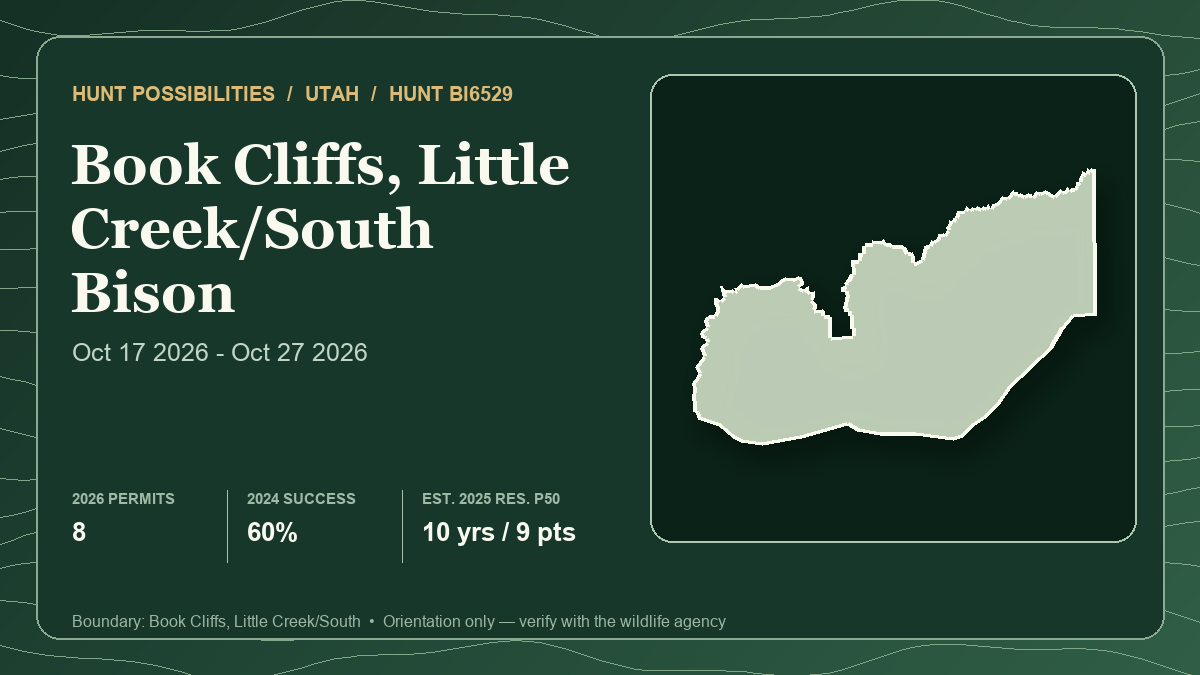
This guide is for a Utah cow-bison applicant—or a 2026 permit holder—trying to choose between better historical draw access, an earlier calendar and a later Henry Mountains season. That choice matters more than usual in September 2026. On August 21, the Utah Division of Wildlife Resources reported that pneumonia had reduced the adult bison population in the Book Cliffs, Bitter Creek area by almost 40%, moved one affected 2026 cow hunt to another unit and canceled that hunt for 2027.
Three current Hunt Planner records remain suitable for a consistent comparison: BI6529, Book Cliffs, Little Creek/South, BI6505, Henry Mountains and BI6506, Henry Mountains. All are cow-only, once-in-a-lifetime, any-legal-weapon hunts. They differ in timing, residency availability, historical samples and field logistics.
The card above represents lead hunt BI6529 only, not all three hunts. It shows the connected Little Creek/South boundary and data years. BI6536 is intentionally outside this comparison because the August emergency action moved its 2026 validity from Bitter Creek to Little Creek/South after the normal guidebook and map publication cycle. A static profile cannot safely stand in for that temporary official change.
What changed—and what did not
The DWR's August 21 notice says the late-July and early-August die-off occurred in Bitter Creek. For BI6536, the November 14–29 cow hunt, permit holders may retain the tag under a modified Little Creek/South boundary or surrender it under special relief terms. The agency also canceled that hunt for 2027 and is monitoring the nearby Little Creek/South herd for evidence of disease spread.
That announcement does not say BI6529, BI6505 or BI6506 was canceled. As of September 14, the official Hunt Planner data still lists all three with their 2026 seasons and quotas. But BI6529 is in the adjacent population the DWR is monitoring, so a September article cannot turn its printed date into a guarantee. A BI6529 permit holder should check direct DWR communications and the current hunt page again immediately before travel.
The comparison is therefore a planning framework, not a prediction. The 2025 draw report describes last year's applicants and permits. The 2024 harvest report describes even older field outcomes. The 2026 quotas are different again. Those year gaps are especially important after a disease event.
Read Utah's bison draw correctly
Utah uses bonus points for bison, not the preference-point system used for general-season buck deer. Unsuccessful once-in-a-lifetime applicants receive a species bonus point. Points improve an applicant's chance, but permits are also issued in a regular round; lower-point applicants can draw. A low-point permit in a historical row proves possibility, not a dependable threshold.
The 2026 application guidebook lists a $10 resident and $21 nonresident application fee for a bonus point and requires a valid hunting or combination license before applying. The bison permit itself is $460 resident or $4,840 nonresident, excluding the license and other transaction costs. Only BI6505 among these three has current nonresident permits: three of its 11 tags. BI6529 and BI6506 list resident permits only.
Obtaining a drawn bison permit uses the once-in-a-lifetime opportunity. Utah also says a hunter may obtain only one bison permit of any kind in the 2026 season. Cow permit holders must complete the online cow-bison orientation before receiving the permit, and all bison hunters must review the state's shot-placement material.
Why a cow-bison hunt is an identification hunt first
Bison are social, tough and often observed in groups. The state's orientation warns that young bulls can be mistaken for cows. It instructs hunters to use several characteristics together: absence of a penile sheath, relatively thin horn bases, inward-curving horns, a narrower face, a visible neck and a less muscular body. No single horn angle is enough.
The same herd structure changes the shot decision. The DWR recommends waiting for an allowed animal to separate, confirming what stands in front of and behind it and avoiding a running shot. Its diagram places the heart and lungs lower than many hunters expect. If the animal rejoins a herd after a shot, keeping visual contact with that individual matters more than firing at another similar-looking bison.
That patience belongs in the hunt comparison. A short season is not automatically easy because bison may be visible. A hunter still needs enough time to verify sex, create a safe shot lane and recover an animal whose body size can turn a casual extraction plan into a waste risk.
Hunt 1: BI6529 — earliest calendar, highest current uncertainty
- Current season and weapon: Book Cliffs, Little Creek/South; cow only; any legal weapon; October 17–27, 2026. The current Hunt Planner row lists eight resident permits and no nonresident permits.
- Tag path: Utah once-in-a-lifetime bison bonus-point drawing. Group applications are not accepted for once-in-a-lifetime hunts.
- Latest draw demand: In 2025, 107 eligible residents competed for eight permits, an aggregate ratio of 1 in 13.4. Four were bonus-round permits and four were regular-round permits. The lowest point level that issued a permit was two, but that isolated result is not a 2026 forecast.
- Latest harvest result: The 2024 report lists five hunters afield, three bison, 60% success and 4.6 average days. Five hunters are too few to treat 60% as a stable rate.
- Public-land/access pattern: The local record does not provide a hunt-level public-land percentage. The Book Cliffs contain large federal and state blocks plus private and Tribal boundaries. In June 2026, Utah finalized the purchase of 50,608 acres for the Book Cliffs Roadless Wildlife Management Area. One Sego Canyon approach also requires a Tribal Access Permit, staying on the road and no motorized use on Tribal land. Neither fact makes every route legal or open.
- Terrain character: BLM describes the broader Book Cliffs as remote country rising from desert shrub near 5,500 feet to aspen and fir around 8,500 feet, cut by deep valleys. Treat that as habitat-scale orientation, not a location prescription.
- Principal tradeoff: This is the earliest of the three hunts and had the same aggregate 2025 resident ratio as BI6505, but its 2024 field sample was smallest and the adjacent Bitter Creek disease event adds a live uncertainty that old odds cannot express.
- Best for: A resident who prioritizes an October schedule, can solve remote access and extraction in advance, and will accept that agency health monitoring may change the plan.
Open BI6529 in the Hunt Planner 3D map.
Hunt 2: BI6505 — the only current nonresident path here
- Current season and weapon: Henry Mountains; cow only; any legal weapon; December 9–20, 2026. The current quota is eight resident and three nonresident permits, 11 total.
- Tag path: Utah once-in-a-lifetime bison bonus-point drawing. The current nonresident allocation makes BI6505 the only one of these three a nonresident could draw in 2026.
- Latest draw demand: The 2025 report lists 343 eligible residents for 25 permits, or 1 in 13.7, and 417 eligible nonresidents for three permits, or 1 in 139. The 2026 total quota is 11, far below the 25 resident permits recorded in the prior draw, so the aggregate 2025 resident ratio should not be carried forward.
- Latest harvest result: In 2024, six hunters reported five bison, 80% success and 2.8 average days. The six-hunter sample is descriptive history, not evidence that an 11-tag 2026 season will repeat it.
- Public-land/access pattern: Much of the Henry Mountains landscape is administered by the BLM, but the official plan spans other jurisdictions and excluded areas. The 2025 Henry Mountains/Fremont Gorge travel decision changed motorized route designations; a familiar track is not automatically open. Capitol Reef National Park also has separate rules, and hunting is prohibited inside the park.
- Terrain character: The current Henry Mountains plan describes a roughly 300,000-acre bison-use area from about 4,800 to 11,500 feet, including steep mountain slopes, foothills, benches, mesas and deeply eroded canyons. December weather can make that elevation range a vehicle and recovery problem before it becomes a spotting problem.
- Principal tradeoff: BI6505 offers the only present nonresident allocation and the strongest latest harvest percentage in the comparison, but its 2026 permit count differs sharply from the 2025 draw and its December logistics demand more margin.
- Best for: A winter-equipped resident or nonresident who values a pre-holiday Henry Mountains window and has a conservative, current route-and-recovery plan.
Open BI6505 in the Hunt Planner 3D map.
Hunt 3: BI6506 — later dates, resident-only and no easy shortcut
- Current season and weapon: Henry Mountains; cow only; any legal weapon; December 23, 2026–January 3, 2027. The current Hunt Planner row lists 11 resident permits and no nonresident permits.
- Tag path: Utah once-in-a-lifetime bison bonus-point drawing, resident only for this hunt in 2026.
- Latest draw demand: The 2025 report lists 384 eligible residents for 30 permits, an aggregate ratio of 1 in 12.8. Fifteen permits came from the bonus round and 15 from the regular round. A one-point applicant drew in that regular round. The current quota is only 11, so 1 in 12.8 and the one-point result are historical context, not a current probability.
- Latest harvest result: The 2024 row lists eight hunters, six bison, 75% success and 8.1 average days. Its average effort was almost three times BI6505's 2.8 days, but both samples are tiny and came from different hunt years and conditions.
- Public-land/access pattern: The legal unit framework is the same broad Henry Mountains boundary as BI6505, but late-December snow, freeze-thaw cycles, short daylight and holiday travel can change which legal roads are practically usable. Confirm the current BLM route layer and closures rather than relying on a saved scouting track.
- Terrain character: The same mountain-to-desert relief applies, with added winter exposure. Bison can range widely, and the Henry Mountains plan notes that their landscape use is less tightly centered on water than cattle use. Do not reduce a winter plan to one water source or one elevation band.
- Principal tradeoff: BI6506 had the most favorable aggregate 2025 resident ratio, yet it also had the longest average effort in the 2024 sample and now offers fewer than half as many permits as the prior draw report lists.
- Best for: A Utah resident with holiday flexibility, winter travel capacity and enough days to absorb a slow search or weather interruption.
Open BI6506 in the Hunt Planner 3D map.
A field plan that transfers across all three
- Start with the live legal boundary. Download the current DWR boundary, land status and land-manager travel map immediately before the hunt. The BI6536 emergency change demonstrates why an old PDF or cached polygon cannot be the final authority.
- Build three access-and-extraction systems. Each needs a legal arrival route, a weather fallback, a safe observation plan and a realistic way to move and cool an animal. Do not build any option around an unverified road, private crossing, Tribal route or park shortcut.
- Search at landscape scale. Compare feed, security, snow exposure and recent sign across broad terrain types. Bison range widely; seeing them during one scouting trip does not establish a durable season pattern.
- Identify before approaching the trigger. Observe long enough to confirm multiple cow characteristics and what is behind the animal. Young bulls deserve extra caution.
- Plan the first hour after the shot. Carry the tools, bags, help and transport capacity for a very large carcass. Tag before moving it, preserve evidence of sex and cool the meat without delay.
- Follow the permit packet. Complete the required orientation, review shot placement, comply with any tooth, blood or collar instructions supplied by the DWR and file the mandatory harvest report. A biological sample does not replace the harvest report.
Best fit by hunter priority
- For an October calendar: BI6529. It avoids Henry Mountains winter travel but carries the greatest live biological uncertainty.
- For a nonresident application: BI6505 is the only one of these three with a 2026 nonresident allocation. Its 2025 ratio was 1 in 139, and the current quota offers only three nonresident permits.
- For the best aggregate historical resident ratio: BI6506 at 1 in 12.8 in 2025, narrowly ahead of BI6529 at 1 in 13.4 and BI6505 at 1 in 13.7. The current quotas changed enough that those ratios cannot be ranked as 2026 odds.
- For the strongest latest harvest headline: BI6505 at 80% in 2024, followed by BI6506 at 75% and BI6529 at 60%. Samples of six, eight and five hunters are too small for a quality ranking.
- For avoiding holiday conflict: BI6529 ends October 27; BI6505 ends December 20; BI6506 spans Christmas and New Year's Day.
- For the simplest current-health assumption: Neither Book Cliffs option should be treated as static after the Bitter Creek die-off. The Henry Mountains hunts were not identified in the August 21 disease action, but they still require current rule, access and weather verification.
There is no universal winner. BI6529 buys an earlier season, BI6505 preserves a current nonresident route and BI6506 gives residents a later window with historically broad regular-round participation. The best application is the one whose weakest condition—health uncertainty, winter access, draw scarcity or holiday time—the hunter can actually manage.
Verification checklist
- Confirm the hunt number, cow-only limitation, weapon, 2026 dates, quota and residency allocation on the live Hunt Planner page.
- Check DWR news and direct permit-holder communications for disease-related changes, especially in the Book Cliffs.
- Read the current application and field-regulations guidebooks; verify license, application and permit costs at purchase time.
- Keep 2025 draw results, 2024 harvest results and 2026 quotas in separate columns. Do not manufacture a same-year success forecast.
- Complete the required cow-bison orientation and review the current shot-placement material.
- Confirm parcels, written permission, Tribal permits, park boundaries, current BLM route status, fire restrictions and weather closures.
- Prepare a legal, temperature-aware extraction and meat-care plan before choosing a shot.
- Do not publish or share camps, current herd coordinates, exact glassing points, water locations or private access routes.
The Hunt Planner methodology explains how state records and evidence years are preserved, and the corrections page accepts source mismatches. This article was researched and drafted with AI assistance, then checked against the linked structured records and official sources under the editorial and AI policy. No hunter report or anecdote is used as representative evidence.
Sources and verification
- Utah DWR Hunt Planner: BI6529 current season, quota and boundary
- Utah DWR Hunt Planner: BI6505 current season, quota and boundary
- Utah DWR Hunt Planner: BI6506 current season, quota and boundary
- Utah DWR 2026 Big Game Application Guidebook
- Utah DWR 2026 Big Game Field Regulations Guidebook
- Utah DWR 2025 once-in-a-lifetime drawing odds
- Utah DWR 2024 limited-entry and once-in-a-lifetime harvest report
- Utah Wildlife Board: August 21, 2026 Bitter Creek pneumonia response and hunt changes
- Utah DWR cow-bison orientation material
- Utah DWR bison shot-placement guidance, updated March 4, 2026
- Utah DWR Henry Mountains Bison Management Plan
- BLM Henry Mountains/Fremont Gorge travel-management update
- BLM Book Cliffs Recreation Area: terrain and remoteness
- Utah DWR Book Cliffs Roadless WMA acquisition, June 18, 2026
- Utah DWR Sego Canyon access requirements
Rules, costs, quotas, boundaries, disease response, access, roads and weather can change. BI6536 was moved after the standard guidebook cycle, and the DWR reserved the ability to make similar accommodations if disease concerns spread. Verify every official source again before applying and before hunting.