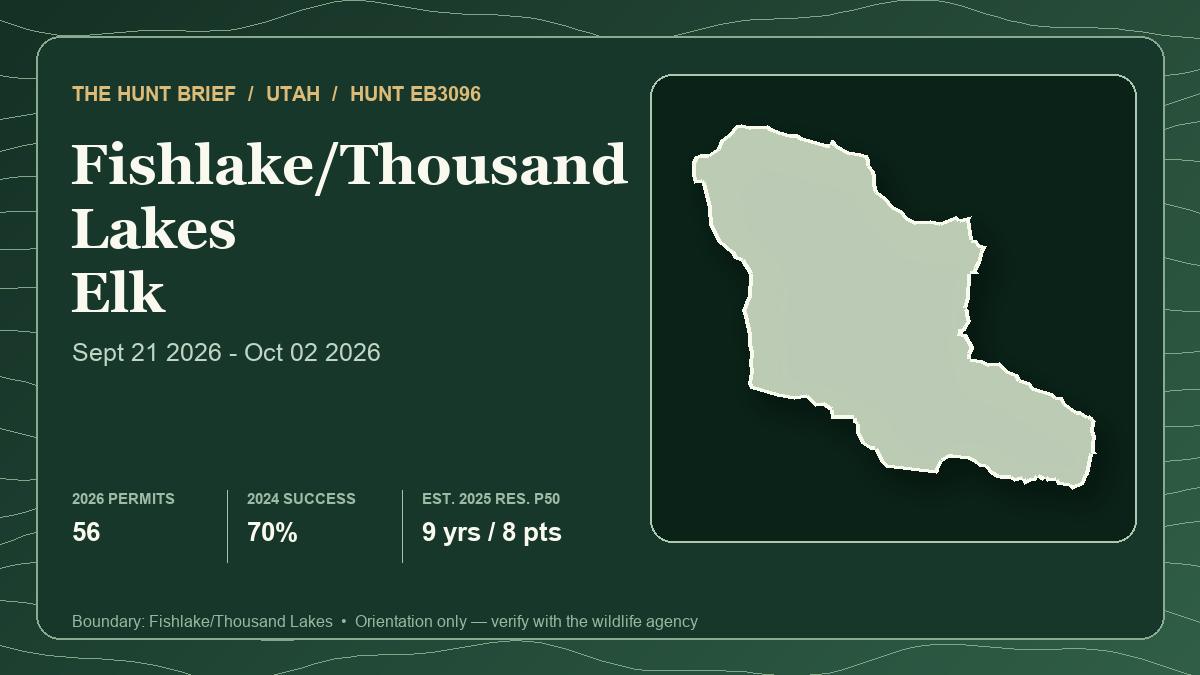
Utah's limited-entry Fishlake/Thousand Lakes muzzleloader bull elk Hunt EB3096 begins September 21 and ends October 2, 2026. The most recent agency harvest report lists 42 bulls taken by 55 hunters afield in 2025, or 76.4% success. That is a useful planning signal for a permit holder heading out today, but it does not say where those bulls were taken or whether the same conditions will recur this fall.
The 2026 numbers also need a careful read. Utah's April 2026 public RAC permit table lists 56 EB3096 permits, split 50 resident and six nonresident, and that is the figure on Hunt Planner's card. The official completed 2026 draw portal, however, displays 55 allocated permits: 49 resident and six nonresident. We cannot establish from those two public sources why one resident permit differs, so the article uses 55 for the completed draw and 56 only for the public RAC table. Do not turn either count into an estimate of hunters actually afield.
Start with the static Hunt Planner profile for EB3096 and open the hunt in the 3D map. The boundary silhouette and 3D view are research aids; confirm legal boundaries and travel with the Utah DWR and land managers before field use.
The decision in one paragraph
EB3096 best fits a tag holder who can devote the 12-day September 21–October 2 window to several verified access systems and who has already tested a legal 2026 muzzleloader setup. A future applicant should see a competitive bonus-point draw, not a shortcut to a bull: the 2026 portal shows 49 successes among 319 adult resident participants and six among 119 adult nonresident participants. These broad ratios describe one completed drawing, not personal odds or a promised point threshold.
What the permit and recent harvest actually say
Utah's 2026 Big Game Application Guidebook identifies EB3096 as a limited-entry muzzleloader bull elk hunt on Fishlake/Thousand Lakes from September 21 through October 2. The current DWR Hunt Planner boundary is the field reference for the named hunt. A muzzleloader permit does not authorize the general-season elk dates or a neighboring unit simply because elk use a connected landscape.
The DWR's preliminary 2025 harvest table reports 55 permits, 55 hunters afield, 42 bulls and 5.3 average days afield. Its 76.4% success is 42 divided by 55 hunters, not 42 divided by the 2026 quota. The linked local structured record uses the older final 2024 table: 52 permits, 52 hunters, 36 bulls, 70% reported success and 5.8 average days. A six-percentage-point change across these two small annual groups is not a trend by itself; weather, effort and the particular permit holders may differ.
The average 2025 participant hunted less than half the 12 calendar days offered by the 2026 season. That does not mean the other days were unproductive. It shows why a tag holder with flexible time can keep reserve plans rather than treating opening day as the whole hunt. Neither report isolates public-land success, bull age, timing within the season or the number of people assisting a hunter.
The 2026 draw is newer than the card's estimate
The DWR's interactive draw portal shows 319 adult resident participants across point rows for EB3096 in 2026 and 49 successful applicants, about 15.4% in aggregate. The nonresident rows total 119 participants and six successful applicants, about 5.0%. The resident allocation breaks into 25 maximum-point and 24 regular-round permits; the nonresident allocation shows three in each round. These are the portal's recorded results, not the April RAC 50-plus-six permit table.
Point rows reinforce the uncertainty. One of 41 zero-point adult residents drew in 2026, while two of 39 at one point drew. The successful zero-point result proves a random route existed; it does not make a zero-point application likely next year. On the nonresident side, one of nine applicants at three points drew in the regular round, while two of four at 23 points drew through the maximum-point round. Pool size, permit allocation and who applies can change in 2027.
The card's “est. 2025 res. P50” is Hunt Planner's model built from connected 2025 draw data. It is not an official 2026 threshold. The older local 2025 record listed 318 eligible resident applicants for 48 permits and 120 eligible nonresident applicants for five permits. Compare each year within its own draw system and residency pool; do not average the card estimate with the 2026 portal.
Why the plateau plan matters, and where it stops
Utah's 2023 Greater Plateau elk plan treats Fishlake/Thousand Lakes as part of a larger connected elk complex. It set a Fishlake/Thousand Lakes winter population objective of 5,000–5,900 and reported a winter 2022–23 estimate of 4,500. It also set a three-year harvested-bull age objective of 5.5–6 years. Those are unit management targets and older survey measurements, not estimates of how many bulls are available to an EB3096 hunter this week.
The same plan maps the complex's elk habitat across Forest Service, BLM, state and private land. Its seasonal ownership table is for the entire Greater Plateau Complex, not an EB3096 public-access percentage. It shows why a single green polygon or public-land share is a poor access test: elk habitat, ownership and legal motorized travel are separate questions. The hunt's actual boundary also spans terrain character that changes from forested uplands to lower, more open country, so scouting should compare habitat bands rather than rely on one elevation assumption.
At this point in September, use current sign and wind to decide among broad habitat patterns: forage next to secure timber, shaded cover near recent feeding, and transitions between higher summer use and lower country as weather changes. Elk may be vocal during the rut, but calling response is not a reliable harvest predictor. Build multiple legal entry and retrieval options without publishing or depending on a single camp, route, wallow, glassing point or animal coordinate.
Access and equipment checks before leaving
The Fishlake National Forest's motor-vehicle information and current Motor Vehicle Use Map should settle which forest roads and trails are designated for motorized travel. Check BLM travel designations, parcel ownership and any Forest Service or BLM closure orders separately. A road drawn in a map app is not proof of legal vehicle access, and public land behind private land may still lack public ingress. Confirm fire restrictions and closures again immediately before travel. The DWR's August 24 wildfire-relief list names several other hunts but does not list EB3096; that is not a guarantee that every road or area in this hunt is open.
Utah's 2026 field regulations require a qualifying muzzleloader loaded with powder and bullet from the muzzle. During a muzzleloader hunt, allowable sights are open sights, peep sights, a red dot or a fixed 1x scope, subject to the guidebook's stated exception for an approved visual-impairment authorization. Read the full muzzleloader section for projectile, caliber and other requirements before relying on an equipment summary. Check tagging, evidence-of-sex, transport and harvest-reporting instructions on the current guidebook and your permit.
Verification checklist
- Match the actual permit to EB3096, Fishlake/Thousand Lakes, limited-entry muzzleloader bull elk and September 21–October 2, 2026.
- Verify the current DWR boundary, legal public ingress, ownership transitions, designated motorized routes, closures and fire status.
- Confirm 2026 muzzleloader and sight rules; carry the permit and a working tagging plan.
- Keep the 2024 final harvest, preliminary 2025 harvest, April 2026 permit table and completed 2026 draw in their own evidence years.
- Prepare more than one habitat-level plan and a safe recovery plan for the actual terrain and weather.
Sources and verification
- Utah DWR Hunt Planner: EB3096 boundary and hunt details
- Utah 2026 Big Game Application Guidebook: EB3096 dates and permit type
- Utah April 2026 RAC packet: EB3096 permit table
- Utah Draw System: 2026 Big Game, Limited-Entry Bull Elk, EB3096 results
- Utah preliminary 2025 big-game harvest report: EB3096 row
- Utah final 2024 limited-entry harvest report: connected card data
- Utah 2025 big-game draw-odds report: connected card data
- Utah Greater Plateau Elk Complex management plan, 2023
- Utah 2026 Big Game Field Regulations: muzzleloader and tagging rules
- Utah DWR wildfire and hunt-relief update, August 24, 2026
- Fishlake National Forest maps and data
- BLM Utah travel and transportation maps
Regulations, permit allocations, boundaries, access and closures can change. The 2023 plan uses older population evidence, the 2025 harvest report is preliminary, and the 2026 draw differs by one permit from the April 2026 RAC table. Historical harvest and draw results do not predict an individual's outcome. This article uses official sources only and was prepared with AI-assisted research and drafting before source and build checks. Read Hunt Planner's methodology, editorial and AI policy and corrections process.