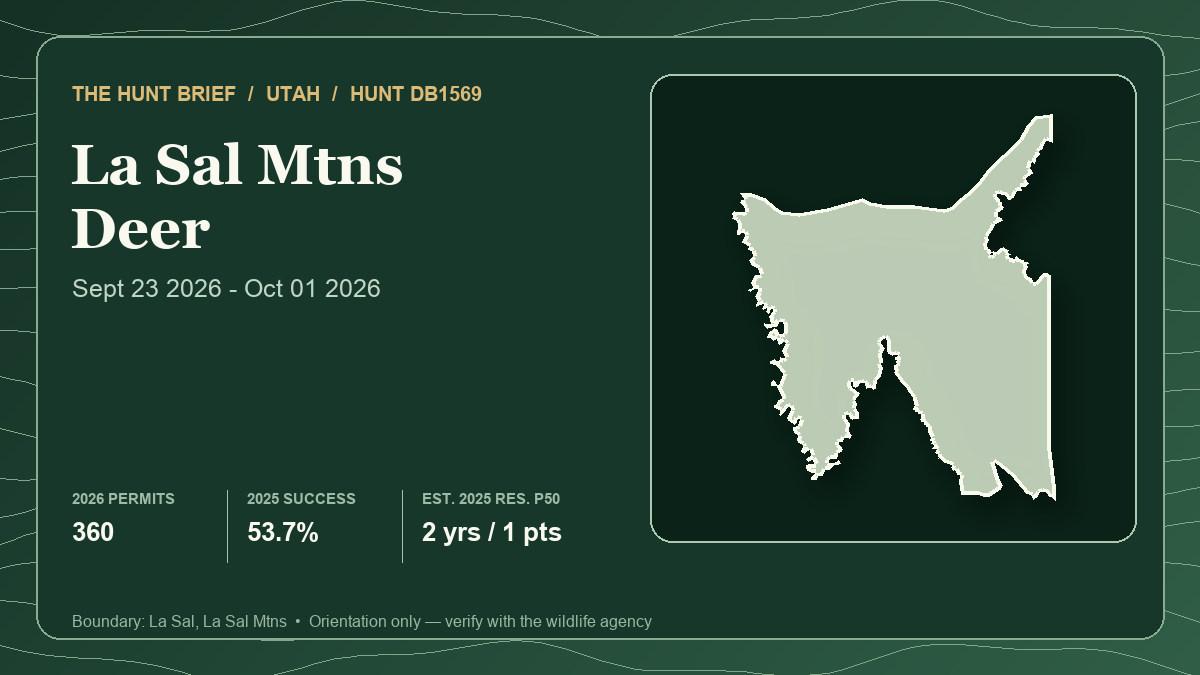
Utah muzzleloader deer Hunt DB1569 opens September 23 and runs through October 1, 2026. Its current Hunt Planner record lists 360 permits, 100 more than the 260 permits in Utah's preliminary 2025 harvest report. That is a 38.5% year-over-year increase in the permit headline, but it is not evidence that the hunt became easier in the field.
The latest completed season produced a strong result: 116 deer from 216 hunters afield, or 53.7% success in 2025. The more useful planning question is whether a nine-day hunter can connect legal access, current deer habitat and a recovery route across a unit whose mapped deer habitat is mostly federal but not uniformly drivable.
Start with the static Hunt Planner profile for DB1569 and open the La Sal Mountains hunt in the 3D map. The card above is an orientation graphic, not an ownership or navigation map.
The quick verdict
DB1569 best fits a muzzleloader hunter who can scout more than one elevation band and is willing to solve road status before opening morning. The current unit plan describes a broad habitat system extending from canyon-and-mesa country to aspen, sagebrush steppe, riparian areas and higher summer range. A single "mountain" strategy will miss that variety.
The favorable 2025 harvest percentage needs two qualifiers. First, it is a preliminary report and can change. Second, the 2026 permit total is 38.5% higher than the 2025 permit count in that report. More permits do not automatically produce more pressure in every drainage, but the old success rate cannot be treated as a forecast for the larger 2026 field.
The 2026 draw was forgiving—but residency still mattered
Utah's 2026 Draw System lists 315 adult resident participants across DB1569 point rows and 229 successful applicants, about 72.7%. At zero points, 113 of 196 adult residents succeeded, about 57.7%. At one point, 94 of 96 succeeded, and all six participants at three points succeeded. One point was nearly certain in that drawing; it is not a guaranteed future threshold.
Adult nonresidents had different math. The 2026 rows show 43 participants and 27 successful applicants, about 62.8%. At zero points, two of 13 succeeded, about 15.4%; at one point, seven of 12 succeeded; and all 12 participants at two points succeeded. Permits appearing below two points mean two points was not an absolute cutoff, while the small nonresident rows make year-to-year percentages especially unstable.
Those 2026 figures are newer than the 2025 draw data used by the card's estimated resident P50 scenario. They are historical results for a preference drawing, not personal odds for 2027. Hunt choice order, quota, residency, youth allocation and demand can all change.
Read 53.7% with participation and time attached
The preliminary 2025 report lists 260 permits, 216 hunters afield and 116 harvested deer for DB1569. About 83.1% of permit holders went afield. Hunters averaged 4.1 days, almost half of the nine calendar days available in the 2026 season.
That makes 53.7% useful as an effort-and-outcome snapshot, not a quality score. It does not say where deer were taken, how access shaped the sample, what age class was harvested or how the larger 2026 quota will behave. Weather and hunting pressure can also change deer visibility during a short late-September window.
The September 2025 La Sal Mountains unit plan adds broader context. It reports a modeled winter 2024 population of 8,800 deer and says the unit's target was raised from 8,000 to 11,500 for 2025–2029, largely because improved models now account for fluctuating survival rates. The plan also reports 30 bucks per 100 does after the 2024 season. Those are unitwide management measures, not DB1569 harvest promises, and the new 11,500 target means the same 8,800 estimate now sits below the current objective.
Public acreage is not an access plan
The unit plan maps approximately 45.58% of mule deer habitat under BLM management, 27.15% Forest Service, 14.22% private, 9.13% Utah trust lands and 3.46% national parks, with smaller categories making up the balance. These are habitat-area ownership shares across Unit 13A, not legal-access percentages for Hunt DB1569.
The distinction matters. National parks are closed to hunting, private land requires documented permission, and a public parcel can still lack a legal motorized route. The Manti-La Sal National Forest travel map says motorized use is limited to designated roads, trails and areas, and temporary closures can supersede the map. Recheck the current Motor Vehicle Use Map, BLM and Forest Service orders, county roads, gates and fire restrictions immediately before travel.
Build at least three independent hunt systems. Each needs a verified parcel, legal arrival, parking plan, wind-safe approach and recovery line. Do not make one road or one private crossing the hinge for the entire nine-day permit.
A habitat-level late-September plan
Use the agency plan to choose patterns, not publish locations:
- Compare current aspen and riparian edges with nearby secure cover. The unit plan identifies those communities as important summer and fawning habitat, but a green patch on a map does not prove September deer use.
- Add lower sagebrush and pinyon-juniper transitions as separate systems. The plan specifically discusses restoration in those communities, while its 2024 assessment rated overall winter range only fair. Do not assume every lower bench offers equal forage.
- Let weather and fresh sign decide elevation. A late-September cold front can change daily movement without forcing an immediate unitwide migration.
- Expect other seasons and recreation. Confirm blaze-orange requirements for the exact place and date, then verify road and trail rules rather than assuming a muzzleloader permit grants vehicle access.
- Keep scouting legal. Utah prohibits trail cameras on public land from July 31 through December 31 and prohibits drones for locating or attempting to observe protected wildlife from July 31 through January 31.
The 2026 field guide also limits muzzleloader technology. During this hunt, scopes stronger than 1x are prohibited; only open sights, peep sights, a red dot or a fixed 1x scope are allowed unless a specific visual-impairment authorization applies. The guidebook also sets barrel, loading, powder, caliber and projectile requirements. Confirm the entire equipment section before sight-in rather than relying on one summary.
CWD belongs in the meat-care plan
The 2025 unit plan calls La Sal Mountains a CWD-positive unit and reports 36 positives among 165 samples in fiscal year 2024, or 22%. It warns that small samples can distort some annual percentages. That result is disease-surveillance evidence, not a statement that 22% of deer a DB1569 hunter will encounter are infected.
DB1569 is not one of the three hunts listed for mandatory CWD sampling in Utah's 2026 field guidance. Still, a La Sal hunter should decide before the hunt whether and how to test, keep the head and neck tissue needed for a sample, avoid contaminating the landscape with high-risk parts, and verify carcass-disposal and import rules for every state the animal will enter. The DWR notes that apparently healthy deer can test positive and points hunters to current testing guidance.
The planning decision
For a 2026 permit holder, DB1569 offers a credible nine-day opportunity backed by a 53.7% preliminary 2025 success rate, but the increase from 260 reported permits in 2025 to 360 current permits in 2026 resets the pressure assumption. Scout several legal systems, prepare for the current muzzleloader restrictions and make CWD testing and carcass care part of the plan.
For a future applicant, the 2026 draw was accessible for many residents and nonresidents, but it was not uniformly easy. A resident at zero points drew 57.7% in the published row; a nonresident at zero drew 15.4%. Choose DB1569 because the season, weapon and La Sal access puzzle fit—not because one point row or one harvest percentage looks comfortable.
Sources and verification
- Utah DWR Hunt Planner: DB1569 current season, permit total and boundary
- Utah Draw System: 2026 interactive drawing results
- Utah DWR preliminary 2025 general-season buck deer harvest report
- Utah 2026 Big Game Field Regulations Guidebook
- Utah DWR 2025 La Sal Mountains deer unit plan
- Utah DWR 2026 deer and elk season briefing
- Utah DWR chronic wasting disease guidance
- Manti-La Sal National Forest travel map and motor-vehicle rules
- Utah DWR 2026 wildfire and hunt-relief updates
Official seasons, boundaries, weapon rules, road status, fire restrictions, CWD guidance and private-land permission can change. Draw evidence is from 2026; harvest is preliminary 2025; the unit plan uses a modeled winter 2024 population and fiscal-year 2024 CWD sample. Those different years and methods are deliberate and should not be collapsed into one score. This article uses official sources only and no hunter report as evidence. It was prepared with AI-assisted research and drafting, then checked against the linked sources. Read Hunt Planner's methodology, editorial and AI policy and corrections process.