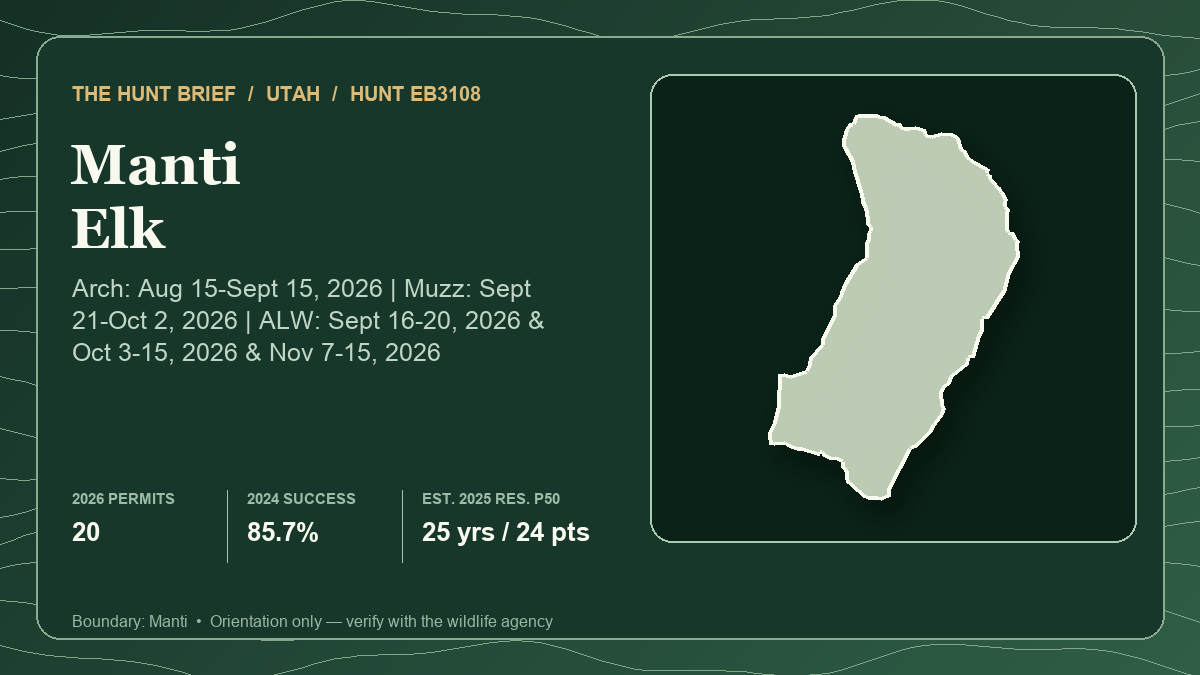
Utah Manti multiseason bull elk Hunt EB3108 reaches a hard reset today. Its muzzleloader segment ends October 2, 2026, and a 13-day any-legal-weapon segment opens October 3. For one of the 20 permit holders, the useful question is not whether the same bull can be pursued with a different firearm tomorrow. It is whether the access, pressure and habitat assumptions built for September still deserve to survive the change.
The official 2026 draw portal lists five EB3108 segments: August 15–September 15 archery; September 16–20 any legal weapon; September 21–October 2 muzzleloader; October 3–15 any legal weapon; and November 7–15 any legal weapon. The permit buys time across all five, but historical success shows that time was often used. Utah's preliminary 2025 harvest table reports 13.3 average days afield for this hunt.
Start with the static Hunt Planner profile for EB3108 and open the Manti hunt in the Hunt Planner 3D map. The boundary card above uses the actual EB3108 polygon. It is an orientation graphic, not an ownership, road-status or navigation map.
The quick verdict
EB3108 best fits a hunter who treats each weapon window as a new hunt and has several complete access systems, enough time to re-locate elk after pressure changes, and equipment already checked against the rules for that segment. It is a poor fit for someone expecting a 20-tag headline to mean an empty unit. The separate Manti midseason any-legal-weapon Hunt EB3126 also opens October 3, and Utah's approved table assigns that hunt 195 permits. Allocated permits do not equal hunters afield on a given day, but EB3108 holders should plan for a meaningful change in human activity.
Five seasons do not make one continuous pattern
The completed 2026 draw record confirms 18 resident and two nonresident EB3108 permits. A permit holder may move through the listed weapon segments, but the legal equipment changes with the calendar. Utah's current field regulations say muzzleloader-hunt sights are limited to open sights, peep sights, red dots or fixed 1x scopes, subject to the guidebook's stated authorization exception. Scopes of any power may be used on muzzleloaders during an any-legal-weapon hunt. Read the complete current weapon rules rather than carrying a September setup into October by assumption.
The October 3 opening also changes the pressure context. The approved 2026 table lists 175 resident and 20 nonresident permits for EB3126, the separate Manti midseason hunt, in addition to EB3108's 18 plus two. Some multiseason hunters may already have harvested; some allocated midseason permits may not produce hunters in the field. The public numbers cannot prove a head count. They do prove that “only 20 tags” is an incomplete way to plan the shared Manti landscape.
The 2026 draw stayed difficult even with a zero-point success
Utah's completed 2026 draw portal reports 544 resident participants across point rows and 18 successful applicants, an aggregate 3.3%. The nonresident side shows 101 participants and two successes, about 2.0%. Those are broad completed-draw ratios, not personalized odds: Utah split each residency allocation evenly between maximum-point and regular rounds, and individual point rows had very different results.
The resident regular round produced one success among 34 zero-point participants. It also produced successes at 3, 5, 8, 9, 12, 13, 14 and 20 points, while several intervening rows produced none. That pattern shows why a regular-round permit is not a point threshold. On the nonresident side, the maximum-point permit went to the single 26-point participant, while the regular permit went to one of three applicants at 22 points. Neither result promises what 2027 will require.
Hunt Planner's card retains its connected 2025 model: an estimated resident P50 scenario of 25 years and 24 points. That is not an official threshold and it is not the 2026 result. The local 2025 record listed 558 eligible resident applicants for 19 permits and 105 eligible nonresidents for two; the 2026 portal shows slightly fewer participants but one fewer resident permit. Keep the years and draw rounds separate.
Harvest was high, but it was not quick
Utah's preliminary 2025 harvest table lists 23 EB3108 permits, 23 hunters afield, 17 bulls, 73.9% success, 13.3 average days and 4.4 average satisfaction. The final 2024 report behind the card lists 22 permits, 22 hunters, 19 bulls, 85.7% success and 16.3 average days.
The permit counts deserve a caveat. Utah's April 2026 permit table describes 21 EB3108 permits for 2025, while the preliminary 2025 harvest table lists 23. The public sources do not explain the two-permit difference, so this article does not merge them or guess at the cause. The practical signal is effort: both recent harvest reports describe successful groups that averaged well beyond a short opening-weekend trip.
Neither report separates harvest by weapon segment, public versus private land, or day of season. A 73.9% season-wide result does not forecast the October 3–15 window by itself, and the 2024-to-2025 decline is not enough to establish a trend.
Use the unit plan as a habitat framework, not a pin
Utah's 2023 Manti elk plan set a 12,000-animal winter objective and reported a January 2023 aerial estimate of 11,700 elk. It also reported that the 2022 limited-entry bull harvest averaged 6.6 years of age. Those are older unit-scale management measurements, not a 2026 bull count or a promise about EB3108.
The plan says recent wildfire had promoted early-successional vegetation while changing elk distribution and migration patterns, and that heavy summer recreation can displace elk from some summer range. It identifies aspen, conifer, mountain brush and sagebrush communities across seasonal ranges. For the October reset, compare broad connections among forage, secure cover and travel terrain, then use current sign, wind and legal access to decide where to spend time. Do not publish or trade camps, routes, bedding areas, wallows, glassing points or animal coordinates.
Ownership changes with the seasonal range. The plan attributes 80% of mapped summer range, 62% of yearlong range and 42% of winter range to the Forest Service; private land accounts for 19%, 30% and 23%, respectively. Those are habitat-range summaries for the Manti unit, not a public-land percentage for EB3108 and not proof of legal ingress.
October reset checklist
- Match the permit to EB3108 and the October 3–15, 2026 any-legal-weapon segment before changing equipment.
- Rebuild the access plan around current parcel status, public-road authority, designated motorized routes, gates, closures, fire information and weather.
- Account for the separate 195-permit Manti midseason hunt without treating allocations as an exact opening-day crowd count.
- Re-scout habitat patterns with current evidence; do not force September rut behavior onto October.
- Keep the 2024 final harvest, preliminary 2025 harvest, 2025 card model and completed 2026 draw in their own evidence years.
- Carry a compliant tagging plan and submit the required harvest report after the hunt.
The Manti-La Sal National Forest says road and trail accessibility changes with weather and season and directs visitors to current conditions and ranger districts. Verify the whole route before relying on it. A public destination does not cure a private crossing, a closed route or a vehicle restriction.
Sources and verification
- Utah DWR Hunt Planner: EB3108 boundary and current hunt details
- Utah Draw System: 2026 Big Game, Limited-Entry Bull Elk, EB3108 results
- Utah 2026 Big Game Application Guidebook: EB3108 multiseason permit and hunt tables
- Utah 2026 limited-entry bull elk permit table: Manti allocations
- Utah preliminary 2025 big-game harvest report: EB3108 row
- Utah final 2024 limited-entry harvest report: connected card data
- Utah 2025 big-game draw-odds report: connected card model data
- Utah 2026 Big Game Field Regulations: weapon, access, tagging and reporting rules
- Utah 2023 Manti elk unit management plan
- Manti-La Sal National Forest: current conditions and road information
Season dates, weapon rules, permit allocations, boundaries, ownership, roads, gates and closures can change. The latest harvest table is preliminary 2025 evidence, the card uses final 2024 harvest and a 2025 estimate, the unit plan reports older biological measurements, and the current season and draw are 2026. Historical harvest and draw results do not predict an individual's outcome. This article uses official sources only and was prepared with AI-assisted research and drafting before source and build checks. Read Hunt Planner's methodology, editorial and AI policy and corrections process.