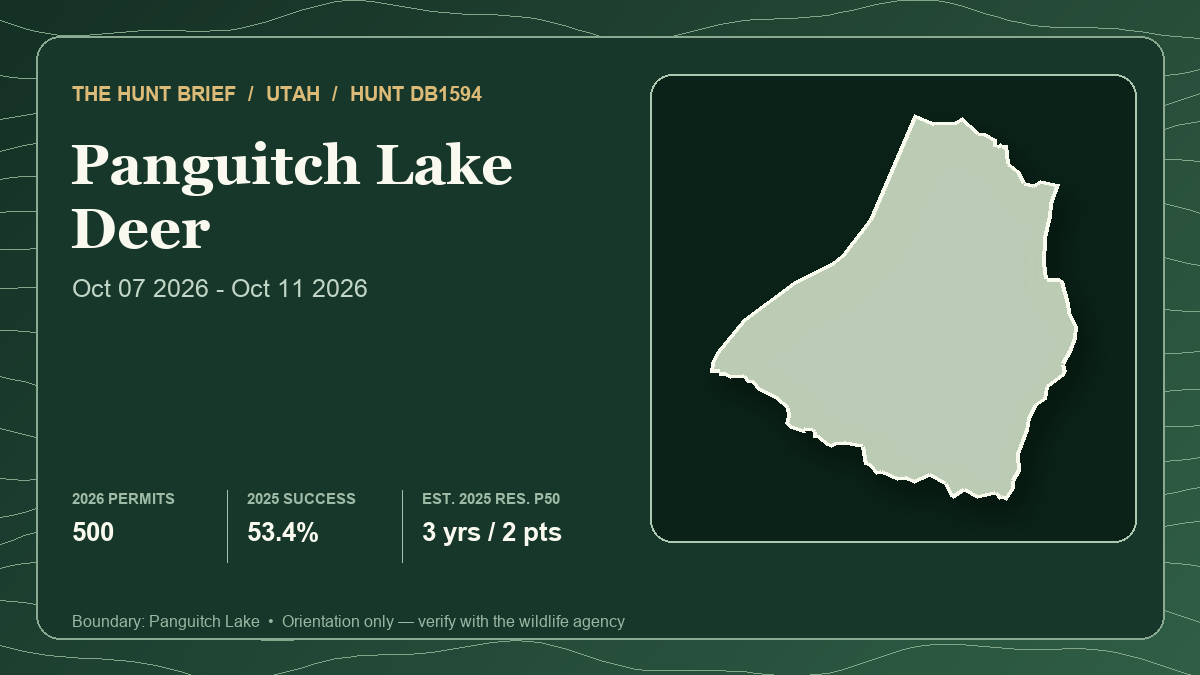
Utah Panguitch Lake early any-legal-weapon deer Hunt DB1594 opens October 7, 2026, and closes October 11. This brief is for a permit holder turning a five-day season into a disciplined plan, and for a future applicant trying to read an unusually layered preference-point result. The current Hunt Planner record lists 500 permits, while the latest preliminary harvest report shows 53.4% success in 2025. Neither number makes the hunt simple.
Start with the static Hunt Planner profile for DB1594 and open DB1594 in the Hunt Planner 3D map. The card above uses the actual DB1594 boundary. It is not an ownership, road-status or navigation map, and it does not reveal a camp, route or animal location.
The quick verdict
DB1594 best fits a hunter who already has several legal access systems, can scout immediately before October 7 and is willing to abandon a stale preseason pattern. The five-day calendar leaves little room for a unitwide tour. The latest harvest history is encouraging, but the 2026 permit headline is higher than the permit count in that harvest report, and Utah says deer distribution and hunter success still vary with weather, habitat and pressure.
For a future applicant, the completed 2026 draw is more useful than a single “points required” label. Adult resident results were clean at two points but sharply partial at one. Adult nonresidents were complete at six and partial at five. Zero-point successes shown in the adult tables include lifetime-license classifications, so they are not evidence that an ordinary zero-point application had the same path.
The 2026 draw ladder moved at the margin
Utah's official 2026 portal lists 930 adult resident participants across DB1594 point rows and 336 successes. At two points, all 206 participants succeeded; at one point, eight of 232 did. The portal also shows 41 successes among 409 zero-point participants, and those 41 are simultaneously identified in its lifetime-license count. Treating that row as a 10% regular zero-point chance would misread the agency's fields.
The adult nonresident side lists 168 participants and 35 successes. All 16 participants at six points succeeded, while 12 of 23 succeeded at five. The four-, three-, two- and one-point rows show no successes. Two of 39 zero-point participants succeeded, and the portal identifies both in its lifetime-license field.
That is a modest easing from the official 2025 table. In 2025, 161 of 187 adult resident participants succeeded at two points and none of 251 succeeded at one. All 13 adult nonresidents at six points succeeded, while none of 34 at five did. The 2026 outcome moved the edge downward, but one completed drawing does not establish a future threshold. Preference-point supply, hunt choices, permit allocations, youth reservations and lifetime licenses can change the row pattern.
The public permit fields also require restraint. Hunt Planner's current DB1594 record lists 500 permits, while the 2026 draw portal lists 454 recorded successes across adult, youth and lifetime-classified rows. Utah's unitwide permit table lists 2,500 general-season permits for Panguitch Lake in 2026, up from 2,300 in 2025, but it does not explain the difference between the DB1594 current headline and completed draw total. This article keeps the figures separate rather than assigning the gap to a category by assumption.
A 53.4% result still used most of the season
Utah's preliminary 2025 harvest report lists 397 DB1594 permits, 348 hunters afield, 186 bucks, 53.4% success, 3.2 average days and 3.8 average satisfaction. The 2026 current permit headline is 103 higher than the report's 2025 permit count, a 25.9% difference. That comparison describes two public records; it does not prove that 500 people will hunt at once or that added permits will cause a particular 2026 success rate.
The effort measure matters. An average of 3.2 days in a five-day season suggests that last year's group used much of the available calendar. It does not identify which days produced deer, separate public from private harvest, or show how weather and pressure affected results. The 53.4% figure describes the 2025 permit holders and conditions, not an individual hunter's probability in 2026.
The broader unit evidence explains why opportunity increased without promising an easy hunt. Utah's April 2026 table reports a 2025 Panguitch Lake population estimate of 10,500 deer against an 11,000 objective. It also reports 20.6 bucks per 100 does in 2025 and a 21.5 three-year average against a 15–17 objective. Those are unit-scale management measurements, not a DB1594 buck count and not a quality score for any parcel.
Build a five-day plan around current evidence
The 2020 Panguitch Lake unit plan describes a landscape where pinyon-juniper expansion into shrubland, sagebrush condition, forage restoration, travel management and winter-range limits all matter. Use those as habitat patterns, not as directions to a named location. In early October, compare several broad combinations of current feed, security cover, elevation and disturbance, then let fresh tracks, sightings and lawful access determine where to spend time.
Build at least three complete systems before opening morning. Each needs a verified public or permitted destination, legal ingress, a route that is actually open for the chosen vehicle or foot travel, and a recovery plan that never assumes a private crossing. A public polygon without legal access is not a backup.
Use the short season deliberately:
- Reconfirm the DB1594 boundary, October 7–11 dates and any-legal-weapon rules in the current state materials.
- Recheck parcels, gates, fire information, land-manager closures and road conditions immediately before travel.
- Spend prime movement periods observing broad cover-and-feed transitions; use midday to validate fresh sign and access rather than repeatedly disturbing one pocket.
- Expect hunting pressure to change visibility. Keep separate fallback systems instead of forcing a preseason sighting after the pattern breaks.
- Plan warm-weather carcass cooling, tagging and recovery before choosing a shot.
- Submit Utah's required harvest report within 30 days after the hunt, even if no animal is taken.
Keep every shared scouting note at the habitat-pattern level. Do not publish exact camps, water sources, private approaches, bedding cover, glassing positions, routes or animal coordinates.
What to verify before October 7
- Match the permit to DB1594, Panguitch Lake, buck deer, early any legal weapon and the October 7–11, 2026 window.
- Carry the current agency boundary and confirm every property line and legal entry independently of the orientation card.
- Verify current weapon, hunter-orange, tagging, evidence-of-sex and carcass-transport rules in the 2026 field guidebook.
- Separate the current 500-permit profile, 454 recorded 2026 draw successes and 397 permits in the preliminary 2025 harvest report; do not merge them into one crowd estimate.
- Keep adult, youth and lifetime-license draw paths distinct when evaluating a future application.
- Recheck closures, wildfire effects, weather and road conditions close to departure.
Sources and verification
- Utah DWR Hunt Planner: DB1594 current season, permit headline and boundary
- Utah Draw System: 2026 Big Game, General-Season Buck Deer, DB1594 results
- Utah 2026 buck deer permit tables: Panguitch Lake unit allocation, herd estimate and buck-to-doe evidence
- Utah preliminary 2025 big-game harvest report: DB1594 row
- Utah 2025 general-season buck deer draw report: DB1594 point rows
- Utah 2026 Big Game Field Regulations Guidebook and current corrections
- Utah DWR 2026 deer and elk outlook: current statewide context and reporting reminders
- Utah Panguitch Lake deer herd unit plan: habitat and management framework
Season dates, boundaries, permit accounting, access, roads, closures, weather and regulations can change. The current hunt record and completed draw are 2026 evidence; harvest is preliminary 2025 evidence; the unit plan was approved in 2020 and contains older biological context. Historical draw and harvest results do not predict an individual's outcome. This article uses official sources only and was prepared with AI-assisted research and drafting before source and build checks. Read Hunt Planner's methodology, editorial and AI policy and corrections process.