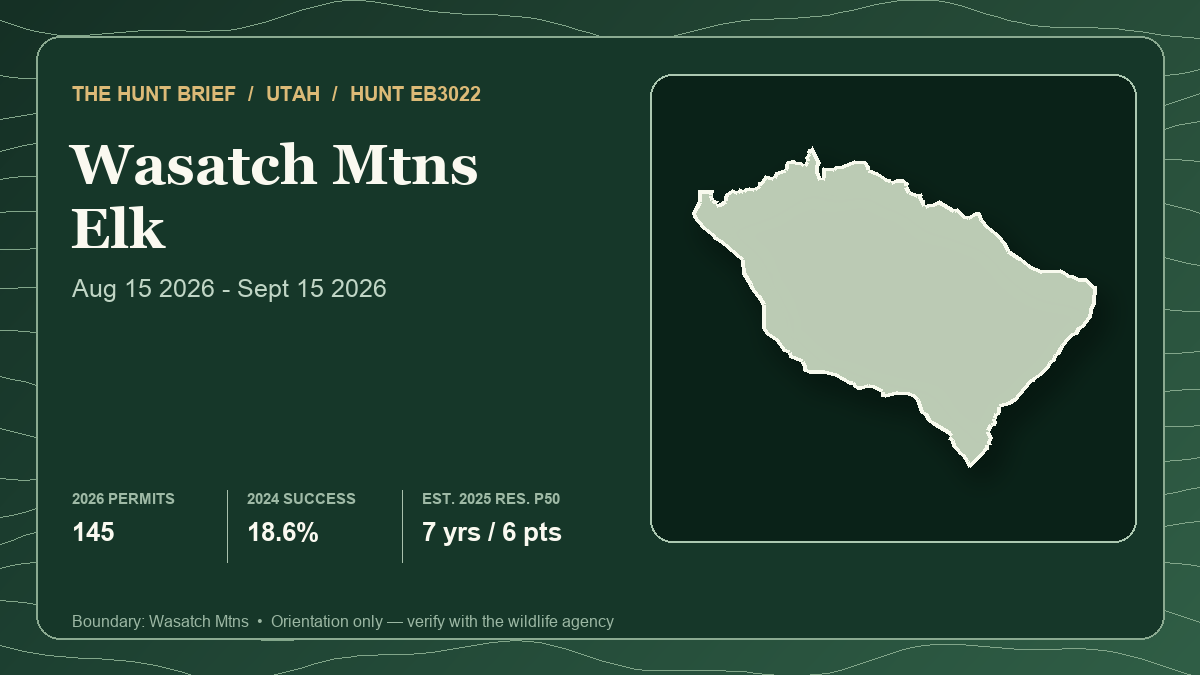
Utah limited-entry archery bull elk Hunt EB3022 opens August 15, 2026, but its most useful planning number is not the 32-day season. It is the latest completed harvest result: 37 elk from 199 hunters afield in 2024, or 18.6% success. This is a hard archery hunt with a long calendar, not a permit that turns the Wasatch Mountains into easy country.
Start with the static Hunt Planner profile for EB3022 and open EB3022 in the Hunt Planner 3D map. The card above uses the official hunt boundary as an orientation graphic. It is not a navigation map, an ownership layer or evidence that a road is open.
The quick verdict
EB3022 best fits a tag holder who can hunt in phases. The August opener rewards a quiet feed-to-cover plan and disciplined access. September may bring more vocal elk, but it also brings more changing distribution and no guarantee of rut activity on demand. The 2024 survey's 11.6 average days afield is the clearest warning against building the hunt around one weekend.
For future applicants, the opportunity story is mixed. The 2026 public-draw quota is 145 permits—130 resident and 15 nonresident—while the 2025 draw issued 176 permits in the local record. That is 31 fewer permits, a 17.6% reduction, compared with the previous draw year. It does not prove that next year's odds will worsen by the same amount; applicant behavior and future permit decisions can change too.
What the 2026 permit authorizes
The current Utah application guidebook lists EB3022 as limited-entry archery bull elk on the Wasatch Mountains unit from August 15 through September 15, 2026. The verified 2026 permit fee is $314 for a resident and $1,950 for a nonresident. Those are permit fees from the current guidebook, not a complete trip-cost estimate.
This is a draw permit, not Utah's unlimited general-season archery elk permit. The distinction matters because general-season permit availability does not make EB3022 available over the counter. A hunter should match the printed permit to the hunt number, unit and weapon before going afield and review the current archery-equipment rules rather than relying on last year's summary.
The 2026 field regulations also prohibit trail cameras on public land from July 31 through December 31, subject to narrow agency and research exceptions. Buying or selling camera media to aid in taking big game is unlawful, and night-vision restrictions also apply. A current scouting plan should rely on firsthand observation, tracks, feed, water and fresh sign—not a camera network left on public land.
Read the 2025 draw as history, not a promise
In the 2025 official odds record, 1,018 eligible resident applicants competed for 160 permits, a total ratio of 1 in 6.4. The point rows show why the total ratio is not a personal forecast: all 50 eligible resident applicants at seven points received permits, while 15 permits went to 60 applicants at six points and seven went to 194 applicants at zero points.
For nonresidents, the same 2025 table reports 273 eligible applicants and 16 permits, or 1 in 17.1 overall. Applicants at different point levels had different outcomes. The card's “estimated 2025 resident P50” is Hunt Planner's historical planning calculation from those rows; it is not an official cutoff and cannot predict a 2027 draw.
The permit years also need to stay separate. The 2025 odds describe the prior draw, while the 145-permit figure is the approved local 2026 quota. Dividing today's quota by last year's applicants would create a hypothetical ratio, not a reported draw result.
What 18.6% success actually measures
Utah's 2024 limited-entry harvest report lists 203 permits for EB3022, 199 hunters afield, 37 harvested elk and 18.6% success. Hunters averaged 11.6 days afield and reported 3.1 satisfaction on the survey scale.
That result belongs to the 2024 season and its conditions. It does not isolate opener success, September success, calling success or public-land success. It also should not be blended with the 2025 draw or 2026 quota into a single score. The useful inference is narrower: even with a month-long archery season, most surveyed hunters did not report a harvest, and the average hunter spent substantial time afield.
The current unit plan adds management context, but it is older than the permit decision. In February 2022, DWR estimated 10,400 elk across the full Wasatch Mountains unit against a target winter herd size of 8,400. The plan also identifies private- and tribal-land refuge, rugged terrain, development and habitat fragmentation as management barriers. That 2022 estimate is not a 2026 population count and should not be used to calculate elk per permit.
Access is a seasonal pattern, not one percentage
The 2023 unit plan does not publish one simple public-land percentage for the entire EB3022 hunt. Instead, it separates subunits and seasonal ranges. In subunit 17A, summer range is listed as 83% Forest Service and 15% private. Across subunits 17B and 17C, summer range is 52% Forest Service, 25% private and 15% DWR. Winter range shifts much more heavily toward private ownership in both tables.
Those figures are planning context, not parcel-level permission. They suggest that a public-land summer hunt is realistic, while also showing why elk movement toward lower or different seasonal range can create access friction. Confirm the hunt boundary, current ownership, motor-vehicle rules and every road crossing separately. A public destination does not legalize a private approach.
A phased August-to-September field plan
- Opening week: Scout broad north-facing cover, shaded benches, timber edges and nearby feed at first and last light. Favor routes that let you reach observation points without crossing likely bedding cover. Heat, water availability and recreation pressure can move elk; verify current conditions rather than treating a habitat model as a pin.
- Middle of the hunt: Rotate among several lawful access systems instead of repeatedly entering one drainage. Fresh tracks, droppings and nighttime movement can justify staying patient, but stale sign should trigger a broader reset. Build recovery time and pack-out elevation into every stalk decision.
- September: Listen more, but do not make bugling the only way to locate elk. Use wind and thermals to protect likely travel corridors, then work from current sign. Calling can confirm an elk's presence; it does not erase swirling mountain wind or private boundaries.
- Every phase: Keep a backup route, offline ownership and travel maps, extra water, and a fire/closure check. Utah DWR's 2026 wildfire page says the state is experiencing an early, active fire season and that access and habitat conditions continue to be monitored, even though EB3022 was not among the relief hunts listed as of July 13.
This is deliberately habitat-level advice. It does not identify camps, wallows, trailheads, private approaches, glassing points or animal coordinates.
Verification checklist
- Match the permit to EB3022, Wasatch Mtns, limited-entry archery bull elk.
- Confirm the August 15–September 15, 2026 season in the current guidebook and on the Utah Hunt Planner.
- Review Utah's current archery equipment, tagging and mandatory harvest-reporting rules.
- Remove or disable any public-land trail-camera plan that conflicts with the July 31–December 31 prohibition.
- Verify ownership, legal approaches, travel management, closures, fire restrictions and weather immediately before each trip.
- Treat 2024 harvest, 2025 draw and 2026 quota as separate evidence years.
Sources and verification
- Utah Hunt Planner: EB3022 current boundary and hunt record
- Utah 2026 Big Game Application Guidebook: EB3022 dates, permit type and verified permit fees
- Utah 2026 Big Game Field Regulations: current equipment, tagging, reporting and access reminders
- Utah Wildlife Board: approved 2026 permit context
- Utah 2025 limited-entry drawing odds
- Utah 2024 limited-entry harvest report
- DWR Wasatch Mountains Elk Herd Unit #17 management plan
- DWR 2026 trail-camera regulations
- DWR wildfire impacts on Utah's 2026 hunts
Official regulations, seasons, boundaries, permit numbers, access rules, fire conditions and closures can change. The population context comes from a 2022 estimate in a 2023 plan; harvest is from 2024, draw results are from 2025 and the season and quota are for 2026. Verify every current fact with Utah DWR and the relevant land manager before hunting. This article uses official sources only, contains no hunter report or precise location, and was prepared with AI-assisted research and drafting before source and build checks. Read Hunt Planner's methodology, editorial and AI policy and corrections process.