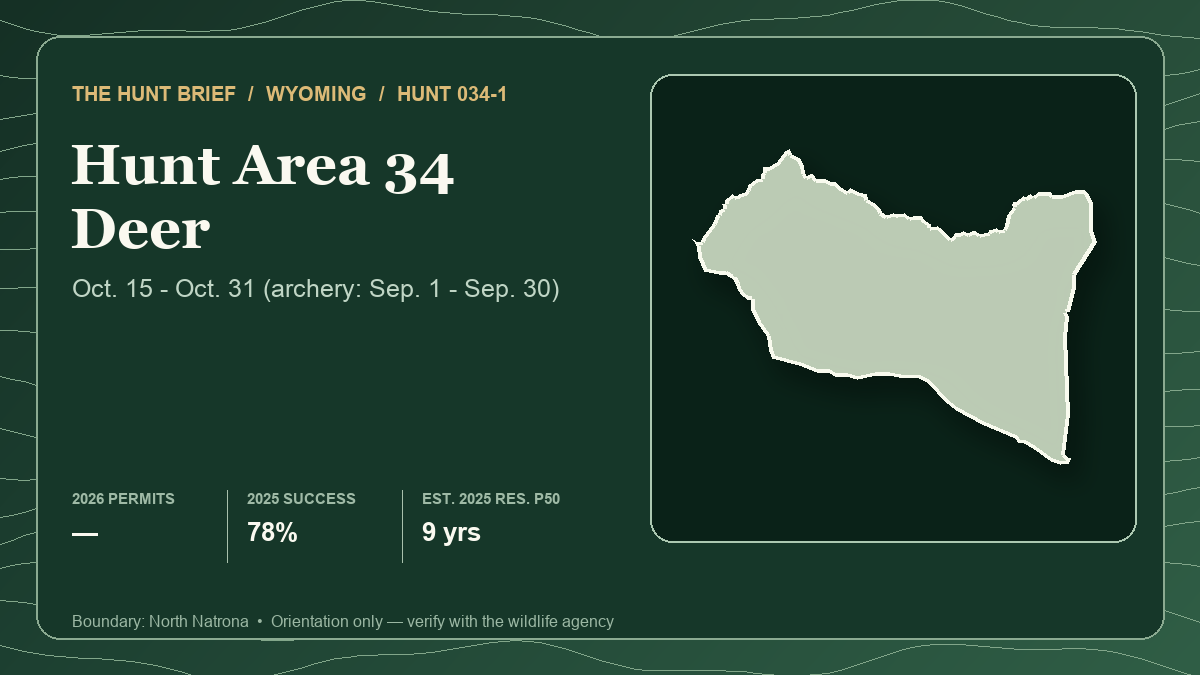
Wyoming deer Hunt 034-1 is already open to archery hunters and its regular season begins October 15, 2026. The latest completed harvest result is attention-grabbing: 96 bucks from 123 active Type 1 hunters, or 78% success in 2025. Wyoming Game and Fish Department's current message is more useful than that number alone. The agency describes Area 34 as an older-buck hunt with modest trophy potential, and it requires every successful Area 34 deer hunter to submit a chronic wasting disease sample in 2026.
That combination defines the hunt. This is a scarce license with good historical harvest, widespread public-land access and a mandatory post-harvest responsibility. It is not evidence that a large-antlered buck is likely.
Start with the static Hunt Planner profile for Hunt 034-1 and open Area 34 in the Hunt Planner 3D map. The card above shows the North Natrona boundary and local structured statistics. It is an orientation aid, not a substitute for the current agency boundary, ownership or route information.
The quick verdict
Hunt 034-1 best fits a tag holder who wants a low-pressure, public-land mule deer hunt, is comfortable judging mature bucks without treating antler score as the only measure of quality, and has a CWD sample plan before leaving home. The 2025 harvest rate was strong, but WGFD explicitly tells hunters to temper trophy expectations.
For a future applicant, the demand history is the warning label. Resident first-choice supply barely kept pace with rising demand in 2026, while the nonresident preference pools required high point levels and the random pools offered only five licenses across regular and special price categories.
What the 2026 license authorizes
WGFD lists 034-1 as a limited-quota Type 1 license valid for an antlered mule deer or any white-tailed deer. The special-archery season runs September 1–30, 2026, and the regular any-legal-weapon season runs October 15–31. A hunter in the special-archery season needs both the appropriate deer license and a Wyoming archery license.
The species language matters. The license permits any white-tailed deer, but WGFD says white-tailed deer in Area 34 are found almost exclusively on private agricultural land. A Type 1 tag does not create access permission. Hunters without private access should plan this primarily as an antlered mule deer hunt on legally reachable ground.
Resident demand stayed near 8%
The June 15, 2026 resident demand report lists 79 licenses and 1,022 first-choice applicants for Hunt 034-1. The raw quota-to-first-choice ratio is 7.73%. In 2025, WGFD listed 76 licenses and 979 first-choice applicants, or 7.76%.
Resident quota increased by three licenses, or 3.9%, while first-choice demand rose by 43 applicants, or 4.4%. The resulting ratio was effectively flat. Those report ratios describe completed drawing inventory and demand; they are not guaranteed odds for 2027, and party applications can affect individual outcomes.
Nonresident pools must remain separate. In 2026 the regular random report lists three licenses for 185 first-choice applicants, a raw 1.62% ratio. The special random report lists two for 47, or 4.26%. In the preference allocation, every applicant at 15 points drew in the regular pool, with the last license awarded at WGFD's grouped “less than 15” tier. In the special pool, all four 14-point applicants drew and three of seven applicants at 13 points drew, an agency-reported 42.86% at that tier.
The special license changes price and pool, not boundary or season. Do not combine regular, special, preference and random figures into one nonresident percentage. Also do not treat a historical point threshold as a reservation; quota and applicant behavior change each year.
Put the 78% harvest result in context
WGFD's 2025 mule deer harvest table reports 123 active Type 1 license holders, 96 bucks, 665 hunter days and 78% success in Area 34. That works out to 6.9 hunter days per harvested buck. The agency lists 127 licenses sold, which is different from active hunters because some license holders did not hunt.
The 78% figure describes all Type 1 hunters and the entire 2025 license season. It does not isolate archery success, public-land success or the chance of taking a high-scoring buck. The current Hunt Planner says license numbers and hunting pressure are kept low and that hunting quality is good in most years, but it also says most mature bucks in the area do not grow large antlers.
WGFD's September 2026 forecast reinforces that distinction. Area 34 is one of four Casper Region limited-quota mule deer hunts the agency says generally produces older bucks with modest trophy potential. Regionally, mule deer remain well below management goals even though above-average fawn production in 2024 and 2025 helped stabilize or slightly increase several herds. The agency says drought, habitat change, disease and predation continue to constrain recovery.
Public acreage is useful, but routes still decide the hunt
WGFD estimates Area 34 at 61% public land and rates public access as good. It describes widespread public ground, primarily BLM land, plus several Walk-In Areas on enrolled private property. The agency also warns that roads can become treacherous during muddy or snowy weather and notes that camping is not allowed on state land.
The habitat changes across the unit. Irrigated agricultural ground lies toward one side of the area, broad sagebrush grasslands dominate the center, and rougher rocky uplifts transition toward the southern Bighorn Mountains. Limber pine, juniper, curl-leaf mountain mahogany and conifer cover appear in that rougher country. WGFD says mule deer use all of those habitats, with higher densities generally associated with transitional cover and with drainages that provide denser vegetation in sage country.
Turn those patterns into options rather than publishing a pin:
- During the remaining September archery period, compare feed, shade and security cover across several broad habitat systems. Avoid assuming a deer seen once will tolerate repeated pressure.
- For the October regular season, build both a dry-road plan and a wet-weather alternative. A high public percentage is not useful if the only chosen road becomes unsafe or impassable.
- Verify every ownership transition, Walk-In rule, gate and vehicle restriction against current sources. Public surface ownership does not authorize crossing private land.
- Keep expectations aligned with the agency's management description. Age structure can support a rewarding hunt even when antler growth is modest.
Do not publish or circulate exact camps, private approaches, bedding areas, glassing points or animal coordinates.
Mandatory CWD sampling changes the exit plan
WGFD's 2026 forecast says CWD sampling is mandatory for all deer license types in Hunt Area 34. The agency's current testing guidance gives hunters several submission paths, including a check station, a regional office or a properly collected self-submitted sample. Confirm the current Area 34 instructions and hours before the hunt; do not wait until a head is frozen, caped incorrectly or hours from a collection point.
The sample requirement should be part of the field plan alongside tagging, meat care and transport. Carry the information needed to connect the sample with the animal and license, preserve the tissue as directed, and follow Wyoming's carcass-transport and disposal rules. WGFD says test results are generally available through its online system, but a laboratory timeline is not a meat-cooling plan.
Verification checklist
- Match the license to Hunt 034-1, Type 1 and the antlered-mule-deer-or-any-white-tailed-deer limitation.
- Confirm September 1–30 special-archery and October 15–31 regular dates in the 2026 rules.
- Carry the required archery license during the special-archery season.
- Verify the official boundary, ownership, Walk-In permission, road status and state-land restrictions before travel.
- Plan mandatory CWD sample submission for any deer harvested in Area 34.
- Recheck fire restrictions, weather and agency notices immediately before departure.
Sources and verification
- WGFD Hunt Planner: Area 34 season, access, habitat, draw history and 2025 harvest
- WGFD 2026 deer regulation brochure
- WGFD 2026 resident deer demand report
- WGFD 2026 nonresident regular random deer demand report
- WGFD 2026 nonresident regular preference-point deer demand report
- WGFD 2026 nonresident special random deer demand report
- WGFD 2026 nonresident special preference-point deer demand report
- WGFD 2025 mule deer and white-tailed deer harvest report
- WGFD 2026 statewide hunt forecast: Casper Region mule deer and mandatory Area 34 CWD sampling
- WGFD 2026 CWD testing options
- WGFD hunting access summary
Official seasons, draw reports, boundaries, ownership, access permissions, road status, fire restrictions and CWD submission procedures can change. The demand figures are from 2026; harvest and the card's estimated resident draw scenario are from 2025. Historical harvest does not predict an individual outcome. This article uses official agency material only and presents no hunter report as representative evidence. It was prepared with AI-assisted research and drafting, then checked against the linked sources. Read Hunt Planner's methodology, editorial and AI policy and corrections process.