Wyoming elk Hunt 100-1 opens its any-legal-weapon season tomorrow, October 9, 2026. The final regulation authorizes 200 any-elk licenses through October 31. The current draw shows why the tag attracts attention: Wyoming Game and Fish Department's resident report lists 3,996 first-choice applicants for 138 licenses allocated to that drawing. The latest completed harvest adds another large number—175 elk and 87.1% success in 2025.
Those figures do not make the hunt automatic. WGFD estimates Hunt Area 100 at 71% public land and rates public access “Good,” then warns about a closed coal mine, checkerboard ownership in the south and variable private crossings. A scarce tag, a strong historical harvest rate and a public-land majority can all be true while the practical hunt still depends on a verified route and current elk distribution.
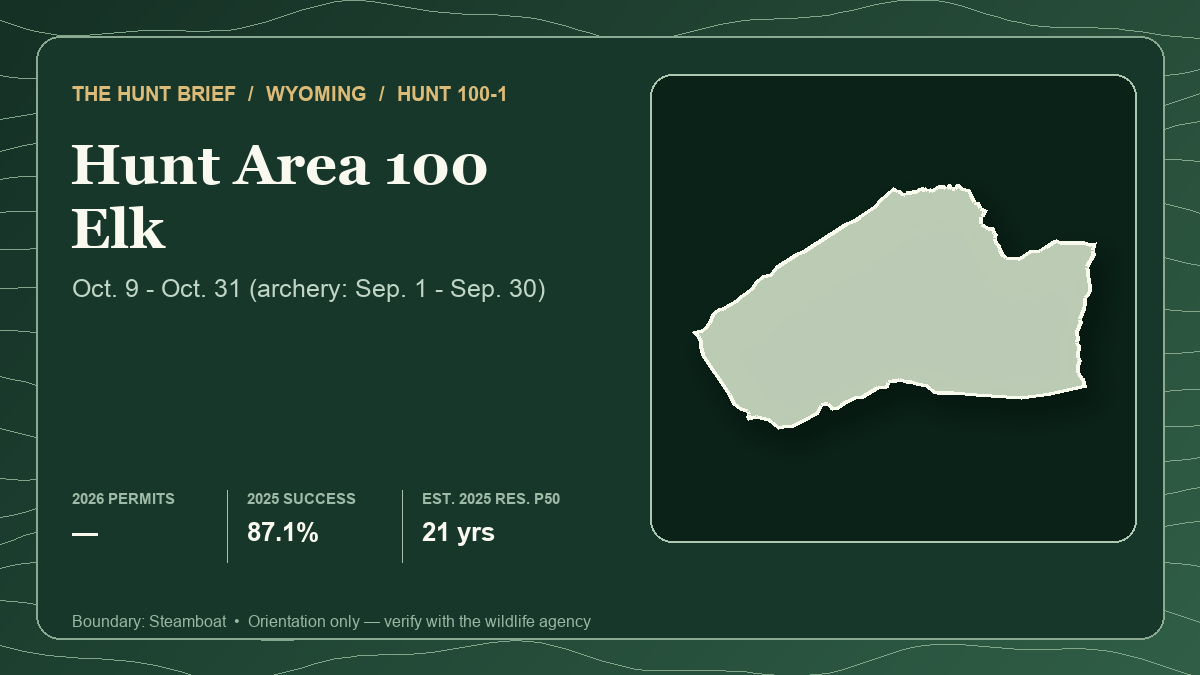
Start with the static Hunt Planner profile for Hunt 100-1 and open Area 100 in the Hunt Planner 3D map. The card above uses the actual Steamboat hunt boundary. It is an orientation graphic, not an ownership, road-status or navigation map.
The quick verdict
Hunt 100-1 best fits a tag holder who can search broad, open country without confusing visibility with certainty. The 23-day regular season provides time to reset after opening pressure or a weather change, but the 2025 report's 7.2 days per hunter is a better preparation cue than the 87.1% headline. Plan several complete access systems, carry a realistic retrieval plan and let current sign replace an old expectation.
For a future applicant, the 2026 resident pool became slightly less restrictive even as first-choice demand increased. Nonresidents faced four materially different pools. No single “Wyoming odds” percentage describes all of them.
What the 2026 license authorizes
The final 2026 Chapter 7 regulation lists Area 100 Type 1 as an any-elk license. Its special-archery season ran September 1–30, and the regular season runs October 9–31. The total quota is 200, unchanged from the final 2025 regulation even though the opener moved three days later.
“Any elk” matters when reading both the season and the harvest result. The 87.1% figure is success for the full Type 1 license, not a bull-only success rate. A hunter pursuing a bull should not convert it into an 87% forecast for that narrower goal.
Area 100 also contains Type 2, 4, 5 and 7 seasons with different dates and animal limitations. A Type 1 license does not inherit another type's boundary language or special restrictions. Match every field decision to the license actually held.
Resident demand rose to 3,996 first choices
The June 15, 2026 resident demand report lists 138 licenses and 3,996 first-choice applicants for 100-1, a raw quota-to-first-choice ratio of 3.45%. The comparable 2025 local record lists 130 resident licenses and 3,915 first choices, or 3.32%.
That is 81 more first choices, a 2.1% increase, alongside eight additional drawing licenses. The raw ratio improved by only about 0.13 percentage point. It is a completed draw summary, not an individual's guaranteed probability; party applications, allocation mechanics and future applicant behavior can change the result.
The 2026 nonresident reports show why the pools must stay separate. The regular random pool lists three licenses against 910 first choices, a raw 0.33% ratio. The special random pool lists two against 233, or 0.86%. In the preference reports, the regular pool's last partially successful tier was 20 points at a reported 76.92%, with none below 20; the special pool's last partial tier was 19 points at 53.33%, with none below 19.
The special license changes price and applicant pool, not the Area 100 season or boundary. Do not blend regular, special, preference and random results into one number, and do not treat a historical point tier as a reservation for the next draw.
Read 87.1% with the full record attached
WGFD's 2025 Type 1 harvest table reports 175 elk harvested, 1,267 hunter-days, 7.2 days per hunter and 87.1% success. That is strong historical evidence, but it does not separate bulls from cows, public from private land, archery from the regular season or one part of the area from another.
The effort line is useful because it resists the “easy hunt” interpretation. Seven-plus days is a meaningful commitment, and a high area-wide success rate cannot tell one hunter whether elk will remain on an accessible public block after the opener.
WGFD's 2025 Steamboat herd report provides longer context. It says license numbers were increased after 2016 when the herd was well above its 1,200-elk objective, and more than 5,100 elk were harvested during the subsequent population-reduction phase. By the 2024 postseason, the agency classified 939 elk—502 adult cows, 163 calves and 274 bulls—and modeled the herd near the 1,200 objective. Managers described the shift as one from population reduction toward maintenance.
That report also found 55 bulls and 32 calves per 100 cows in the December 2024 classification flight and an average harvested Type 1 bull age of 6.6 years in 2024. Those are herd-level and prior-year measures, not promises about an animal available in 2026. The current 2026 Green River forecast is broader: it says regional elk herds are mostly at or above objective and describes generally good limited-quota opportunities. It does not publish an Area 100 bull-age or success forecast.
Public-heavy still has a checkerboard problem
The current Hunt Planner estimates Area 100 at 71% public land and calls access “Good.” Its details are more useful than the label. WGFD says public access is widespread through most of the area, but the Bridger Coal Mine is closed to the public. The southern portion contains alternating public and private sections, and the ability to cross private land varies by landowner. The page also notes no designated federal wilderness inside the area, while identifying several Bureau of Land Management wilderness study areas.
Two current Access Yes properties add options rather than blanket permission. Sweetwater County Walk-In Area 3 lists 20,641 acres, year-round dates and motorized travel on established roads only for Area 100 elk. Fremont County Walk-In Area 22 lists 1,731 acres and August 15–December 31 access. Verify each current map, species authorization and rule before treating either as part of the plan.
The Rock Springs Field Office manages a much larger surrounding public-land system, but its 3.6-million-acre headline is not an Area 100 access figure. BLM status does not establish that a particular road is open, that a private crossing is lawful or that a wilderness study area allows the travel method a hunter intends to use.
A field plan for the opener
- Verify the complete access chain. Confirm parcel ownership, the legal public route, parking, vehicle restrictions, foot travel and retrieval before committing to a destination block.
- Build multiple landscape-scale searches. In open country, compare broad forage, broken terrain and security-cover patterns, then use fresh tracks, droppings and direct observations to update the plan. Do not publish exact camps, water, bedding areas, routes, glassing points or animal coordinates.
- Budget for the historical effort. The 2025 table's 7.2 days per hunter argues for time, fuel, water and recovery capacity beyond a one-morning plan.
- Separate visibility from availability. An elk seen across a checkerboard or mine boundary is not a huntable elk until the land status and lawful approach are established.
- Recheck conditions daily. Current drought, wind, fire restrictions and unmaintained roads can change safe access. Use the agency and land manager for live conditions immediately before entry.
- Read the carcass rules before harvest. Confirm tagging, evidence-of-sex, transport and chronic-wasting-disease guidance while service is available, not after an animal is down.
Hunt 100-1 combines rare access to a special-management elk herd with a long regular season and a strong historical harvest record. Its central tradeoff is not hidden: the same open landscape that helps hunters find elk also exposes pressure, distance and ownership problems. Treat 3,996 applications and 87.1% success as evidence of demand and past performance—not as substitutes for a legal, current field plan.
Sources and verification
- WGFD Hunt Planner: Area 100 season, access, public-land estimate and 2025 harvest
- WGFD final 2026 Chapter 7 elk seasons
- WGFD 2026 resident elk demand report
- WGFD 2026 nonresident regular random elk demand report
- WGFD 2026 nonresident special random elk demand report
- WGFD 2026 nonresident regular preference-point elk demand report
- WGFD 2026 nonresident special preference-point elk demand report
- WGFD 2026 statewide hunt forecast: Green River Region
- WGFD 2025 Green River Region management report: Steamboat elk herd
- WGFD Sweetwater County Walk-In Area 3
- WGFD Fremont County Walk-In Areas: Area 22
- BLM Rock Springs Field Office
Official seasons, allocations, draw systems, Access Yes enrollment, land status, roads, fire restrictions, weather and disease guidance can change. The season, quota and draw evidence are from 2026; the latest completed harvest is from 2025; herd classification and bull-age evidence are from 2024. The card's estimated resident draw scenario uses the local 2025 record. Each year answers a different question, and no historical result predicts an individual outcome. This article uses official agency material only and presents no hunter report as representative evidence. It was prepared with AI-assisted research and drafting, then checked against the linked sources. Read Hunt Planner's methodology, editorial and AI policy and corrections process.